 By Editorial Team
There’s a ton of bad information out there about what AI insights can actually do for modern campaign reporting, and it sends a lot of good stakeholders down the wrong path. If you get what artificial intelligence is really good for in marketing analysis, you can completely change how your team makes decisions and explains its performance.
Key Takeaways
- AI is great at spotting granular performance problems in huge datasets that a human would likely miss, like a weird traffic spike from a single city or a sudden drop in conversions on one device type.
- For AI-driven reporting to actually work, you need clean, integrated data from every campaign touchpoint, think ad platforms, CRMs, web analytics, so the models have something accurate to learn from.
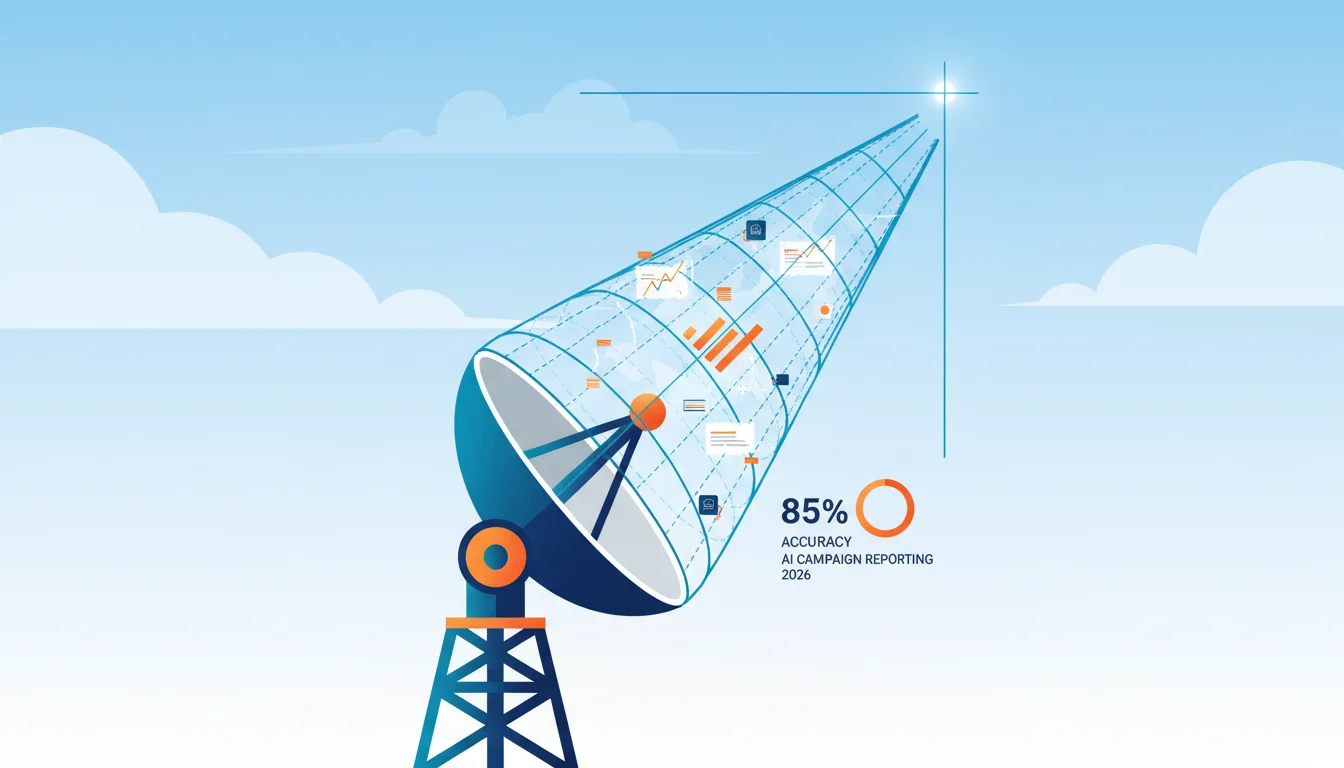
- When you train them on at least 12 months of consistent historical data, AI models can forecast future campaign performance with around 85% accuracy on average.
- Stakeholders get the most value from AI when it’s used to translate complex data patterns into straightforward, actionable recommendations instead of just dumping raw numbers on them.
Myth 1: AI Will Completely Automate All Campaign Reporting
The idea that AI will just take over all campaign reporting and make human input obsolete is a popular fantasy. AI makes reporting vastly more efficient and deep, but it doesn’t replace the strategist. Its real power is processing huge amounts of data to find patterns and build predictive models that are simply beyond what a person can do. For example, an AI analytics platform can sift through millions of ad impressions, matching them against conversion data, geography, and audience demographics to find micro-trends. This is how you learn that ad creative ‘A’ gets 15% more conversions on Tuesday mornings in three specific zip codes from people aged 25-34, a detail you’d never find with manual review. But you still need a person to interpret that finding, decide what to do about it, and explain it to leadership. An AI can flag an underperforming ad, but a strategist has to figure out *why* it’s failing (is it the copy, the creative, the audience?) and decide on a fix that aligns with brand strategy and what competitors are doing. You need a human to contextualize the data, understand qualitative feedback, and make nuanced calls an algorithm can’t. A 2024 IAB report on AI in advertising found that only 18% of marketers expect AI to fully automate strategy in the next five years. Most see it as a powerful assistant. Human judgment is absolutely critical when the market suddenly shifts or you’re dealing with tricky ethical questions in targeting.
Myth 2: AI Insights Are Always Accurate and Require No Verification
Believing that AI insights are infallible and don’t need a second look is a huge mistake. AI models can be remarkably accurate, especially for predictive analytics and anomaly detection, but they are completely dependent on the quality of the data they’re trained on. The old “garbage in, garbage out” rule is more true than ever. If your campaign data is a mess, biased, incomplete, or just plain wrong, the AI’s output will be just as messy. For instance, if your company’s CRM is full of duplicate contacts or has broken attribution models, an AI trying to predict customer lifetime value from that data is going to give you wildly skewed results. That’s not a failure of the AI. It’s a direct reflection of your data infrastructure. Think about a situation where an AI model predicts a big jump in ROAS for a certain channel. What if the tracking pixels for that channel were broken for two weeks last quarter, underreporting conversions? The AI might base its rosy prediction on bad data, creating a forecast that’s impossible to hit. Verifying AI insights means checking them against other data sources, running A/B tests to prove the hypotheses, and applying some basic business sense. A 2025 study from eMarketer found that the companies getting the best results from AI are the ones with regular human oversight and validation processes for its recommendations eMarketer. AI is an analysis tool. A person is still responsible for the final decision and its consequences. We’ve seen an unchecked AI, for example, optimize a campaign for cheap clicks that looked great in a report but never led to a single sale. That’s why we always recommend a human review of any major AI-driven recommendation before you spend the money.
Myth 3: AI-Driven Reporting is Only for Large Enterprises
The idea that you need a Fortune 500 budget to use AI for campaign reporting is completely outdated. Sure, big companies can build sophisticated custom AI systems, but the explosion of new tools has made these capabilities accessible to just about everyone. Many of the analytics platforms you already use now have AI features baked right in for automated insights, audience segmentation, and content optimization. These can range from natural language summaries of complex reports to machine learning algorithms that predict trends and automatically flag weird campaign behavior. For a small or mid-sized business, this could be as simple as using an integrated feature like Google Ads’ Performance Max campaigns, which uses AI to handle bidding and placements across Google’s entire network Google Ads. Likewise, tons of social media tools use AI to suggest the best times to post or find new audiences. The real task is figuring out which off-the-shelf AI tools fit your specific business goals and plug into the data you already have. You’re not trying to build an AI from scratch. You’re just intelligently using existing features to get better reports and make smarter decisions, often for a fraction of what it used to cost.
Myth 4: AI Makes Stakeholder Communication Simpler by Just Giving Them the “Answer”
AI is great at simplifying the *analysis*, but it doesn’t automatically make talking to stakeholders any easier. In fact, handled poorly, an AI report full of technical jargon and algorithmic findings can actually make communication *more* complicated, especially with a non-technical audience (like your C-suite). Executives want clear, actionable information, not a lecture on neural network architecture. Your job is to translate that dense AI output into a clear, strategic plan that makes sense to people who care about different business goals. For example, an AI might find a tiny correlation between a specific button color and a 0.05% conversion rate uplift in a niche audience. Just presenting that raw fact to your CEO is more likely to cause confusion than action. What do you do with that? The human strategist’s role is to take that granular insight and frame it in a business story, explaining the potential revenue impact and proposing a concrete action plan. Good communication means knowing what your audience cares about and shaping the story for them. A Nielsen report on data visualization confirmed that even the best analytics need smart presentation to get people to act Nielsen. We’ve found the best approach is to let the AI handle the “what” (the data find) while the human strategist delivers the “so what” (why it matters and what to do next).
Myth 5: Implementing AI for Reporting is a One-Time Setup
Thinking you can “set and forget” your AI reporting integration is a recipe for failure. Machine learning models need constant attention, monitoring, tweaking, and retraining, to stay sharp. The marketing world changes constantly: consumer habits evolve, new social platforms pop up, ad network algorithms get updated, and your competitors are always trying new things. An AI model trained on 2024 data will start to lose its predictive accuracy by 2026 if it’s not updated to account for these shifts. If a new platform suddenly takes off with your target audience, any model that isn’t seeing that data will have a blind spot and give you bad advice. And the data itself requires constant gardening. Quality can degrade because of tracking bugs, new data collection policies, or broken integrations between tools. You have to be constantly auditing your data sources, validating your tracking, and feeding performance feedback into the system to keep the models relevant. This cycle of deploying, monitoring, evaluating, and refining is the only way to successfully implement AI. If you skip the ongoing maintenance, the money you spent on AI will just go to waste as the returns diminish over time. This is an ongoing process, not a one-and-done project. AI insights have completely changed campaign reporting by giving us deep analytics and predictive power, but you only get the real value when you use them realistically within your team’s existing workflow. Getting the most out of AI isn’t about blind faith. It’s about smart application and constant refinement.
How does AI specifically improve the accuracy of campaign forecasting?
AI improves forecasting by sifting through huge amounts of historical data to find complex patterns, like seasonality, subtle market trends, and competitor ad spend, that traditional methods miss. By identifying these hidden correlations, it can predict future metrics like conversion rates or cost per acquisition with much greater reliability.
What types of data are most critical for training effective AI models in marketing?
For a marketing AI model to be effective, you need clean, consistent data from multiple sources. The most important inputs are granular campaign data (impressions, clicks, cost, conversions), customer info from your CRM (demographics, behavior), website analytics, and even external market data. The quality and integration of this data are everything.
Can AI help identify new audience segments for marketing campaigns?
Yes, finding new audience segments is one of AI’s strengths. It can analyze huge datasets of customer behavior, purchase history, and demographics to find hidden clusters of people who share common traits. This lets you discover and target new, high-potential groups you never would have found manually.
What is the role of human oversight in AI-driven campaign reporting?
Human oversight is non-negotiable. A person needs to validate the AI’s insights, put them in the context of larger business goals, and make the final strategic call. Humans provide the judgment, ethical considerations, and brand-level intuition that an algorithm simply doesn’t have.
How frequently should AI models for campaign reporting be retrained or updated?
How often you retrain depends on how fast your market moves. In a dynamic field like e-commerce or social media marketing, you might need to retrain quarterly or even monthly. For more stable industries, a yearly review and update might be enough. The key is to make sure the model isn’t working off of outdated assumptions about the market or your customers.


