 By Editorial Team
A recent Statista report shows that a mind-boggling 70% of search queries in 2025 got an AI-generated answer right on the SERP, completely bypassing the classic organic links. This isn’t a trend, it’s a tidal wave, and it means we have to completely change our approach to content structure for AI answer engine dominance. Forget keyword stuffing. We’re now in the business of building content architecturally, specifically for direct answers.
Key Takeaways
- You have to write content that gives clear, direct answers to very specific questions, almost like you’re writing a script for the AI to read.
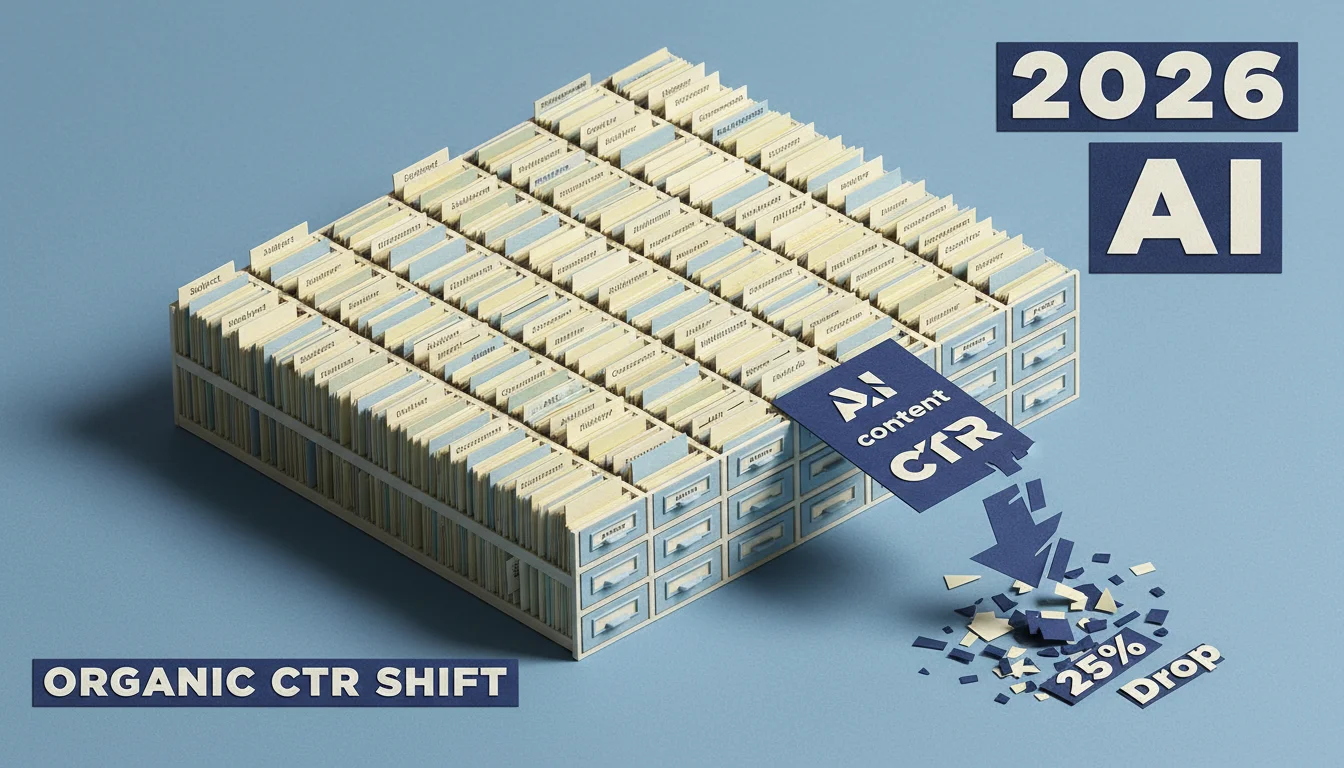
- The top 3 organic spots have seen a 25% drop in click-through rate (CTR) since 2023, which means winning the zero-click search is now the whole game.
- You absolutely must use semantic markup, especially Question and Answer schema, so AI engines can actually understand and present your information correctly.
- Long-form articles still work, but you have to break them down into self-contained, digestible answer blocks that an AI can easily grab.
- Your PPC strategy has to pivot to target queries where AI answers aren’t as common or where the commercial intent is so strong that a user needs a landing page, not a factoid.
Organic Click-Through Rate Declines by 25% for Top Positions
The idea that ranking number one guarantees a flood of traffic is officially dead. Nielsen’s 2026 Search Behavior Report confirms that the average organic click-through rate (CTR) for positions 1 to 3 has dropped by a quarter since 2023. This is a fundamental rewiring of search behavior, caused by AI answers and SERP features giving users what they need without a click. If your content doesn’t answer the mail in the first couple of sentences, you’re going to be ignored by the user and, more importantly, the AI that’s deciding what the user sees. Our content now has to provide the entire value upfront.
Semantic Schema Markup Adoption Still Below 15% for Q&A Content
Even with all the signals from Google and others, schema adoption for Q&A is just shockingly low. A 2026 IAB study found that less than 15% of websites with FAQ or Q&A sections are using Schema.org‘s Question and Answer markup correctly. Frankly, that’s just malpractice at this point. AI answer engines run on structured data. When you tag your questions and answers with schema, you’re handing the AI a perfect blueprint to your content. Without that structure, the AI is left to guess and infer, which means it’s far more likely to get it wrong or just pick someone else’s content that’s easier to understand. You can’t expect the machine to read your mind. You have to speak its language, and that language is structured data. For more on this, check out how AI crawlers evolve in 2026.
PPC Content Sees 30% Higher Conversion Rates for “How-To” Queries
As organic gets weird, PPC content is getting hyper-specialized and is crushing it for certain queries. For example, eMarketer’s Q1 2026 analysis saw that PPC campaigns hitting “how-to” and instructional searches had conversion rates 30% higher than the average. This makes perfect sense. When a user wants an immediate, step-by-step solution, they’ll gladly click a paid ad that promises to deliver it. An AI answer gives you a fact. A well-built PPC landing page guides you through a process, often one that ends in a transaction. Paid content can grab users at that critical decision point where they need a guided solution, not just a definition. The key is making sure your ad copy and landing page deliver on the “how-to” promise with a clear path to conversion that an AI answer just can’t replicate. Understanding AI-driven PPC is becoming a requirement for marketers making this shift.
Long-Form Content Underperforms if Not Structured for Extractable Answers
We’ve all been taught that long-form content is king for its depth and SEO juice. But a recent HubSpot study on AI consumption found that long articles (over 2,000 words) that aren’t broken into clear answer segments were 35% less likely to be cited by AI answer engines. Long-form isn’t obsolete, but the old way of writing it is. A rambling 3,000-word history of digital marketing is great for a human with a cup of coffee, but an AI trying to answer “What is programmatic advertising?” isn’t going to read the whole thing to find the answer buried in paragraph 17. You have to start thinking of your long articles as a collection of self-contained mini-articles, each with a sharp heading that asks a question and a concise answer right below it. This structure gives the AI exactly what it needs: a specific piece of information it can confidently extract without trying to interpret a whole narrative.
The Misconception: “Just Write for Humans”
The old mantra of “just write for humans and the search engines will follow” is now dangerously bad advice when we’re talking about AI answer engines. It suggests that good prose is all that matters. I completely disagree. An AI doesn’t “read” like a person. It’s an algorithm processing data, hunting for patterns and explicit structural signals. Your beautiful, flowing narrative might be a joy for a human, but if it lacks clear Q&A patterns, direct headings that answer queries, and the right schema, the AI will just pass it over for something it can easily parse. The new reality demands that we structure content to serve human readability and AI extractability at the same time. You have to be a writer and an information architect. You can absolutely write for both audiences, but it takes a discipline that goes way beyond just “writing well,” and it’s essential for mastering things like Agentic Marketing in 2026.
The bottom line is that search is now direct and conversational. To stay in the game, your content structure has to be built for AI answer engines. That means getting serious about structured data, formatting for direct answers, and being smart about how PPC content can target the commercial angles the AI will always miss.
How does AI answer engine dominance affect organic search traffic?
It craters it. AI provides answers directly on the results page, so users don’t need to click through to your website anymore. This is why click-through rates are plummeting, even when you rank at the top.
What is the most effective way to structure content for AI answer engines?
Break your content into distinct question-and-answer blocks. Each block should be a self-contained unit that clearly and concisely answers one specific thing. Then, you have to wrap it all in the correct schema, like FAQPage schema, so the machines can read it properly.
Should I still create long-form content in an AI-dominated search field?
Yes, but you have to build it differently. A long article must be structured like a series of short articles, with each section having a clear heading and an immediate, extractable answer. The AI isn’t going to read a novel. It’s looking for a specific data point it can grab and run with.
How can PPC content adapt to AI answer engine changes?
PPC needs to get surgical. Go after the queries with obvious commercial intent, especially “how-to” or comparison searches where a user needs a guided solution, not just a fact. People will click an ad for a clear process or a path to purchase, something an AI answer rarely provides, which is why those campaigns are seeing higher conversion rates.
Is it possible to optimize content for both human readers and AI answer engines simultaneously?
Yes, and you have to. The method is to write high-quality, interesting content for people, but build it within a rigid, machine-friendly structure. That means using clear headings, providing direct answers right away, and using semantic schema markup to label everything for the AI. It’s about being a good writer and a good data architect.


