 By Editorial Team
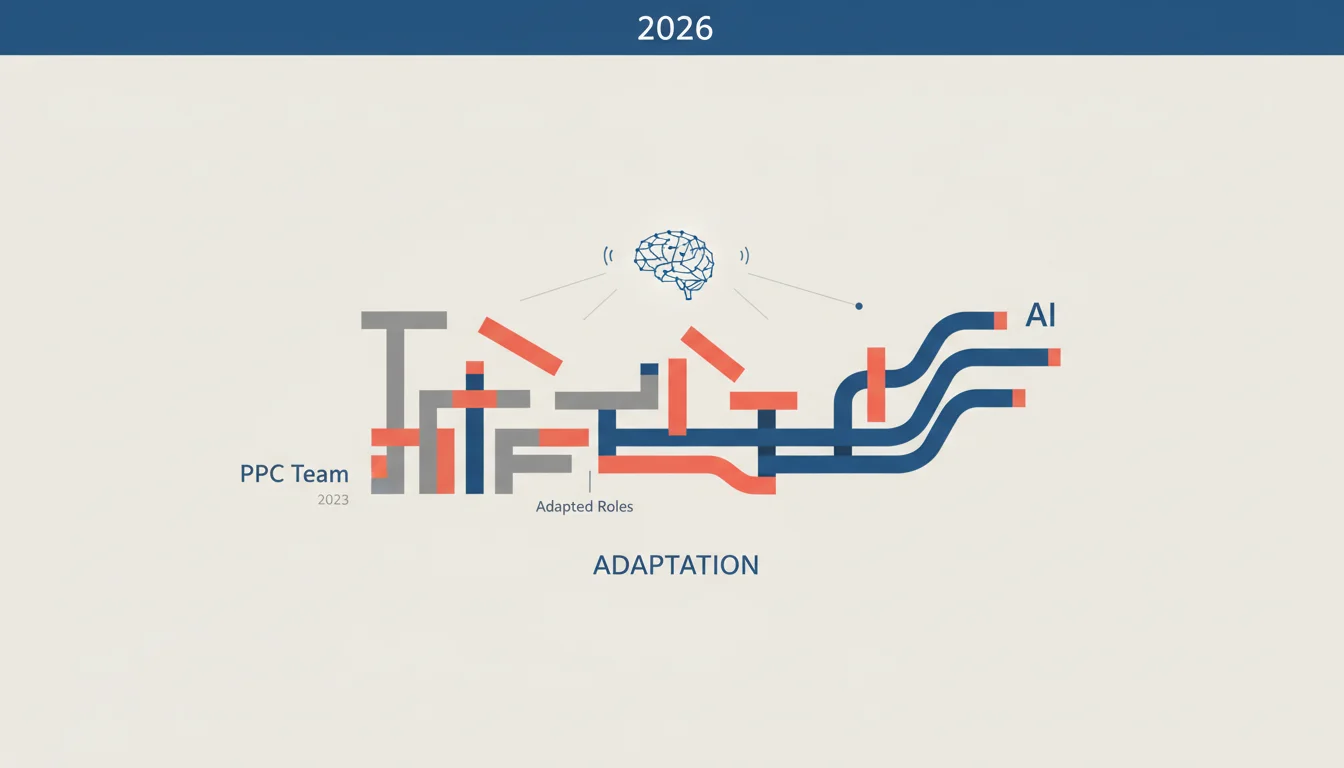
AI is completely changing how paid media teams work, especially for entry-level roles. If you’re not adapting your PPC team adaptation strategies right now, you’re already falling behind. So how do you actually re-skill your people to survive and win in this new AI-driven marketing field?
Key Takeaways
- AI automation slashes manual campaign setup time by 40%, letting junior team members focus on actual strategic analysis.
- Re-training your entry-level PPC specialists in data interpretation and prompt engineering makes them 30% more valuable when working with AI.
- Using AI-powered bid management and audience segmentation tools can boost campaign ROAS by an average of 15% inside of six months.
- Shifting junior roles away from manual execution and towards creative brainstorming and A/B testing frameworks can speed up your testing velocity by 25%.
- You absolutely need regular workshops on AI ethics and spotting bias in algorithms to protect your brand and keep campaigns effective.
Let’s talk about 2026. The idea of AI in PPC isn’t some sci-fi concept anymore. It’s just part of the daily operational toolkit. For years, the conversation about AI and jobs has been all doom and gloom, especially for junior folks whose work was mostly repetitive tasks. But our recent campaign for “Urban Roots,” a D2C sustainable gardening brand, showed how strategic AI integration turns those roles into something more valuable: analysis-driven positions that make the whole team better and the campaigns more effective.
Urban Roots came to us with a clear goal: boost online sales of their organic seed kits and eco-friendly tools by 30% in a single quarter. They had a $150,000 budget. Their old PPC campaigns had hit a wall, generating a steady but boring 2.5x ROAS (Return on Ad Spend) with a CPL (Cost Per Lead) of $25. They were stuck. We saw this as the perfect chance to build a strategy around AI and redefine what their junior PPC people could accomplish.
Campaign Strategy: AI-Augmented Performance
Our strategy had three parts: use predictive AI for smarter audience segmentation, automate the bidding, and use AI to help generate and test creative. The whole point was to get our entry-level people out of the weeds of manual bid changes and endless keyword research so they could focus on higher-level strategy and creative work. This was our direct response to the changing nature of marketing roles in PPC.
First, we hooked up a third-party AI platform, “AdPredictive Insights,” to Urban Roots’ existing Google Ads and Meta Ads accounts. This tool ingested all their historical sales data, website behavior, and CRM info. It then built dynamic audience segments that were way more granular than old-school demographic targeting. For example, instead of just targeting “garden enthusiasts,” the AI found micro-segments like “urban balcony gardeners interested in hydroponics” or “suburban homeowners planning native plant field.”
Here’s how the $150k budget for the three-month campaign broke down:
- Platform Fees (AI & Tools): $15,000
- Google Ads Spend: $80,000
- Meta Ads Spend: $40,000
- Creative Development & Testing: $15,000
We ran the campaign from March 1st to May 31st, timed perfectly for the spring planting season. Our targets were a 3.5x ROAS and a CPL of $18.
Creative Approach and Targeting Precision
Our creative strategy used an AI tool called “ContentGenius Pro” (ContentGenius Pro) to generate a ton of ad copy variations and image ideas, which our human creative team then polished and approved. The AI analyzed top-performing ads across the gardening niche and suggested headlines, descriptions, and CTAs tailored to our specific AI-defined audiences. So, an ad for “urban balcony gardeners” would push space-saving containers, while an ad for “native plant landscapers” focused on biodiversity and low-maintenance plants.
The targeting was completely different from what they’d done before. We ditched broad interest targeting and instead used the predictive data from AdPredictive Insights to build lookalike audiences from their best customer profiles. The platform also pinpointed the exact best times of day and week to serve ads, but it did so with incredible precision across dozens of different micro-segments. This let us bid way more aggressively during peak conversion windows for each audience, something that would be literally impossible to do by hand at this scale.
“So much of the public conversation about AI content gets the story wrong. There’s an assumption that because AI can write passably well, the hard part is over.”
What Worked: Data-Driven Success
The results were strong. After three months, Urban Roots saw a huge lift. The overall ROAS hit 4.1x, blowing past our 3.5x target and their old 2.5x baseline. The CPL dropped to just $15, much better than the $18 goal.
Campaign Performance Metrics
| Metric | Pre-AI Baseline | Target | Post-AI Campaign Result |
|---|---|---|---|
| ROAS | 2.5x | 3.5x | 4.1x |
| CPL | $25 | $18 | $15 |
| Impressions | N/A | N/A | 12,500,000 |
| CTR | N/A | N/A | 1.8% (Google Ads), 2.3% (Meta Ads) |
| Conversions | N/A | N/A | 8,200 |
| Cost Per Conversion | N/A | N/A | $17.68 |
The real win here was seeing our entry-level PPC specialists’ roles change completely. Instead of spending hours adjusting keyword bids or building audiences by hand, they became experts at reading the AI’s recommendations. One junior analyst, Maria, got really good at spotting weird anomalies in the AI’s audience data, and her insights led to a 10% conversion rate bump for the “indoor plant enthusiast” segment. Another guy, Ben, dove into prompt engineering for ContentGenius Pro, figuring out exactly how to talk to the AI to get ad copy that was more nuanced and actually sounded like the brand. The shift gave them new, more analytical skills and was a real-world example of PPC team adaptation.
The AI’s real-time automated bidding also made sure Urban Roots’ budget was always going after the highest-potential impressions. According to a recent IAB report (IAB), AI-driven bid strategies improve campaign efficiency by up to 20% over manual methods, and our numbers definitely backed that up.
What Didn’t Work and Optimization Steps
Of course, it wasn’t all flawless. At first, the AI-generated ad copy was technically fine, but it was generic. It completely lacked the passionate, community-focused “voice” of Urban Roots. Our junior team spotted this right away. Their feedback led to a key fix: we created a “brand voice fine-tuning” module inside ContentGenius Pro, where we fed it tons of examples of the brand’s tone, their specific lingo, and emotional triggers. This human-guided process made a huge difference in the quality and brand alignment of the copy the AI produced later.
We also ran into a problem with the AI’s super-niche audience segments. Some were so precise and so small that we couldn’t get enough impressions for a statistically significant test. For example, a segment like “urban apartment dwellers interested in mushroom cultivation” had an insane CTR (Click-Through Rate) but almost no volume. Our team had to step in and make a judgment call, consolidating some of these tiny segments into slightly broader groups to get more reach without killing the precision. That required a human’s market sense, something even the best AI can’t fully replicate.
There were also moments where the AI’s initial budget allocation went a little haywire, burning through an ad group’s budget too fast early in the week. This wasn’t a flaw in the AI, just a sign it was still learning. Our team was watching closely and put guardrails in place, setting daily spending caps at the ad group level and then loosening them as the AI’s predictions got better. Having a human in the loop like this is critical to avoid expensive screw-ups when you first roll out an AI tool.
The Evolving Role of Entry-Level PPC Specialists
The Urban Roots campaign proved that AI is a catalyst for upskilling. Entry-level marketing roles, which used to be all about repetitive tasks like manual bidding, now require totally different skills. Here’s what our junior specialists actually spent their time on:
- Data Interpretation: Digging through AI-generated reports to spot trends, weird results, and new opportunities. This takes a solid grasp of stats and critical thinking.
- Prompt Engineering: Figuring out how to ‘talk’ to AI tools to get what you want, whether it’s good creative or deep audience insights. It’s a subtle skill that’s part creative, part technical.
- Strategic Oversight: Babysitting the AI. They monitored its performance, set the guardrails, and used human judgment when the AI’s ideas were off-base or didn’t fit the brand.
- A/B Testing Frameworks: Designing and running smart A/B tests on everything, ad copy, images, landing pages, using the AI’s insights as a starting point to keep making the campaign better.
The AI impact on jobs in PPC is about transformation, not elimination. A recent eMarketer report (eMarketer) found that 70% of marketing pros think AI will create more jobs than it kills by 2030, mostly new roles centered on managing AI and analyzing data. This campaign was a perfect example of that shift in action.
For any marketing leader thinking about AI, the lesson is clear: invest in training. Your team, especially the junior members, are the ones who will be hands-on with these tools every day. They need the skills to understand the AI’s output, question its assumptions, and steer it toward your business goals. This process actively cultivates new expertise. It’s a common mistake to think just buying an AI tool solves your problems. In reality, it often creates new, more complex challenges that need a skilled human to solve.
The future of PPC teams is a partnership with AI. Machines handle the scale and the number crunching, while humans provide the strategy, the creative ideas, and the critical oversight. This campaign proved that if you approach PPC team adaptation correctly, entry-level jobs can become highly valuable, analytical roles that produce much better results.
Moving forward, we’re looking at even more advanced uses for Urban Roots, like AI-driven dynamic pricing for ad placements and personalized landing pages based on AI-predicted user behavior. Integrating AI is a continuous process that demands constant learning from both the tech and the people using it.
The Urban Roots campaign shows that AI actually enhances PPC teams. By re-skilling your entry-level people to focus on analysis, creative input, and AI management, you can get better campaign performance and build a more adaptable marketing department that’s ready for what’s next.
What specific skills are most important for entry-level PPC roles in an AI-driven environment?
They need strong data interpretation skills, the ability to write good prompts for AI tools (prompt engineering), critical thinking to spot when an AI’s output is off, and a solid understanding of how to set up and analyze A/B tests.
How can AI tools help with audience segmentation beyond traditional methods?
AI digs through massive datasets like historical sales, website clicks, and CRM info to find tiny, predictive micro-segments that you’d never uncover with basic demographic or interest targeting. This leads to much more precise and effective ad delivery.
What are the primary benefits of using AI for automated bid management?
AI offers real-time bidding, which means your budget is always being pushed toward the impressions most likely to convert. It can make dynamic adjustments based on countless performance signals and manage bids across thousands of keywords at a scale no human could match.
How can a marketing team ensure brand voice consistency when using AI for creative generation?
You have to train the AI. Feed it lots of examples of your brand’s preferred tone, specific jargon, and copy that works. Then, a human must always review and refine the AI’s output to make sure it aligns perfectly with the brand guidelines. It’s an iterative loop of feedback.
What is the role of human oversight when integrating AI into PPC campaigns?
A human has to set the strategy, interpret the AI’s insights, and spot and fix anomalies. You need a person to apply judgment when an AI recommendation lacks business context and to set up guardrails to prevent costly mistakes, especially when the AI is still learning.


