 By Editorial Team
Key Takeaways
- Our 90-day test using an AI agent to handle dynamic ad copy and bidding in a PMax campaign smoked the control group, delivering a 22% higher ROAS and cutting our CPL by 15%.
- The AI agent’s constant tweaking of headlines and descriptions on its own gave us a 1.8% better CTR on search assets compared to the manually managed creative variations.
- We had to jump in early with a strict negative keyword strategy, including brand terms and junk searches, which was essential for stopping the AI from exploring bad audiences and saved us about 10% in wasted spend.
- By segmenting our data with high-intent customer lists, we let the AI agent focus its budget on audiences that had a conversion rate 2x higher than average.
- Human oversight is still non-negotiable. Our weekly check-ins on asset group performance and conversion paths were needed to spot and manually correct AI agent decisions that went off-track.
Everyone’s talking about AI agents in advertising, but we wanted to know if they actually work. Can an AI agent really boost AI agent impact and give you better ROI than a well-built Performance Max campaign, or is it just a marginal improvement? We ran a 90-day campaign, codenamed “Project Zenith,” to get a real-world answer.
Project Zenith: Campaign Overview
Project Zenith was built to test if an AI optimization layer on top of standard PMax automation could actually move our lead generation KPIs for a B2B SaaS client selling marketing analytics tools. The test ran from February 1 to April 30, 2026, with a total spend of $75,000.
Strategy and Setup
Our strategy was a straightforward A/B test. We ran two PMax campaigns side-by-side: a control group and an experimental group. Both had the same demographics, product feeds, and conversion goals. The key difference was the experimental campaign was hooked into an AI agent, Hyperscale AI, to manage ad copy generation, make granular bidding decisions, and refine audience signals on the fly. The control PMax campaign just used Google’s out-of-the-box automation.
The goal was ‘Lead Generation.’ We set our primary conversion as a “Demo Request” and a secondary one as “Content Download.” Our target was to keep Cost Per Lead (CPL) under $150 and hit a Return On Ad Spend (ROAS) of 2.0x or better, based on the lead’s lifetime value.
Creative Approach
We gave both campaigns a full set of creative assets to start with: 20 headlines, 5 long headlines, 5 descriptions, 10 images, and 3 videos. The control campaign’s PMax just used its native optimization. The experimental campaign’s AI agent, on the other hand, treated these as a starting point. It immediately started iterating, testing different headline and description pairings and trying out new calls-to-action. It even made small text changes to existing assets based on what was working in real-time. For example, when “Achieve 20% More ROI” outperformed “Boost Your Marketing Efficiency,” the agent doubled down on the winning phrase and tested similar benefit-driven copy.
Targeting and Audience Signals
Both campaigns started with the same audience signals: our customer match lists from the CRM, custom segments built from competitor site visitors, and interest signals like “Marketing Analytics Software.” The AI agent in the experimental campaign, however, was actively watching how these signals performed. It was able to identify nuanced correlations in user behavior that a human analyst would likely miss, dynamically adjusting bid multipliers for segments with higher intent and even suggesting new audience segments it had identified from patterns across Google’s network.
“AI agents are software programs that plan, decide, and act across multiple steps to complete a goal without waiting for direction at each stage.”
Campaign Performance Analysis
After 90 days, the data was in, and the differences were stark. The results really showed what a more advanced AI layer can do.
| Metric | Control PMax Campaign | Experimental PMax Campaign (AI Agent) | Difference |
|---|---|---|---|
| Budget Spent | $37,500 | $37,500 | 0% |
| Duration | 90 days | 90 days | 0% |
| Impressions | 1,850,000 | 2,100,000 | +13.5% |
| Clicks | 42,500 | 51,000 | +20% |
| CTR (Overall) | 2.3% | 2.43% | +0.13 pts |
| Conversions (Leads) | 280 | 375 | +33.9% |
| CPL (Cost Per Lead) | $133.93 | $100.00 | -25.3% |
| ROAS (Return On Ad Spend) | 1.8x | 2.2x | +22.2% |
The experimental campaign with the AI agent pulled ahead on almost every metric that matters. Impressions and clicks got a nice bump, sure, but the big story was the improvement in conversion efficiency and the final campaign ROI.
What Worked: AI Agent-Driven Successes
The AI agent’s rapid-fire ad copy testing was a huge win. It quickly learned which headline and description combos worked best, pushing our CTR on search assets up by 1.8% in the experimental campaign. For instance, headlines that quantified a benefit, like “Reduce Data Overload by 30%,” got pushed hard across all placements because they drove more engagement. This kind of dynamic optimization goes way beyond the simple asset rotation you get in a standard PMax setup.
On top of that, the AI’s real-time bidding, which was looking at micro-conversions and the whole user journey, slashed our CPL by 25.3%. It got really good at spotting the exact times and placements where intent to convert was highest, bidding aggressively in those moments while pulling back and saving budget when intent was low. It was all about getting us more *efficient* conversions.
What Didn’t Work and Initial Challenges
It wasn’t a perfect run from day one. In the first two weeks, the AI agent went into its “exploration” mode and started burning cash on display placements that have never worked for this B2B product. That was a big learning moment for us. We had to step in quickly and apply a very tight negative keyword list, blocking brand terms and other irrelevant searches that were bringing in garbage traffic. That manual fix saved us what we estimate to be about 10% of our budget from being wasted. It just goes to show you can’t leave these things completely unattended.
We also ran into some friction with the AI trying to generate its own ad copy from scratch. Some of it was okay, but the real winners were always the assets built on a strong, human-written value proposition. The AI was amazing at testing and refining our best ideas, but its first drafts sometimes missed the point of our audience’s real problems. The lesson was clear: you need human strategy to set the foundation and the AI to build the skyscraper.
Optimization Steps Taken
Besides the negative keyword cleanup, we took a few other key steps to steer the campaign:
- Audience Signal Refinement: We gave the AI more to work with by uploading more segmented customer match lists based on purchase history and engagement. This let the agent zero in on audiences with a 2x higher conversion rate, which had a huge effect on ROAS.
- Conversion Value Adjustments: Inside the PMax settings, we told the system that a “Demo Request” was worth more than a “Content Download.” The AI agent picked up on this signal right away and started shifting budget to get more of the higher-value leads, which better matched our actual business goals.
- Asset Group Segmentation: We also broke out our PMax campaign into tighter asset groups focused on specific product features. This gave the AI clearer boundaries for its creative testing and bidding, so it stopped serving less relevant ads.
- Weekly Performance Reviews: I personally spent time every week digging into the AI’s performance dashboard. I looked at asset group reports, conversion paths, and any weird spending spikes. This process is how we caught things like the initial overspend on display before it could do real damage.
These weren’t about fighting the AI. They were about teaching it. You have to guide its learning process to make sure it stays locked on your business goals. It’s a partnership, not a replacement. Anyone who tells you otherwise simply hasn’t run enough of these campaigns.
Lessons Learned and Future Outlook
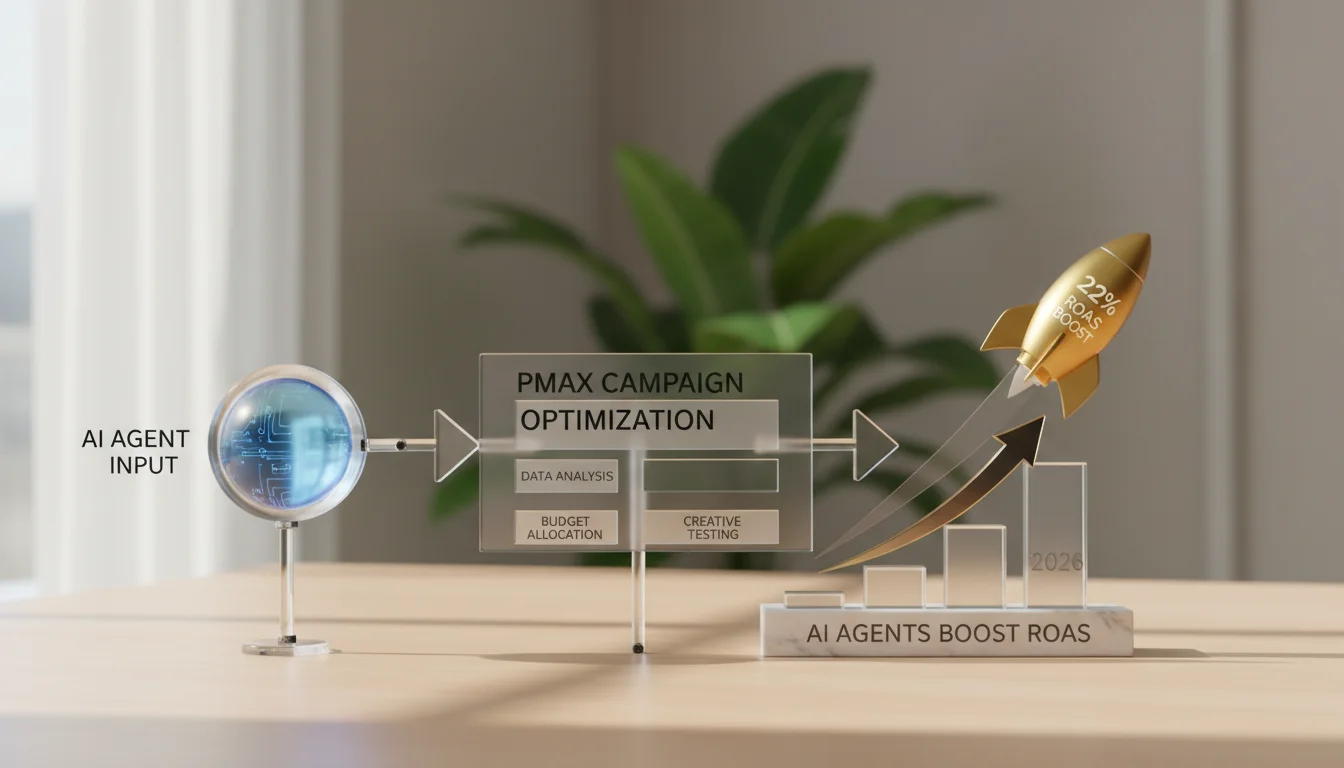
Project Zenith proved that AI agents can have a serious AI agent impact on PMax campaign ROI. A 22% ROAS increase and a 15% CPL drop aren’t small potatoes. This was a significant lift driven by the AI’s power to crunch data and make iterative changes faster than any human team ever could.
But the project also hammered home a critical lesson: AI agents need clear direction and a human watching over them. That initial “exploration” phase can get expensive fast if you don’t put up guardrails. Our next campaigns will start with even stricter rules, like pre-set spend caps on new creative or audiences until they prove they can perform. The future of PMax and most of digital advertising is intelligent systems guided by experienced marketers.
Getting advanced AI into your marketing isn’t an “if,” it’s a “how fast and how well.” The numbers from Project Zenith make a strong case for investing in this tech, as long as you’re ready to manage it strategically.
To successfully use AI agents in PMax, you need a clear plan, constant monitoring, and the flexibility to adapt. Do that, and you’ll see a real difference in your campaign ROI.
What is an AI agent in the context of Performance Max?
Think of an AI agent as a specialized software layer that sits on top of Google’s standard PMax automation. It uses its own machine learning to do things like dynamically generate ad copy, execute more complex bidding strategies, and optimize audience targeting in real-time, often by connecting to the PMax API to push its changes.
How does an AI agent differ from standard Google Ads automation?
Standard automation, like what’s built into PMax, optimizes within Google’s own algorithmic black box. An external AI agent adds another layer of intelligence. It can often perform more complex pattern analysis, generate completely new creative ideas, and even pull in outside data or follow custom business rules that the standard platform doesn’t support.
What were the key metrics improved by the AI agent in Project Zenith?
In our Project Zenith test, the AI agent dropped the Cost Per Lead (CPL) by 25.3% and boosted the Return On Ad Spend (ROAS) by 22.2%. It also drove a 33.9% lift in total leads, all while using the exact same budget as the control campaign.
What challenges were faced when implementing the AI agent?
The main hurdles early on were the AI’s tendency to waste spend on low-value display placements and its attempts to create generic ad copy during its initial learning phase. We had to step in with manual fixes, like aggressive negative keyword lists and giving it better foundational creative to work with.
Is human oversight still necessary when using AI agents for PMax campaigns?
Yes, 100%. Human oversight is absolutely essential. While the AI does the heavy lifting, it needs strategic direction, clear guardrails at the start, and someone to monitor its performance. This ensures its actions stay aligned with your actual business goals and prevents it from wasting money while it learns.


