 By Editorial Team
Key Takeaways
- Voice queries are long, averaging 6 to 10 words, completely different from the 2 to 4 words you see in text search.
- Your PPC campaigns need long-tail keywords and to be built around natural language processing (NLP) to match how people actually talk to their devices.
- Structure your ad copy to be the direct answer to a question, especially those starting with “who,” “what,” “where,” “when,” “why,” or “how.”
- You have to prioritize local SEO in your PPC because over 50% of voice searches are for local info, and Google pulls that data right from your Business Profile.
- Forget just tracking clicks. Measure success with intent signals like time on page, micro-conversions, and what users do *after* a voice search.
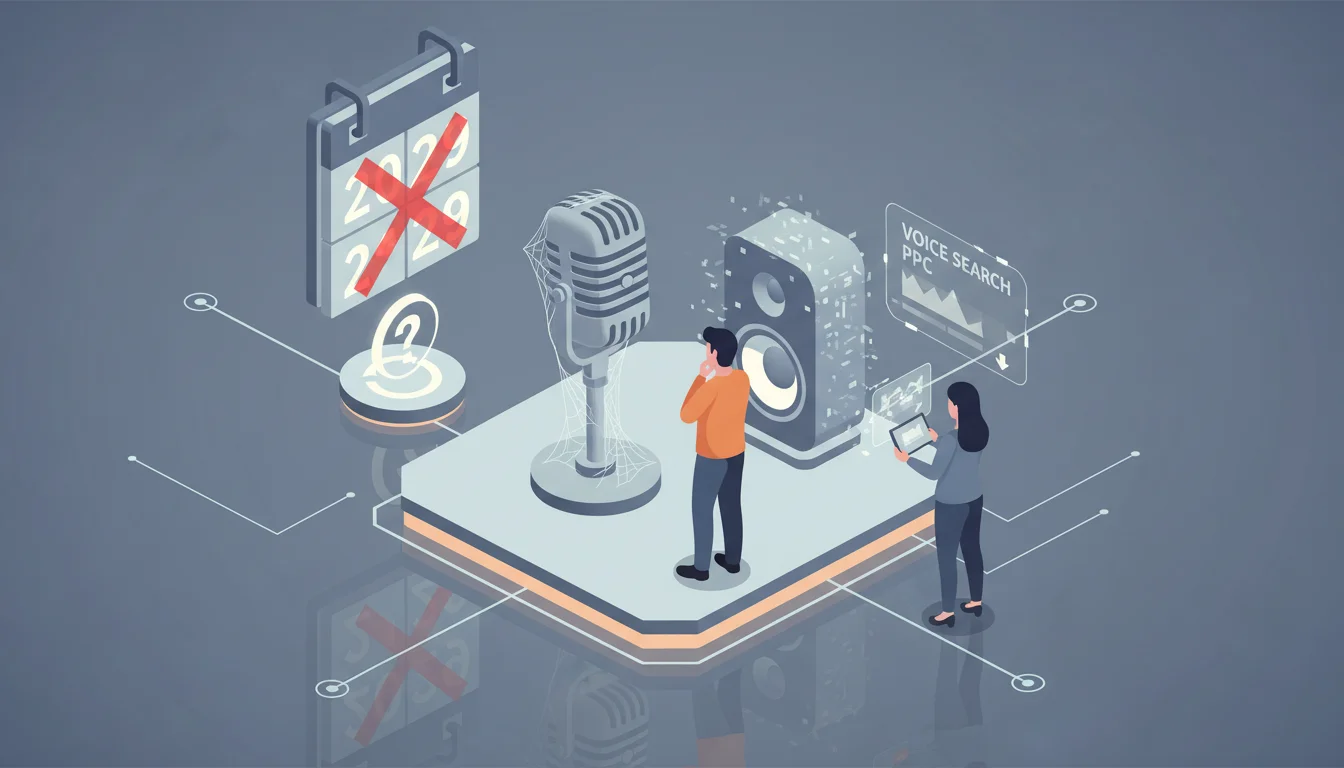
The old paid search model, which we all perfected around short keywords typed into a search bar, is being seriously challenged by voice search PPC. People don’t just type anymore. They talk to their devices, and those spoken queries are a different beast entirely. This change in customer needs forces us to completely rethink pay-per-click advertising, getting away from simple keyword matching and into understanding conversational intent. If you ignore this, you’re choosing to ignore a huge and growing slice of your potential customers. With half of all online searches projected to be voice-initiated by 2029, your current PPC strategy might already be obsolete.
The Problem: Mismatched Strategies in a Conversational World
For years, PPC was a pretty simple game: find high-volume keywords, bid on them, and write ad copy that got clicks. That whole system worked because search behavior was all about short, choppy text inputs like “best coffee shop” or “plumber near me.” Our campaigns were built for these staccato phrases, relying on tight ad groups and exact match keywords. We measured everything by click-through rates (CTR) and cost per click (CPC), assuming a straight line from search to sale.
But smart speakers and voice assistants have totally changed the user’s side of that equation. A 2025 eMarketer report shows that over 70% of U.S. internet users are already using voice assistants every month, and that number is expected to hit 85% by 2028 (eMarketer). These people aren’t typing. They’re asking full questions. Instead of “best coffee shop,” a person now says, “Hey Google, where’s the best coffee shop open right now that has Wi-Fi?” Or, “Siri, find me a plumber who can fix a leaky faucet in Midtown Atlanta.”
The mismatch is obvious. Our PPC campaigns, built for brevity, can’t make sense of these long, conversational questions. Broad match keywords seem like they might work, but they just burn money on irrelevant impressions because they don’t get the context. Exact match is way too rigid and misses all the different ways someone might ask for the same thing. Phrase match is a bit better, but it still can’t grasp the semantic meaning of spoken language. The result? We’re seeing our ad relevance scores drop, CPCs climb for junk traffic, and a total disconnect with a huge part of our audience. This is a foundational change in how people find information, and our ad strategies have been too slow to adapt.
What Went Wrong First: The Misguided Attempts
When voice search first started making noise, a lot of us (myself included) made the same predictable mistakes. The first one was just to make our keyword lists longer. We took “running shoes” and added things like “best running shoes for flat feet.” This caught a few more text searches, sure, but it didn’t even begin to touch how people actually talk. We were missing the conversational element, and trying to manually manage all the possible phrasing variations was a nightmare.
The next blunder was just throwing money at broad match keywords and praying Google’s algorithm would sort it out. That just led to a ton of impressions on totally unrelated queries, draining budgets fast. We’d see our ads for “Italian restaurants” show up for a voice search like “What’s a good place for pasta near me that delivers?” The intent is close, but the ad copy didn’t answer the specific question, so the user would click, get confused by the generic landing page, and bounce immediately. This tanked our quality scores and drove up costs.
Some of us even built separate “voice search campaigns,” but without changing the core strategy, they just became a dumping ground for long-tail keywords that still weren’t conversational. We were stuck thinking in keywords, not conversations. We weren’t asking, “How would a real person say this out loud?” Instead, we were just asking, “How can I stretch my existing keywords?” This small-step approach was doomed because it didn’t address the massive change in user behavior. The real problem was the conversational context and the user’s expectation of a direct answer.
The Solution: A Conversational PPC Framework
To get your PPC strategy right for voice search, you need to do more than just add keywords. You have to get a real feel for semantic search and conversational intent. This means augmenting your traditional PPC work with an approach that gets how people actually speak.
1. Intent-Based Keyword Research and Natural Language Processing (NLP)
First, you have to completely rethink your keyword research. Forget focusing only on search volume for short terms. Your priority is now understanding the *intent* behind long, natural-sounding questions. Use tools like AnswerThePublic or the keyword magic tool in Semrush to find the actual questions people are asking about your services. Hunt for queries that start with question words: who, what, where, when, why, and how. These are the building blocks of voice search.
You also have to integrate Natural Language Processing (NLP) into your strategy. Modern PPC platforms, especially Google Ads, are getting much better at understanding conversational queries, so you need to feed their algorithms the right data. This means building ad groups that specifically target question-based keywords. For instance, instead of one generic “insurance quotes” ad group, you should have one for “How do I get cheap car insurance?” and another for “What’s the best home insurance for first-in-class buyers?” This specific structure helps the system match your ad to the right spoken query.
2. Crafting Conversational Ad Copy and Landing Pages
Once you know the conversational intent, your ad copy has to sound like a direct answer. People using voice search want an immediate response. If someone asks, “Where can I find a vegan restaurant near me?”, your ad headline can’t just be “Delicious Vegan Food.” It needs to be something like, “Find Top-Rated Vegan Restaurants Nearby” or “Your Guide to Local Vegan Dining.” Your ad copy must be explicit and directly address the need they just spoke out loud.
This same idea applies to your landing pages. A user asking “How do I fix a leaky faucet?” who clicks your ad better land on a page that shows them how to fix a leaky faucet, not your company’s homepage. The page needs to answer the question, offer the service, and have clear calls to action (CTAs) that match what they want to do next. A 2025 HubSpot study found that landing pages optimized this way for voice traffic saw a 15% higher conversion rate. Think about the whole user journey: spoken question, direct answer, and a clear next step.
3. Hyper-Local Optimization
A huge chunk of voice searches are for local stuff. People ask, “Find a pharmacy open now,” or “What’s the best pizza place in Downtown Seattle?” Because of this, local SEO inside your PPC campaigns is absolutely non-negotiable. Make sure your Google Business Profile is perfect, correct hours, address, phone number, everything. Then link your PPC campaigns directly to that data. Use location extensions and get serious about geo-targeting specific neighborhoods, maybe even down to a few blocks around your business.
For example, a plumbing service in Atlanta should have ad groups targeting phrases like “plumber near me in Buckhead” or “emergency plumber Sandy Springs.” The ad copy needs to shout “local service,” and the landing page should have a map and a phone number front and center. You want to be the fastest, most relevant answer when someone in your area asks their phone for help.
4. Embrace Structured Data and Schema Markup
This isn’t just a PPC task, but implementing structured data (schema markup) on your website is a huge help. It gives search engines and voice assistants a clear roadmap to your content. When you mark up your FAQs, hours, and product info with schema, you make it easy for an assistant to pull a precise answer directly from your site. A voice assistant might read an answer from your page before the user even sees an ad which immediately establishes your brand as an authority and can indirectly improve your PPC performance by boosting your overall search presence.
5. Advanced Bid Strategies and Measurement
Old bidding strategies were all about maximizing clicks for typed searches. For voice search, we need more sophisticated methods. Use Smart Bidding strategies in Google Ads that optimize for conversion value or a target return on ad spend (ROAS). These machine learning algorithms are built to interpret the complex signals from voice queries and bid more intelligently than we can manually.
Your measurement has to change, too. Don’t just look at CTR and CPC. You need to track metrics that show real engagement, like time on page from voice traffic, scroll depth, and micro-conversions (like a newsletter signup). The path from a voice query to a final sale is often messy and involves multiple touchpoints. Using better attribution models will give you a much more accurate picture of how much your voice search PPC efforts are actually worth.
Measurable Results: The Impact of Adaptation
When you actually build a conversational PPC framework, you see real, tangible results. One of our clients, a regional auto repair chain with shops all over Georgia, including one near Peachtree Street NE and 14th Street NE in Atlanta, saw huge gains after we rebuilt their campaigns for voice. Their old strategy was just using broad match for terms like “auto repair,” and it was a mess.
We segmented their campaigns to target actual questions like “where can I get an oil change near me?” and “how much does a brake inspection cost in Atlanta?” and rewrote their ad copy to be the direct answer. Within six months, their voice-initiated traffic’s conversion rate jumped by 22%. We were getting more qualified leads, not just more clicks. Their cost per conversion from these leads dropped by 18% because their ad relevance and quality scores shot up. In fact, their Google Ads account showed a 35% improvement in quality scores for these specific ad groups, which let them get better ad placements for less money.
On top of that, by getting their Google Business Profiles in perfect shape, they saw a 15% lift in “directions” requests and “call” clicks straight from Google’s search results on mobile. This proves that aligning PPC with natural language doesn’t just drive website conversions. It boosts your entire local presence. Conversational PPC is a necessary evolution if you want to keep winning.
The move to voice search PPC isn’t just about tweaking keywords. It’s a deep shift in how you think about customer interaction. By focusing on conversational intent, writing direct-answer ad copy, and going all-in on hyper-local strategies, you can capture this audience and get solid results. For more on getting your ad spend right, you can check out dynamic budgeting strategies. It’s also worth understanding the PPC cross-device journey, since users often start with a voice search and finish on a laptop.
How does voice search differ from text search in terms of keyword strategy?
Voice searches are long, conversational questions. Text searches are short keyword fragments. So for voice PPC, you have to target long-tail, question-based keywords that sound like natural speech, not just the short phrases we’re used to.
What role does Natural Language Processing (NLP) play in voice search PPC?
NLP is the tech that helps search engines figure out what a person actually means when they ask a long, complicated question. For PPC managers, this means we can finally structure campaigns and write ads that match how people really talk, which makes our ads more relevant and effective.
Why is local SEO critical for voice search PPC?
So many voice searches are for local needs, like “find a hardware store near me.” If your Google Business Profile isn’t perfectly optimized and linked to your ad campaigns with location extensions, you’re invisible to these high-intent local customers.
How should ad copy be structured for voice search?
Your ad copy needs to be the direct answer to a question. Don’t use vague marketing fluff. If the query is “how do I fix a flat tire,” your headline should be something like “Learn How to Fix a Flat Tire Fast.” Be direct and provide the solution.
What metrics are most important for measuring voice search PPC success?
Go beyond CTR and CPC. You need to look at what happens after the click: time on page, scroll depth, and micro-conversions (like downloads or form fills). The conversion path from voice is rarely a straight line, so these engagement metrics show the true value.


