 By Editorial Team
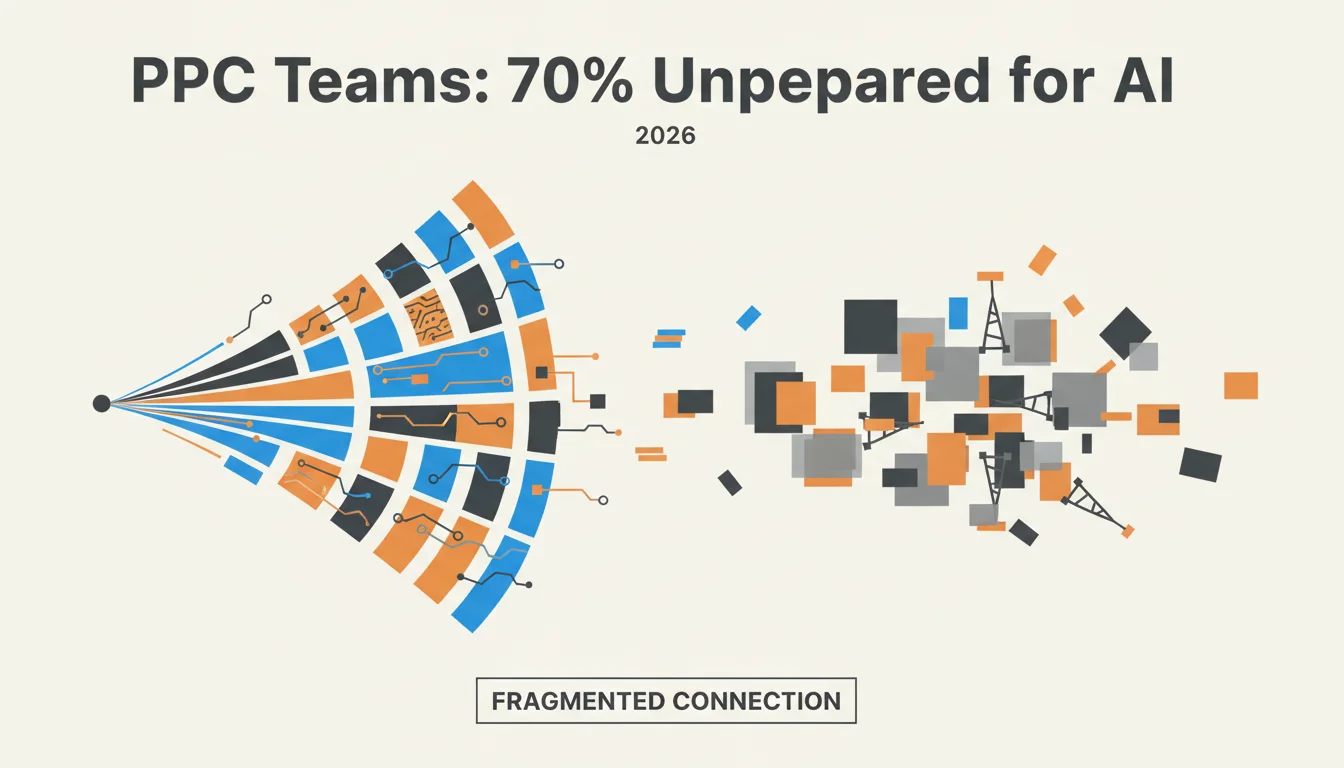
That a recent Gartner survey shows nearly 70% of marketing leaders feel unprepared to effectively integrate AI into their existing team structures by 2026 points to a problem much deeper than simply buying new software. The organizational challenge AI throws at us is about the people. It forces a complete teardown and rebuild of roles, workflows, and the very definition of a paid media specialist. So how do PPC teams actually pull this off without derailing their operations?
Key Takeaways
- Aim to automate at least 25% of your team’s manual bidding and reporting with AI in the next 12 months so they can focus on strategy.
- Upskill your current PPC talent in prompt engineering and data interpretation, teaching them to validate AI output instead of just running the tools.
- Reshape your PPC teams to have a dedicated AI strategist or liaison who translates technical AI functions into real campaign goals.
- Roll out AI tools in phases, starting with small pilot programs on less important campaigns to get feedback and fix workflows before going all-in.
- Build clear communication lines for AI-generated insights, making sure the intelligence is actually understood and used by the people making decisions.
45% of PPC Teams Lack a Clear AI Implementation Roadmap
The biggest organizational block I see is the lack of a defined strategy. A 2025 IAB report on AI in advertising found that almost half of PPC teams are just playing around with AI tools, with no real plan for how they’ll fit into the bigger picture. Honestly, that’s not surprising. Agencies and internal teams see the promise of better performance, so they buy licenses for Google’s Performance Max or Meta’s Advantage+ Shopping Campaigns and think the job is done. They treat it like an add-on, which leads to a mess of disconnected tools, garbage-in-garbage-out data, and no one really owning the AI-driven processes. That 45% figure is really a failure of leadership to set a direction. Without a concrete roadmap, teams just use AI to automate the same old tasks, completely missing the point. I’ve seen teams spin their wheels for months because no one decided if AI’s main job was bid management, creative generation, or audience segmentation, leading to duplicated work and a lot of frustration with expensive, underused tech. A good roadmap picks specific use cases, puts hard KPIs on the AI’s performance, and spells out the training plan for everyone involved.
Only 30% of PPC Specialists Feel Adequately Trained for AI Tools
This stat from a HubSpot marketing trends report is a huge red flag because it shows a massive disconnect. Organizations think because their PPC people are good with tech, they’ll just figure out AI. That’s a dangerous assumption. Advanced AI tools demand a completely different skillset than classic PPC management. The job becomes less about tweaking bids by hand and more about knowing how to write a good prompt, judge the AI’s output, and know when its recommendations are garbage. The real training gap is strategic. It’s one thing to know where the target ROAS setting is inside Google Ads’ AI, but it’s another thing entirely to develop the judgment to know when to trust the AI’s audience insights and when to override them because of what you know about the market. This takes critical thinking and a healthy dose of skepticism. PPC managers are shifting from being task-doers to being strategists who audit machine-driven results. If only 30% feel ready for that, a huge part of the workforce is being set up to fail, which will create performance bottlenecks as AI gets more integrated. Full-on training programs covering AI ethics, prompt writing, and output validation are now just the cost of doing business.
PPC Teams Report a 20% Increase in Data Overload Post-AI Adoption
You’d think AI would simplify things, but it often does the opposite by creating an absolute firehose of new data. A 2025 eMarketer analysis pointed this out, showing that while AI processes tons of data, it also spits out more granular metrics and predictive models than a human team can handle. This influx of information, if you’re not ready for it, just leads to analysis paralysis. The problem is the lack of a framework for making sense of it all. Most PPC dashboards are not designed to visualize or prioritize what an AI finds. For example, an AI might identify 50 different micro-audiences with weird performance trends, but your team can only realistically act on three or four of them. Which ones? That’s where your organizational structure has to change. Someone’s job has to be turning all that AI data into a handful of actionable orders. Without that person or process, the data is just noise. And this all assumes the data you’re feeding the AI is clean in the first place, which is why strong data governance is so important, bad data in, bad insights out.
Only 15% of Companies Have Restructured PPC Roles to Accommodate AI
This stat from Nielsen’s 2025 State of Marketing report says it all. Most companies are just trying to cram new AI functions into their old, siloed team structures. You can’t just drop a new engine in an old car and expect it to work. Traditional PPC roles, where one person does bidding, another does reporting, and a third does creative, are completely misaligned with how AI-driven campaigns actually work in an iterative, cross-functional way. Think about what a “PPC specialist” is supposed to do in 2026. If a machine handles 80% of the bidding and writes the first drafts of all the ad copy, the specialist’s job shifts to high-level strategic oversight, training the AI through feedback, refining prompts, and analyzing performance in a totally new way. This means we’re starting to see new job titles like “AI Campaign Strategist” or “Ad Prompt Engineer” pop up, roles that mix creative skills with a technical grasp of how these models think. If you ignore this restructuring, you’ll end up with underused AI and burnt-out people doing tasks a machine should be handling. This is exactly where getting targeted help can be a shortcut. For teams struggling with this stuff, agencies like Moburst bring that specific expertise. Their AEO / AI SEO services help companies do more than just install tools. They help adapt the internal processes and job roles to actually get value from the tech. That kind of outside guidance can save a team from having to learn all the hard lessons from scratch.
Challenging the Conventional Wisdom: AI Doesn’t Replace, It Improves (But Not Always Directly)
The common line we hear is that AI just changes jobs, making everyone’s role more strategic. While that’s broadly true, it papers over a much messier reality for PPC teams. It’s not a direct promotion for everyone. For example, the junior PPC manager who spent all day doing manual bid changes and pulling basic reports finds their entire job has been eaten by AI. Their role wasn’t “improved”, it was made obsolete in its original form. This demands a massive reskilling effort that most companies aren’t planning for. I’ve seen that the “improvement” comes with a very steep and uncomfortable learning curve. The human job shifts to a type of strategy that involves untangling complex AI outputs, figuring out why the algorithm did something weird, and designing experiments to test the AI’s limits. It’s a completely different job. The easy narrative suggests a smooth change, but the ground truth is full of organizational friction and talent gaps. We need to be honest that some roles will be eliminated while others will morph into something that requires a whole new set of skills, forcing us to rethink what a “PPC expert” even is. Facing that is the first step to managing the change effectively. The real challenge of AI for PPC teams is a human one, not a technical one. Getting this right depends on leaders who will define a clear path, invest seriously in reskilling their people, build new frameworks for interpreting data, and restructure their teams to match what AI can do. Pretending these organizational problems don’t exist will only lead to failed AI projects and a very frustrated team.
What are the primary organizational challenges PPC teams face with AI integration?
The main challenges are the lack of a clear implementation strategy, not enough of the right kind of training for specialists, getting swamped by data without a way to interpret it, and not changing old job roles to fit new AI-driven workflows.
How can PPC teams effectively train their staff for AI tools?
Good training needs to focus on skills like prompt engineering, understanding the limits of AI models, and validating AI outputs. It’s about teaching people to interpret AI-generated insights and develop the strategic oversight to guide the AI, not just operate the software.
What new roles might emerge in PPC teams due to AI adoption?
We’re seeing roles like AI Campaign Strategist, Prompt Engineer for Ads, AI Performance Analyst, and AI Data Synthesizer. They all focus on steering the AI, making sense of its complex outputs, and plugging its insights into the bigger marketing plan.
How can PPC teams avoid data overload when using AI?
Teams need to set up strong data governance, use visualization tools that are actually built to display AI insights, and have a clear process for turning a flood of data into a few actionable recommendations. A big part of the job becomes prioritizing what the AI finds.
Is it true that AI will only improve existing PPC roles?
Not exactly. While AI does push some roles toward more strategic work, it also makes some manual tasks completely redundant. This means people whose jobs were focused on those tasks need significant reskilling for a new type of role, not just a simple “upgrade.”


