 By Editorial Team
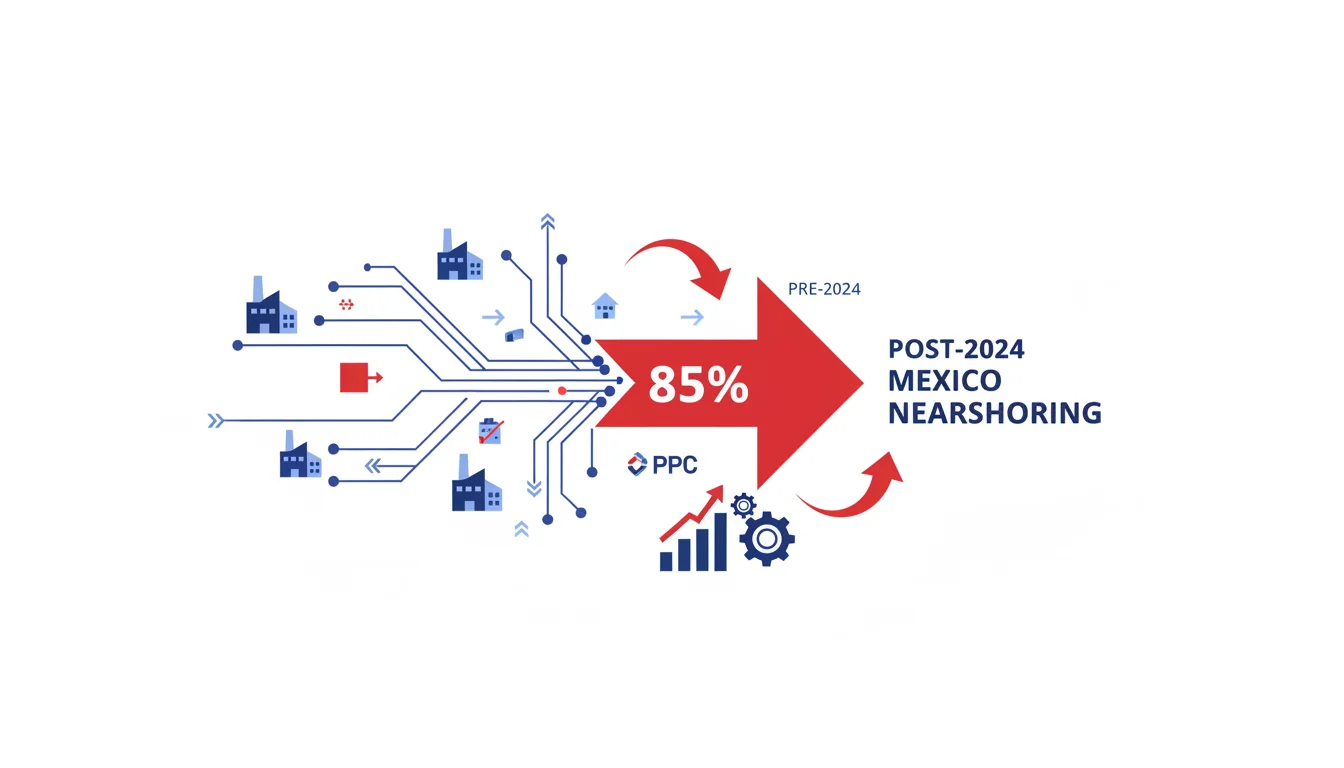
A surprising 85% of North American manufacturers surveyed in 2024 either already have or are actively planning to shift production to Mexico, according to a recent report by Kearney. This surge in nearshoring to Mexico manufacturing facilities presents a significant opportunity for businesses to refine their PPC content strategies, targeting a new wave of industrial buyers and supply chain managers.
Key Takeaways
- Manufacturers are expanding their digital ad spend on platforms like LinkedIn and Google Ads to reach decision-makers involved in Mexican operations.
- PPC campaigns for nearshoring content must emphasize logistics, compliance, and local labor market expertise, using specific keywords related to Mexican industrial parks and customs.
- Geotargeting strategies should focus on key industrial corridors such as Monterrey, Tijuana, and Ciudad Juarez to maximize ad relevance and conversion rates.
- Content should address common pain points of companies considering nearshoring, like supply chain resilience and reduced lead times, with data-backed solutions.
- A/B testing ad copy that highlights cost savings versus speed to market will reveal optimal messaging for different segments of the nearshoring audience.
The 2024 Logistics Surge: 62% Increase in Cross-Border Freight Volume
According to data released by the U.S. Bureau of Transportation Statistics, cross-border freight volume between the U.S. and Mexico saw a 62% increase in the first three quarters of 2024 compared to the same period in 2022. This statistic isn’t just about trucks on highways. It indicates a massive expansion in the operational footprint of companies manufacturing in Mexico. For PPC content, this means an urgent need to focus on logistics-centric keywords. Think beyond “Mexico manufacturing services” and consider terms like “cross-border logistics solutions Mexico,” “customs brokerage for nearshoring,” or “freight forwarding Monterrey to Laredo.”
My interpretation is that buyers are no longer just evaluating production costs. They are deeply concerned with the entire supply chain velocity and reliability. Your ad copy and landing page content must reflect this. Highlight specific port capabilities, border crossing efficiencies, and warehousing options near key industrial hubs. A campaign that successfully targets decision-makers researching “just-in-time inventory Mexico” with a detailed case study on reduced transit times will outperform generic ads every time.
Investment in Industrial Parks: Over $15 Billion in New Developments by 2026
By the end of 2026, over $15 billion in new industrial park developments are projected across Mexico, according to Colliers International. This isn’t just a number. It represents tangible infrastructure and a clear geographical concentration of manufacturing activity. The conventional wisdom often focuses on broad geotargeting for Mexico, but this data demands a more granular approach. We should be targeting specific industrial corridors and cities where these investments are most pronounced.
For instance, PPC campaigns should geotarget areas like the Apodaca Industrial Park in Monterrey, the Pacifico Industrial Park in Tijuana, or the Intermex Industrial Park in Ciudad Juarez. Your ad groups need to be hyper-specific. An ad for “electronics assembly services” will perform significantly better if it’s shown to someone searching from a location within or near these new industrial zones, rather than a broad national campaign. This level of specificity demonstrates a deeper understanding of the market, which builds trust with potential clients. It also allows for ad copy that speaks directly to the advantages of a particular region, such as access to specific labor pools or proximity to major U.S. consumer markets.
Labor Market Dynamics: 1.2 Million New Manufacturing Jobs by 2025
The Mexican manufacturing sector is expected to create 1.2 million new jobs by 2025, as reported by the National Institute of Statistics and Geography (INEGI). While this signals strong growth, it also points to potential challenges in labor availability and specialized skills. Many businesses considering nearshoring worry about securing a skilled workforce and working through local labor laws. This is where your PPC content can differentiate itself.
Instead of merely stating “skilled labor available,” your ad copy should address these concerns head-on. Consider ad variations that highlight “labor force development programs for manufacturing Mexico” or “HR solutions for nearshoring operations.” Landing pages should offer insights into specific training initiatives, average wages in different regions, or even partnerships with local technical schools. Plus, PPC campaigns can target keywords related to labor compliance and regulatory frameworks in Mexico, providing valuable information that establishes your authority in a complex area. A common mistake I observe is glossing over labor issues. However, these are often deal-breakers for companies assessing new locations. Providing clear, data-backed solutions to labor concerns can significantly improve conversion rates.
Supply Chain Resilience: 78% of Executives Prioritize It Over Cost Savings
A recent survey by PwC revealed that 78% of manufacturing executives now prioritize supply chain resilience over initial cost savings when making sourcing decisions. This statistic directly challenges the long-held belief that nearshoring is primarily about reducing expenses. While cost efficiency remains important, the emphasis has dramatically shifted towards mitigating risks and ensuring continuity.
My take is that your PPC content needs to move beyond “save money by manufacturing in Mexico.” Your ads and landing pages should focus on “supply chain stability Mexico,” “risk mitigation nearshoring,” or “resilient manufacturing solutions.” Highlight how shorter supply lines to Mexico reduce vulnerability to global disruptions, geopolitical events, and transit delays. Show real-world examples of how businesses have maintained production schedules through unforeseen challenges by having operations closer to their end markets. This angle resonates deeply with executives who have experienced the turmoil of recent years, making your offering more compelling than a purely cost-driven pitch.
The Misconception: “Mexico is a Low-Cost Labor Haven”
While Mexico still offers competitive labor costs compared to the U.S., the notion that it’s simply a “low-cost labor haven” is outdated and misleading. The real value proposition, as evidenced by the PwC data on resilience, lies in its integrated supply chain, geographical proximity, and increasingly skilled workforce. Many businesses still approach nearshoring with a dated mindset, focusing solely on hourly wages.
This conventional wisdom misses the mark on several critical fronts. The true advantage of manufacturing in Mexico today comes from the total cost of ownership, including reduced shipping expenses, faster time-to-market, and greater supply chain control. PPC campaigns that perpetuate the “cheap labor” narrative risk attracting the wrong kind of client or, worse, misrepresenting the sophisticated manufacturing ecosystem that has developed. Instead, I advocate for PPC content that emphasizes the total landed cost of goods, the benefits of the USMCA trade agreement, and the strategic advantages of operating within a highly integrated North American supply chain. This positions your services not as a discount option, but as a strategic imperative for modern manufacturers.
The shift towards Mexico manufacturing is not a fleeting trend but a strategic realignment driven by global economic pressures and a demand for greater supply chain resilience. By crafting highly specific and data-driven PPC content, businesses can effectively capture this growing market, speaking directly to the nuanced concerns and priorities of decision-makers in 2026.
What are the primary benefits of nearshoring to Mexico for manufacturers?
The primary benefits include reduced lead times, lower transportation costs due to geographical proximity to the U.S., increased supply chain resilience against global disruptions, and duty-free access to North American markets under the USMCA agreement.
How can PPC campaigns effectively target companies interested in Mexico manufacturing?
Effective PPC campaigns use precise geotargeting to industrial zones in Mexico, employ keywords related to specific logistical challenges and solutions, and craft ad copy that addresses concerns like supply chain stability, skilled labor availability, and regulatory compliance.
What kind of content performs best for nearshoring PPC ads?
Content that performs best includes case studies demonstrating reduced lead times, detailed guides on working through Mexican customs and logistics, data sheets comparing total landed costs, and whitepapers on regional labor market specifics and workforce development programs.
Should I focus on cost savings or supply chain resilience in my ad messaging?
While cost savings remain a factor, current market data suggests a stronger emphasis on supply chain resilience. Ad messaging should highlight how nearshoring to Mexico mitigates risks, ensures continuity, and offers greater control over the manufacturing process, alongside any cost efficiencies.
What specific regions in Mexico are seeing the most nearshoring activity?
Key regions experiencing significant nearshoring activity and industrial park development include Monterrey (Nuevo León), Tijuana (Baja California), and Ciudad Juarez (Chihuahua), among other border states and central Mexico industrial corridors.


