 By Editorial Team
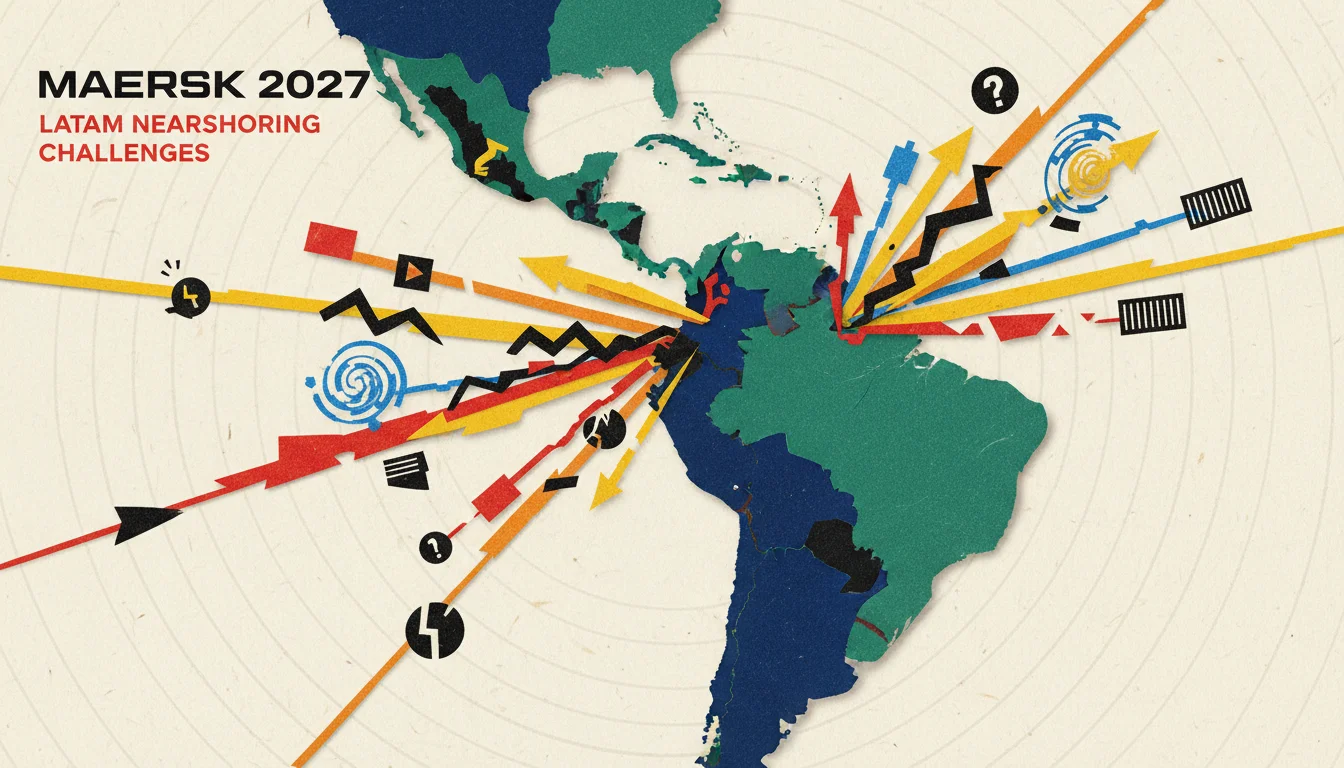
Forecasts are calling for a 22% jump in trade between Latin America and North America by 2027, and it’s almost all because of nearshoring. This is a massive shake-up for global supply chains, creating new revenue streams for companies like Maersk but also clogging up infrastructure. The real question for every business is no longer *if* they should look at Latin America, but how they can get a foothold in this new commercial geography without getting burned.
Key Takeaways
- The expected spike in Asia-to-Latin America container rates didn’t happen. Instead, they dropped an unexpected 15% in Q3 2026, which hints at carrier overcapacity or a real shift in sourcing.
- Good luck finding space in Mexico. The industrial parks on its northern border hit 98% occupancy in August 2026, putting incredible strain on the infrastructure needed for nearshoring.
- Investment in cold chain logistics shot up 18% in Brazil and Argentina during the first half of 2026, a direct result of more people wanting fresh food and imported pharmaceuticals.
- The Panama Canal’s expansion, set to finish by late 2027, will boost daily transit capacity by 20%, which is going to completely change the math for East Coast shipping routes.
- Colombia and Chile are getting their acts together on customs. Digitalization efforts have cut average clearance times by a solid 10% this year, giving importers real, tangible time back.
The Surprising Dip in Asia-LATAM Shipping Rates
The data from Q3 2026 is a head-scratcher: a 15% drop in average container shipping rates from Asian hubs to Latin American ports. This flies in the face of the whole nearshoring story, where we expected logistics costs to keep climbing. The assumption was that even as companies moved assembly closer to the US, they’d still need a steady flow of parts from Asia to feed those new factories, keeping demand high. This dip tells us something more complicated is going on.
My read is that the initial hype around nearshoring led carriers to overcommit. Maersk and others likely repositioned vessels expecting a massive, sustained surge, creating a temporary glut of capacity on these specific routes. Or, and this is more interesting, it could be the first sign of a major procurement shift. What if Latin American manufacturers are already starting to source components from their neighbors instead of from across the Pacific? I’m convinced we’re seeing the start of a real trend here: nearshoring is forcing regional supply chains to actually develop, which in turn cuts the need for so many transpacific shipments of intermediate goods. This is a short-term window to get cheaper inbound freight from Asia, but it’s also a loud signal to rethink your entire global sourcing strategy.
Mexico’s Nearshoring Capacity Crunch: 98% Occupancy
The August 2026 report on industrial real estate along Mexico’s northern border is a flashing red light: 98% occupancy in the big industrial parks around Monterrey, Tijuana, and Ciudad Juárez. That’s not just “high,” it’s a full-blown bottleneck. The gold rush to set up plants near the US has eaten up virtually every square foot of available space, sending lease rates through the roof and pushing construction timelines for new buildings way out. For any company just now deciding to make a move, this means they’re already behind, facing bidding wars and long delays.
For logistics operators, the pressure is now on warehousing and last-mile services. With no room to spare, inventory has to be managed with ruthless efficiency and trucks need to be turned around faster than ever. It also forces a hard look at Mexico’s interior logistics hubs, far from the crowded border. Anyone planning a nearshoring move has to bake in these inflated real estate costs and the very real possibility of waiting months just to find a building. This isn’t a temporary problem. It’s a structural deficit of space that will define the market for the next 18-24 months. The companies that got in early now have a massive head start.
18% Growth in Latin American Cold Chain Investment
In the first half of 2026, a huge 18% more capital poured into cold chain infrastructure across Brazil and Argentina. This isn’t happening in a vacuum. It’s a direct reaction to what people are buying. Consumers there want fresher food and higher-quality imported goods, while the region’s growing pharma and biotech sectors need absolutely reliable temperature-controlled supply lines.
This is where the real money is for Maersk and other carriers. The game is evolving from just moving dry boxes to providing specialized, high-value services that maintain precise temperatures, guarantee product integrity, and navigate a web of tough regulations. The companies that can deliver a true end-to-end refrigerated solution, from transport and storage to final distribution, are going to win a big piece of this market. This also throws the doors wide open for tech firms building IoT sensors for real-time temperature tracking and predictive maintenance on reefer units. While everyone obsesses over dry cargo for nearshoring, the cold chain is a high-growth, high-margin opportunity that’s too big to ignore.
Panama Canal Expansion and Future Capacity
People talk about the Panama Canal expansion a lot, but they still don’t grasp the scale of what’s happening. The projects, due to be finished by late 2027, are on track to boost the canal’s daily transit capacity by around 20%. A 20% jump in capacity for one of the world’s most critical arteries fundamentally redraws global shipping maps, with huge effects on trade between Asia and the US East Coast and, by extension, on Latin America’s entire transshipment business.
A faster, more efficient canal capable of handling bigger ships will make some of the overland US routes and other workarounds less attractive. For a carrier like Maersk, it’s a chance to run more efficient routes and offer better transit times. But it also creates a new set of problems, namely how to manage all that increased volume without causing gridlock at key ports in the Atlantic and Pacific. Businesses need to be running the numbers on their supply chain models right now, because the canal’s expanded capacity will change everything. The winners will be the ones who adapt their networks to take full advantage of this bigger, faster maritime highway.
10% Reduction in Customs Clearance Times in Colombia and Chile
The push to digitize customs in Latin America is finally paying off. Specifically, Colombia and Chile are seeing a 10% drop in average customs clearance times this year. They achieved this by investing in electronic documents, pre-arrival processing, and smarter risk-assessment tools. That 10% might not sound like a revolution, but in the world of logistics, it translates directly into fewer fees, better cash flow, and more predictable schedules.
Everyone loves to complain about bureaucracy and delays at Latin American ports. But these numbers show that some countries are serious about making it easier to do business. For a company importing goods, a 10% time reduction means less money wasted on port demurrage charges and inventory getting to shelves or production lines faster. It makes these countries far more attractive places to set up shop. My take is that this trend is only going to accelerate. The smart move is to find logistics partners who are already deeply integrated with these new digital customs platforms and know exactly how to navigate their electronic submission rules. It’s a clear competitive edge.
Challenging the Nearshoring Hype: It’s Not a Panacea
There’s a popular story going around that nearshoring is the magic bullet for every supply chain problem. Let’s be real: that’s a dangerously simplistic view. Moving production closer to home has its benefits, but thinking it solves everything is a mistake. Take Mexico, its proximity is great, but the 98% industrial park occupancy rate I mentioned means you’re walking into a market with almost no available space and rampant wage inflation, which quickly eats into any cost savings you projected.
And what about your raw materials? If all your key components are still being shipped from Asia, you haven’t really “nearshored” your supply chain. You’ve just moved the final assembly step and kept all the trans-oceanic risk. Before jumping in, you have to run a serious total-cost-of-ownership analysis that includes not just labor, but real estate bidding wars, local regulatory headaches, and IP protection. Just being “closer” isn’t enough. You can easily get blindsided by unexpected labor shortages or infrastructure gaps that wreck your budget and timeline. A “friendshoring” strategy, partnering with politically stable countries that have a proven track record, is a much more resilient approach than simply chasing the shortest distance on a map.
The logistics world in Latin America is definitely changing, pushed by the powerful forces of nearshoring and digitization. But success won’t come from following broad trends. It’ll come from sweating the details.
Companies have to stop reading headlines about nearshoring and start digging into the specific data, like industrial occupancy rates in Monterrey or customs processing times in Chile, and then build a strategy that fits reality. The operators who do their homework and stay agile are the ones who will come out on top in this market over the next few years.
What is the primary driver of increased trade volume between Latin America and North America?
It’s nearshoring. Companies are moving their manufacturing and supply operations out of Asia and into Latin America to be physically closer to their customers in the North American market.
Why have Asia-Latin America shipping rates decreased in Q3 2026 despite nearshoring?
There are two likely reasons. Either carriers overestimated the immediate demand and put too many ships on the route, creating an oversupply. Or, Latin American manufacturers are beginning to source components from other countries in the region instead of from Asia.
What challenges does 98% industrial park occupancy in Mexico’s northern border present?
It creates a massive bottleneck for businesses. They face soaring real estate costs, long construction delays for new facilities, and immense strain on local warehousing and last-mile delivery infrastructure.
How does investment in cold chain logistics impact Latin American trade?
This investment makes it possible to reliably transport temperature-sensitive products. It directly supports the region’s growing exports of perishable foods and serves the expanding pharmaceutical industry which creates a strong market for specialized, high-value logistics.
Which Latin American countries are leading in customs digitalization and what is the benefit?
Colombia and Chile are ahead of the curve, using new electronic systems to cut average customs clearance times by 10%. For businesses, this means lower port fees, less cash tied up in waiting inventory, and a faster overall supply chain.


