 By Editorial Team
Running ads for the European logistics sector, especially for temperature-controlled goods, is a tough game. To get results with reefer PPC, you have to know the specific regional demands, tangled regulations, and just how fierce the competition is from one port to the next. So what does it actually take to win in this European niche?
Key Takeaways
- Your targeting in Europe needs to be hyper-specific, focusing on country regulations and local port infrastructure instead of just targeting whole countries.
- Ad copy has to shout about compliance certifications (like GDP for pharma) and the exact temperature ranges you handle, which separates you from generic freight carriers.
- You have to use mobile bid adjustments because drivers and dispatchers are constantly on their phones looking for real-time freight options.
- Use Google Ads’ geographic bid modifiers to bid up in high-demand hubs like Rotterdam, Hamburg, and Valencia, where cost-per-click is higher but so is the value.
- Set up retargeting for people who looked at specific service pages, like your frozen transport page, and hit them again with ads tailored to that service.
Understanding the European Reefer Market Field
The European reefer market is a patchwork of different national rules, seasonal spikes, and unique logistical headaches. You can’t treat it as one big block. For example, running ads for produce transport out of Spain’s agricultural regions during harvest is a completely different ballgame than bidding on keywords for seafood distribution in Scandinavia. Too many advertisers just throw a single pan-European strategy at the wall, which is a fast way to burn through your budget without getting any real conversions.
The market’s entire structure is shaped by regulations, especially around food safety and pharma transport. For instance, the European Food Safety Authority (EFSA) guidelines directly affect how you move fresh produce across borders, setting the rules for everything from the truck specs to the allowed transit times. When you’re talking about pharmaceuticals, following Good Distribution Practice (GDP) isn’t optional, and you have to make that crystal clear in your ad copy and on your landing pages to get any traction with clients. If you don’t mention these specifics, your ads get ignored by decision-makers who care more about compliance and reliability than a cheap rate, meaning your cost-per-acquisition will go through the roof for zero return.
Competition is all over the place, too. You’ll see intense bidding wars for keywords along major corridors, like the routes connecting German industrial centers to ports in Belgium or the Netherlands. On the other hand, you might find lower competition and cheaper cost-per-click (CPC) rates on specialized or less common routes. You absolutely have to dig into these regional differences with a tool like Google’s Keyword Planner, looking at country-level data before you commit any serious spend.
Strategic Keyword Selection and Ad Copy for Reefer PPC
Good reefer PPC starts with getting your keyword targeting right, ditching broad terms like “refrigerated transport Europe” that just eat your budget with junk clicks. You need to get into long-tail keywords that show a searcher knows exactly what they want, like “frozen food logistics Germany to France,” “pharmaceutical cold chain Spain,” or “chilled produce transport Netherlands.” These signal much higher intent and lead to better conversions.
A strong negative keyword list is just as important for protecting your budget. You need to block all the irrelevant stuff like “refrigerator repair,” “home fridge,” or “personal transport.” I’ve seen accounts burn hundreds of euros a day just because they didn’t take five minutes to check their search query reports and add new negatives. It’s a simple mistake that costs a fortune.
Your ad copy needs to get straight to the point and speak to the real-world problems of logistics managers. You have to spell out your differentiators: specific temperature ranges you can hold, real-time tracking, multi-modal capacity, and any compliance certs you have (e.g., “GDP certified cold chain”). Use calls to action that sound like a solution, like “Secure Your Cold Chain” or “Request Pharma Transport Rates.” Then use ad extensions to pack in more value: structured snippets can list your service types (“Deep Freeze,” “Chilled,” “Ambient Controlled”) and callouts can broadcast benefits like “24/7 Monitoring” or “Cross-Border Expertise.”
Geographic Targeting and Bid Adjustments
Targeting in Europe has to be surgical. Throwing a campaign at the entire continent is a waste of money. You need to break down your campaigns by country, region, or even down to specific cities and industrial parks. A provider moving fresh produce from Southern Europe, for example, should be concentrating their ad spend on agricultural areas in Spain (like Andalusia or Murcia) and key distribution hubs up north (like Rungis Market near Paris). Google Ads lets you get super granular with this, targeting by postal codes or a radius around a business park.
This is where you have to get smart with bid adjustments. Data from sources like the Interactive Advertising Bureau (IAB) shows huge swings in CPCs and conversion rates for B2B services across different European markets. So you bid up for the high-value locations where you know demand is hot and you’re willing to pay for the click. Then you dial back your bids in areas where you don’t convert well or can’t compete effectively. And definitely think about device bidding. Dispatchers and drivers are searching on mobile for immediate solutions, and as a recent eMarketer report shows, mobile ad spending in Europe is only going up through 2026.
You should also schedule your ads to run during business hours in your target regions. Sure, logistics is a 24/7 operation, but the people who make the buying decisions are typically searching and filling out forms during their workday. Go look at your historical conversion data. It will tell you exactly when you should be pushing your budget for maximum visibility.
Performance Measurement and Optimization
Successful Europe logistics campaigns are defined by the metrics they track. Forget clicks and impressions. You need to be obsessed with your conversion rates, cost per conversion, and your actual return on ad spend (ROAS). In the reefer business, a conversion could be a submitted quote form, a call to your sales team, or a brochure download. Make sure you have solid conversion tracking set up in Google Analytics and that the data is flowing back into your ads platform.
You have to A/B test constantly. Test ad copy, test landing page layouts, test your call-to-action buttons. Tiny changes can sometimes cause a huge jump in conversion rates. For instance, you might find that a landing page built only for pharmaceutical cold chain clients converts way better than a general-purpose refrigerated transport page when targeting that audience. Don’t ever assume what works in Germany will work in Italy, because cultural expectations are different even in B2B. Germans might prefer a direct, fact-heavy page, while an Italian prospect might respond better to a message that feels more personal.
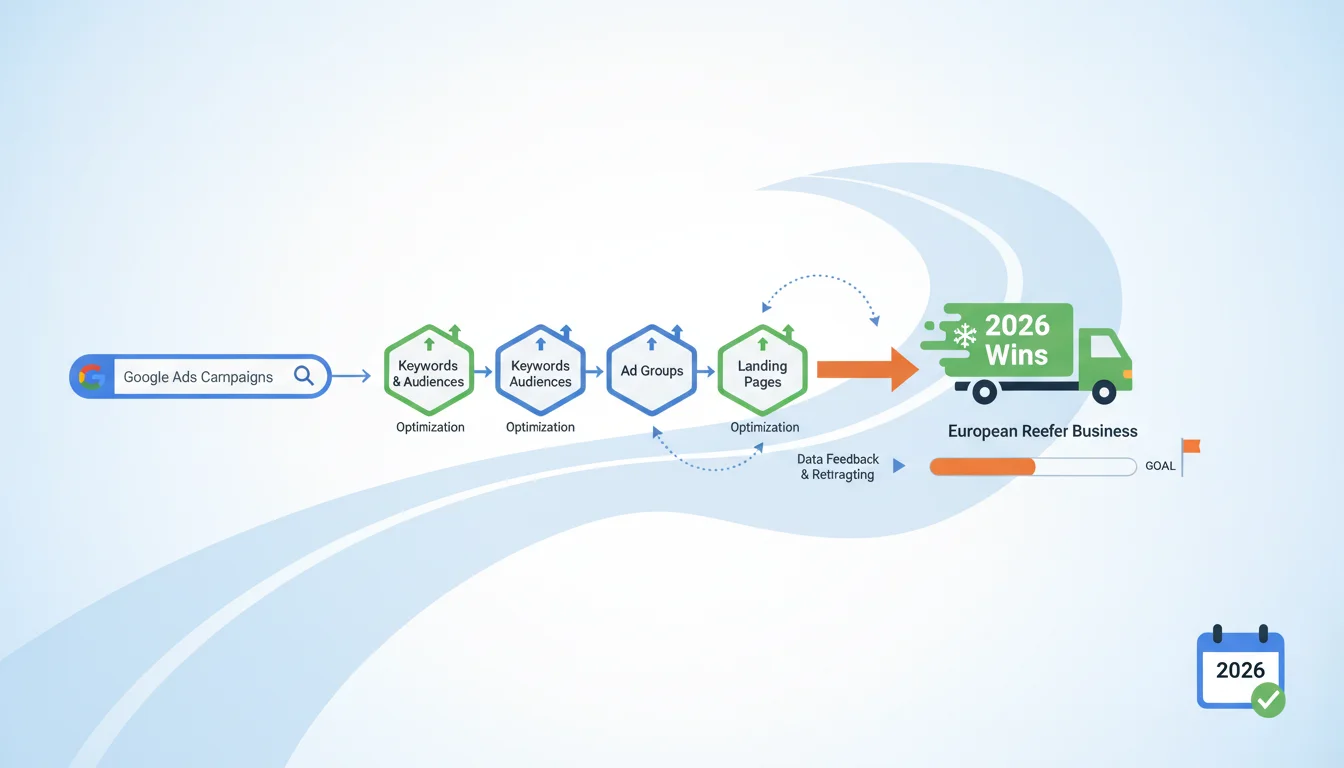
This is an ongoing process. You have to be in your search terms report regularly, digging for new high-intent keywords and adding junk searches to your negative list. You have to watch your geographic performance data to see where you should cut spend and where you should double down. Effective PPC management is a constant feedback loop, not a set-it-and-forget-it task.
Using Ad Extensions and Landing Page Experience
Ad extensions give you extra screen real estate to pack in more information and boost your click-through rates, yet so many advertisers don’t use them well. For reefer campaigns, use structured snippet extensions to list out exactly what you do (“Deep Freeze Transport,” “Chilled Logistics,” “Temperature Monitoring”) or the standards you meet. Use callout extensions to hit them with your selling points like “24/7 Support,” “GPS Tracking,” or “Multi-Temperature Zones.” Your sitelink extensions need to go to deep pages on your site, like “Pharma Transport,” “Food & Beverage Logistics,” or “Request a Custom Quote.” This gives users shortcuts and also tells Google your ad is highly relevant, which can help your Ad Rank.
Your landing page is where you close the deal. For reefer campaign insights, a good landing page has to load fast, work perfectly on mobile, and directly match the promise you made in the ad. If your ad says “GDP certified pharmaceutical transport,” that exact phrase and proof of it better be the first thing a user sees on the page, along with info on safety protocols and maybe a case study. Your contact forms and phone numbers must be impossible to miss. A page that’s slow or irrelevant to the ad click will have a sky-high bounce rate and just wastes money, no matter how good your keywords are.
You could also try offering a lead magnet on your landing page, like a white paper on cold chain practices or a spec sheet on your fleet. It’s a great way to capture contact info from people who aren’t quite ready to request a quote but are still valuable leads for your sales pipeline. Remember that the B2B logistics sales cycle can be long and involve a whole committee of people, so your website and ads need to support that entire journey.
Running successful reefer volume campaigns in Europe comes down to knowing the markets on a granular level, targeting keywords with precision, and constantly tweaking your campaigns. If you concentrate on regional details, write ad copy that solves problems, and provide a clean landing page experience, you can turn those high-intent searches into actual business.
What are the main challenges for reefer PPC in Europe?
The biggest headaches are the mix of national regulations, wild seasonal demand swings between countries, and heavy competition on major shipping routes. You also have to deal with different languages and cultural expectations for your ads.
How important is mobile optimization for these ads?
It’s absolutely essential. Logistics pros like drivers and dispatchers use their phones for urgent, on-the-go searches all the time. If your ads and landing pages aren’t mobile-friendly, you’re missing out on that immediate business.
Which ad extensions work best for reefer campaigns?
Structured snippets for listing services (“Frozen,” “Chilled,” “Pharma”), callouts for selling points (“24/7 Monitoring,” “GPS Tracking”), and sitelinks pointing to specific pages (“Request a Quote,” “Cold Chain Solutions”) work really well.
Should I use broad match keywords?
No, broad match is a bad idea here. It costs too much and brings in a ton of irrelevant traffic. Stick to exact match, phrase match, and modified broad match keywords to control your budget and get qualified clicks.
How do I measure if my reefer PPC campaigns are working?
Track your conversion rate, cost per conversion, and return on ad spend (ROAS). Make sure your conversion tracking is set up correctly for valuable actions like quote requests, phone calls, and brochure downloads so you know where your money is working.


