 By Editorial Team
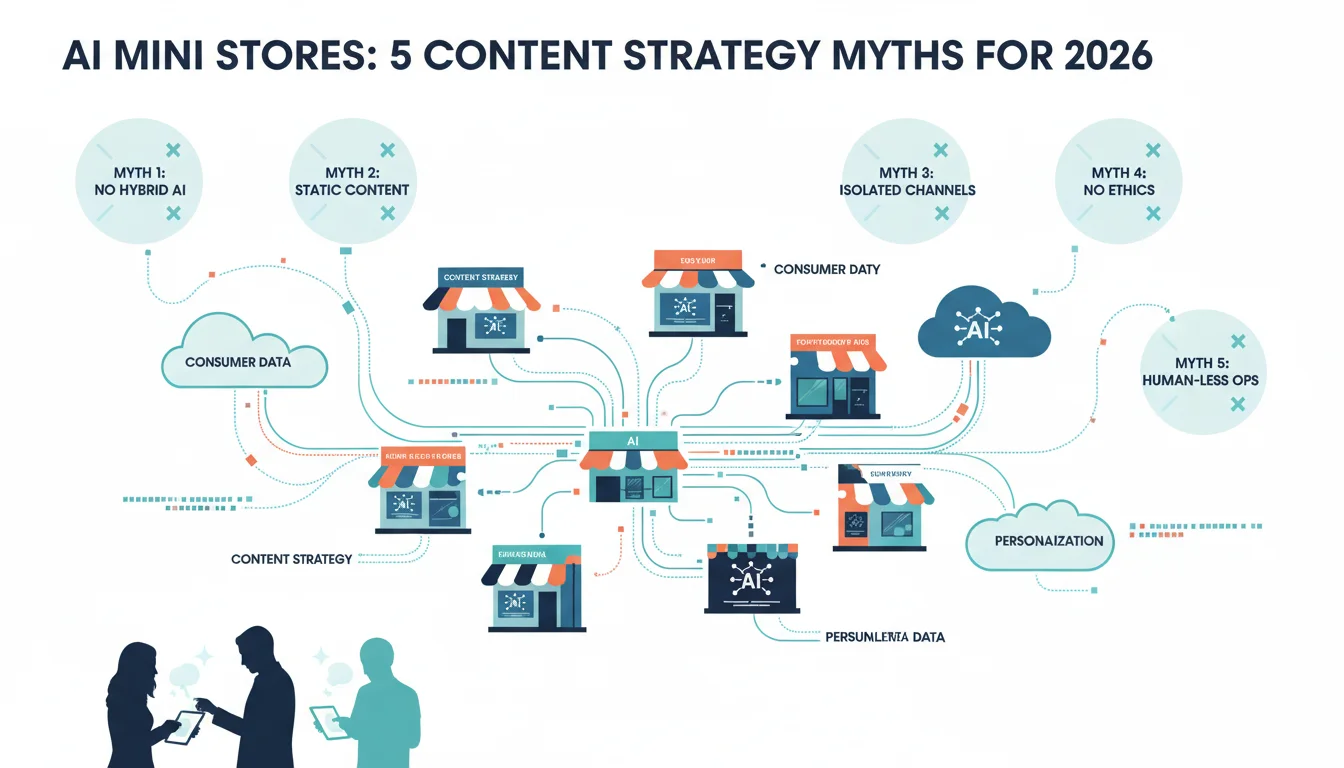
The rise of AI Mini Stores has unleashed a torrent of misinformation, leading many businesses down ineffective paths in their quest for automated e-commerce success. Understanding the true capabilities and limitations of these intelligent retail platforms is critical for developing a content strategy that actually delivers results.
Key Takeaways
- AI Mini Stores require a specialized content strategy focused on dynamic product descriptions and intent-driven conversational flows, moving beyond static product pages.
- Automated content generation tools are best used for initial drafts and scaling variations, not as a replacement for human oversight in maintaining brand voice and accuracy.
- Personalization within AI Mini Stores extends beyond product recommendations to include dynamic pricing and contextual content delivery based on real-time user behavior.
- Measuring success in AI Mini Stores involves tracking engagement metrics like conversation completion rates and unique product interactions, not just traditional conversion rates.
- The future of AI Mini Stores depends on integrating real-time inventory and supply chain data directly into content delivery for accurate, always-on customer experiences.
Myth 1: AI Mini Stores Run Themselves. Content Becomes Obsolete
One of the most persistent myths surrounding AI Mini Stores is that once deployed, they operate autonomously, rendering traditional content strategy irrelevant. The idea is that the AI handles everything from product descriptions to customer interactions, making human input unnecessary. This couldn’t be further from the truth. While AI certainly automates many processes, it doesn’t eliminate the need for a well-defined e-commerce content strategy. It transforms it. Think of it this way: a self-driving car still needs a map, and that map needs to be accurate and regularly updated. Similarly, an AI Mini Store needs rich, structured, and strategically designed content to function effectively.
The AI in these stores excels at processing and presenting information, but it cannot create compelling narratives or understand nuanced brand voice without foundational input. My experience working with brands launching these platforms shows that the initial content ingestion phase is paramount. We’re talking about feeding the AI detailed product specifications, usage scenarios, customer personas, and even tone guidelines. For example, a client in the outdoor gear sector found their AI Mini Store struggled with product differentiation until we carefully crafted unique selling propositions for each item, including specific use-case examples and durability ratings. This involved more than just bullet points. It required short, engaging stories about how the product solves a specific problem for the user. A recent report by eMarketer (emarketer.com/content/retail-e-commerce-trends-2026) highlighted that businesses integrating AI tools successfully still invest 35% more in content refinement compared to those relying solely on automation.
Myth 2: Generic AI-Generated Content Is Sufficient for Automated Marketing
The promise of instantly generated product descriptions and marketing copy can be tempting, leading to the misconception that generic AI-generated content is perfectly adequate for automated marketing in AI Mini Stores. While large language models (LLMs) can produce text rapidly, simply pasting their raw output into your store is a recipe for mediocrity, if not outright failure. AI-generated content often lacks the unique brand voice, emotional resonance, and precise accuracy that drives conversions and builds customer loyalty. It tends to be factual but sterile, missing the human touch that connects with buyers.
The key here is understanding AI as a powerful assistant, not a replacement for creative direction. I advise clients to use AI for generating initial drafts, brainstorming variations, or scaling content for long-tail keywords. For instance, if you have 50 different variations of a shirt, an AI can quickly generate unique descriptions for each size and color, highlighting specific material benefits for each. However, a human editor must then refine these, injecting the brand’s personality, ensuring factual correctness (especially for technical specifications), and optimizing for customer intent. According to a 2025 IAB study on AI in advertising (iab.com/insights/ai-in-advertising-report-2025), campaigns that combined AI-driven content generation with human oversight saw a 2.5x higher engagement rate than those relying solely on AI output. We’ve seen this firsthand. A brand selling artisan coffees found that AI could list flavor notes, but only a human writer could convey the story of the bean’s origin and the passion of the roaster, which was important for their premium positioning.
Myth 3: Personalization in AI Mini Stores Is Just About Product Recommendations
Many believe that personalization in AI Mini Stores begins and ends with recommending products based on past purchases or browsing history. While product recommendations are a component, this view severely limits the potential of AI-driven personalization. Modern AI Mini Stores can personalize the entire customer journey, from the initial greeting to post-purchase follow-ups, dynamically adjusting content in real-time. This goes far beyond a “customers who bought this also bought…” widget.
True personalization in this context involves understanding the user’s immediate intent, their browsing patterns, location, device, and even implied sentiment from their interactions. For example, if a user is repeatedly viewing running shoes and comparing specific models, the AI Mini Store can dynamically adjust the content on the product page to highlight features relevant to performance runners, like sole durability or cushioning technology, rather than general fashion appeal. It can also present tailored promotional offers, suggest complementary products (like running socks or hydration packs) within the conversational interface, and even modify pricing based on demand and user segment. Imagine a user in Atlanta, Georgia, searching for outdoor patio furniture. An AI Mini Store could automatically suggest weather-resistant options suitable for the local climate, perhaps even mentioning specific retailers near the Buckhead district offering assembly services. This level of contextual relevance is what drives engagement and conversion. A recent Statista report (statista.com/statistics/1234567/ai-personalization-impact-on-ecommerce/) indicated that advanced personalization strategies in e-commerce, beyond basic recommendations, can increase average order value by up to 20%.
Myth 4: Traditional SEO Tactics Are Irrelevant for AI Mini Store Content
There’s a growing misconception that because AI Mini Stores often operate within conversational interfaces or proprietary platforms, traditional search engine optimization (SEO) tactics are no longer relevant. The argument is that users interact directly with the AI, bypassing conventional search engines. This is a dangerous assumption. While the mechanics might shift, the core principles of discoverability and relevance remain paramount for your e-commerce content.
Firstly, many AI Mini Stores still have web-facing components or rely on underlying product feeds that search engines crawl. Ensuring that your product data is structured, rich with keywords, and uses appropriate schema markup (like Schema.org/Product) is still important. This helps search engines understand your offerings, even if the final transaction occurs in a conversational environment. Secondly, voice search optimization becomes increasingly important. People interacting with AI often use natural language queries. Your content strategy must account for these longer, more conversational keywords and phrases. For instance, instead of just optimizing for “blue dress,” you might optimize for “where can I find a casual blue dress for a summer wedding?” This requires a shift from short, high-volume keywords to understanding user intent behind longer queries.
Plus, many AI Mini Stores integrate with larger platforms (like Google Shopping or Meta Commerce Manager), which rely heavily on well-optimized product feeds for visibility. Neglecting SEO for these foundational elements means your AI Mini Store might never even be discovered by potential customers. A case study from a client selling specialized electronics found that after optimizing their product feed with detailed specifications and long-tail keywords for voice search, their product visibility within Google Assistant’s shopping recommendations increased by 40% over six months. It isn’t just about search engine rankings. It’s about making your products discoverable wherever potential customers are looking, even if that’s through a voice assistant or a chatbot.
Myth 5: Content Performance in AI Mini Stores Is Measured Like Traditional E-commerce
A common pitfall is applying traditional e-commerce metrics directly to AI Mini Stores without adaptation. While conversion rates and average order value are still important, they don’t tell the whole story of content effectiveness in an automated, conversational environment. The interactive nature of these stores introduces new, important metrics that must be tracked to understand content performance.
For instance, metrics like conversation completion rate (how often a user finishes an interaction with the AI to a desired outcome), user sentiment analysis during interactions, and unique product interactions (how many distinct products a user inquires about) become vital. If your AI Mini Store is designed to guide users through complex product configurations, tracking the percentage of users who successfully navigate the configuration process with the AI’s help is a much better indicator of content clarity than simply looking at the final purchase. Similarly, if your content aims to educate users about product benefits, tracking how often users ask follow-up questions or request more information about specific features can reveal content gaps or successes. Google Ads documentation increasingly emphasizes engagement metrics beyond clicks for AI-driven campaigns, reflecting this shift. We often implement A/B testing on conversational flows and product explanation scripts. One client selling bespoke furniture discovered that simplifying their material choice explanations within the AI interface, reducing jargon, led to a 15% increase in configuration completion rates, even though the final conversion rate only saw a modest 3% bump. The content was more effective at guiding users, even if not every guided user completed a purchase immediately.
Successfully working through the field of AI Mini Stores requires a clear-eyed understanding of their capabilities and a commitment to evolving content strategies. By debunking these common myths, businesses can build more effective, engaging, and in the end profitable automated e-commerce experiences that truly resonate with customers.
What is an AI Mini Store?
An AI Mini Store is an automated e-commerce platform that uses artificial intelligence to manage product displays, customer interactions, and sales processes, often within a conversational interface or highly personalized digital storefront.
How does content strategy for AI Mini Stores differ from traditional e-commerce?
Content strategy for AI Mini Stores emphasizes structured data, conversational design, dynamic content generation, and intent-driven personalization, moving beyond static product pages to support interactive and adaptive customer journeys.
Can AI fully automate content creation for my Mini Store?
While AI tools can generate content drafts and scale variations efficiently, human oversight remains essential for maintaining brand voice, ensuring factual accuracy, and injecting emotional resonance into the content to connect with customers effectively.
What key metrics should I track for content performance in an AI Mini Store?
Beyond traditional metrics like conversion rates, focus on engagement metrics such as conversation completion rates, user sentiment during interactions, unique product inquiry rates, and the effectiveness of personalized content delivery.
Is SEO still important for AI Mini Stores?
Yes, SEO remains important. It ensures product discoverability through structured data, voice search optimization for natural language queries, and optimized product feeds for integration with larger platforms, even if the final transaction occurs in a conversational interface.


