 By Editorial Team
There’s a staggering amount of misinformation circulating regarding content strategy in the age of Google AI, particularly as search engines move beyond simple keyword matching. Understanding how semantic search truly operates is critical for any brand aiming to maintain visibility and relevance in 2026 and beyond.
Key Takeaways
- Google’s AI prioritizes understanding the full context and intent behind user queries, not just individual keywords, requiring content to address broader topics comprehensively.
- Content creators must shift from keyword density metrics to developing detailed topic clusters and semantic networks that answer related user questions.
- Building authority and trust through original research, expert contributions, and transparent sourcing significantly impacts how AI models evaluate content quality and relevance.
- User engagement signals, such as time on page and bounce rate, provide AI with important feedback on content utility, emphasizing the need for compelling, user-centric experiences.
- Adapting to AI-driven search means focusing on creating evergreen, in-depth resources that serve as definitive answers for complex queries, rather than chasing fleeting keyword trends.
Myth 1: Keyword Density Still Reigns Supreme
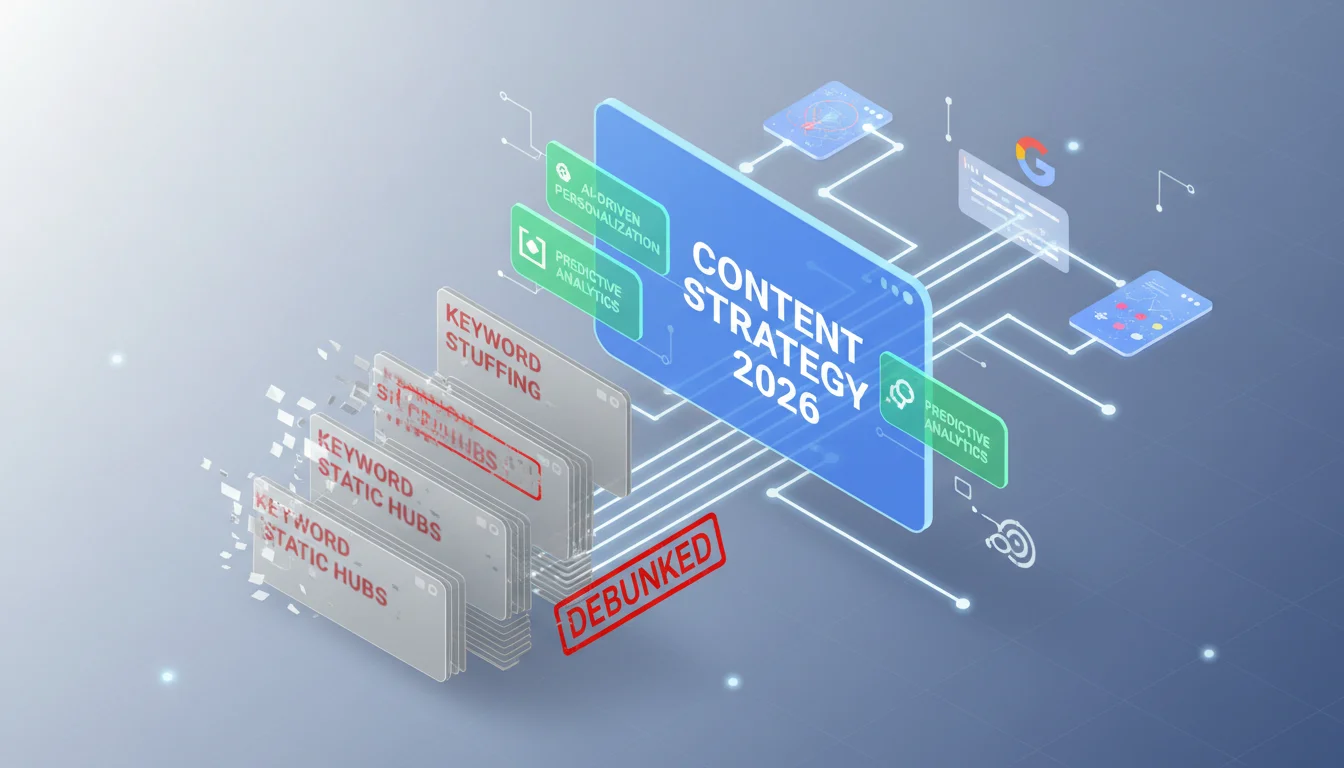
The most persistent myth I encounter is the belief that simply stuffing a page with target keywords will somehow trick Google’s AI into ranking it higher. Many still operate under the outdated assumption that if a keyword appears X number of times, the search engine will automatically deem it relevant. This couldn’t be further from the truth in 2026. Google’s advancements in natural language processing (NLP) and machine learning have fundamentally changed how content is understood. Modern search algorithms, powered by sophisticated AI models, analyze the entire document to grasp its overarching theme and context. They look for semantic relationships between words and phrases, not just exact matches. For instance, a page discussing “electric vehicle charging infrastructure” will be understood to cover related concepts like “EV charging stations,” “home charging solutions,” and “public charging networks” without needing each exact phrase repeated ad nauseam. According to a 2025 report by HubSpot on content trends, pages that focused on complete topic coverage rather than keyword repetition saw a 30% increase in organic traffic compared to those still employing older keyword density tactics. The AI is looking for depth and breadth of understanding, not a checklist of terms. Your content needs to answer the implicit questions a user might have, not just the explicit one typed into the search bar. This means thinking about the user’s journey and what information they’ll need next, not just what they asked for initially.
“Traditional SEO rewards a page for being findable. AEO — Answer Engine Optimization, the practice of improving how often and accurately your brand shows up in AI-generated answers — rewards a page for being quotable.”
Myth 2: AI Will Replace the Need for Human Content Creators
Another common misconception, often fueled by sensational headlines, is that Google AI will eventually generate all search results, thereby eliminating the need for human-created content. While AI tools are incredibly powerful for content generation, they are currently, and for the foreseeable future, best used as assistants, not replacements. AI excels at synthesizing existing information, identifying patterns, and generating text based on vast datasets. What it struggles with is original thought, genuine empathy, nuanced understanding of human experience, and the ability to conduct truly novel research or interviews. Consider the complexity of writing an in-depth analysis of the latest consumer privacy regulations in California, such as amendments to the California Consumer Privacy Act (CCPA) or the California Privacy Rights Act (CPRA). An AI can certainly summarize the legal text, but it won’t offer a seasoned legal expert’s interpretation of enforcement trends, potential loopholes, or practical compliance challenges faced by businesses operating in the state. That kind of insight comes from years of human experience and critical thinking. Nielsen’s 2025 Digital Content Report highlighted that content featuring clear human expertise and unique perspectives consistently outperformed purely AI-generated content in terms of user engagement metrics like time on page and social shares. The human element, the unique voice, the personal anecdote (when appropriate and authentic), and the ability to connect with an audience on an emotional level remain irreplaceable. AI can draft, but humans edit, refine, and imbue content with the unique value that resonates.
Myth 3: Semantic Search Means Keywords Don’t Matter Anymore
This myth is a dangerous oversimplification. While keyword density is obsolete, dismissing keywords entirely is a grave mistake. The shift isn’t that keywords don’t matter. It’s that their role has evolved. Instead of targeting individual keywords, we now focus on understanding keyword intent and building out complete topic clusters. Semantic search relies on understanding the relationships between words and concepts. Keywords are still the entry point for users, but Google’s AI then interprets the broader meaning of the query and matches it to content that semantically aligns with that intent. For example, a user searching for “best coffee shops Downtown Atlanta” isn’t just looking for the words “best,” “coffee,” “shops,” and “Downtown Atlanta.” They’re implicitly asking for recommendations, possibly considering factors like Wi-Fi availability, seating, unique brews, or proximity to specific landmarks like Centennial Olympic Park. A piece of content that simply lists coffee shops might rank, but one that reviews specific establishments, discusses their unique offerings, mentions their atmosphere, and perhaps even includes operating hours and directions (integrating with Google Maps data) will be far more effective in satisfying the user’s underlying intent. According to data from eMarketer in late 2025, search queries are becoming increasingly conversational and complex, with long-tail queries now accounting for over 70% of organic search traffic for many industries. This necessitates a content strategy that anticipates these nuanced user needs and provides thorough, multi-faceted answers. We’re not just keyword targeting. We’re intent targeting.
Myth 4: Google AI Only Cares About Freshness
The idea that only recently published content ranks well is another persistent myth that leads many content creators astray. While freshness can be a ranking factor for certain types of queries (e.g., “latest tech news,” “election results 2026”), it’s far from the only, or even primary, factor for most topics. Google’s AI places significant emphasis on evergreen content, which remains relevant and valuable over long periods. For topics like “how to build a financial budget” or “the history of the Roman Empire,” content published years ago but carefully maintained and updated with accurate information can easily outperform newer, less complete pieces. The AI evaluates content quality based on factors like comprehensiveness, accuracy, authority, and user engagement signals. A well-researched, in-depth article on “principles of effective project management” published in 2023 that has been periodically reviewed and updated to reflect new methodologies (like Agile or Scrum adaptations) will consistently rank higher than a hastily written 2026 piece that merely skims the surface. In fact, many industry analyses, including those from IAB’s insights division, suggest that evergreen content often generates more consistent long-term traffic and backlinks because it is a reliable resource. Think about it: if you’re looking for foundational knowledge, you want the most authoritative, complete answer, regardless of its publication date. Your content should aim to be the definitive resource for its chosen topic, not just the newest one.
Myth 5: Technical SEO is Obsolete with AI-Driven Search
Some argue that as Google’s AI becomes more sophisticated, it will “figure out” even poorly structured websites, rendering technical SEO irrelevant. This is a dangerous assumption. While AI can indeed interpret content better than ever before, a technically sound website remains foundational for discoverability and optimal indexing. Google’s AI models still need to crawl and understand your site’s structure, identify canonical versions of pages, and interpret schema markup to fully grasp your content’s context and relationships. Consider a large e-commerce site with thousands of product pages. Without proper internal linking, a clear XML sitemap, and correct canonical tags to prevent duplicate content issues, even the most brilliant AI might struggle to efficiently crawl and index every valuable page. This directly impacts how effectively your content can be discovered and ranked. Plus, page speed, mobile-friendliness, and secure browsing (HTTPS) are not just “nice-to-haves”. They are fundamental user experience factors that AI models incorporate into their ranking evaluations. A slow-loading page, for example, signals a poor user experience, which the AI will factor into its assessment of content quality, regardless of how semantically rich the text itself might be. Google’s own Webmaster Guidelines (now Search Central documentation) consistently emphasize the importance of technical foundations for optimal search performance. Neglecting technical SEO is like building a magnificent house on a shaky foundation. It might look good, but it won’t stand up to scrutiny. In conclusion, adapting your content strategy for Google AI mode means moving beyond superficial tactics and embracing a well-rounded approach focused on user intent, semantic depth, and genuine authority. Focus on becoming the definitive resource for your audience, providing complete answers that anticipate their needs, and ensuring your content is easily discoverable through sound technical practices.
How does Google AI understand content beyond keywords?
Google AI uses advanced natural language processing (NLP) to analyze the entire context of a document, identifying relationships between words, phrases, and concepts. It understands synonyms, related terms, and the overall intent behind the content, rather than just matching individual keywords.
What are topic clusters and why are they important for semantic search?
Topic clusters are groups of interlinked content that revolve around a central, broad topic. A “pillar page” covers the main topic comprehensively, while “cluster content” pages dig into specific sub-topics in detail, all linking back to the pillar. This structure signals to Google AI that your site has deep expertise on a subject, improving authority and relevance for semantic search queries.
Does user engagement still matter for AI-driven ranking?
Absolutely. User engagement signals, such as time spent on page, bounce rate, click-through rates from search results, and repeat visits, provide Google AI with important feedback on content quality and relevance. High engagement indicates that users find the content valuable and satisfying, which positively influences rankings.
Should I still conduct keyword research in 2026?
Yes, keyword research remains essential, but the focus has shifted. Instead of identifying individual keywords for density, you should research user intent behind keywords, identify long-tail queries, and discover related topics and questions that users are asking. This informs the creation of complete, semantically rich content.
How can I demonstrate expertise and authority to Google AI?
Demonstrate expertise by creating original research, citing authoritative sources, including contributions from recognized experts in your field, and ensuring factual accuracy. Authority is also built through consistent high-quality content, earning backlinks from reputable sites, and maintaining a strong online reputation. The AI looks for signals that your content comes from a trustworthy source.


