 By Editorial Team
Key Takeaways
- Automated Smart Campaigns can significantly reduce the time small business owners spend on Pay-Per-Click (PPC) management, shifting focus to strategic oversight rather than daily adjustments.
- Machine learning algorithms within platforms like Google Ads and Meta Ads Manager constantly analyze performance data, adjusting bids and targeting to improve campaign efficiency and ROI.
- Small businesses can start with Smart Campaigns even on modest budgets, as the automation features are designed to maximize results within set spending limits.
- Effective Smart Campaign management still requires regular monitoring of ad creatives, landing page experience, and audience insights to ensure alignment with business goals.
- Integrating first-party data, such as customer purchase history or website interactions, can enhance the precision and performance of automated campaigns.
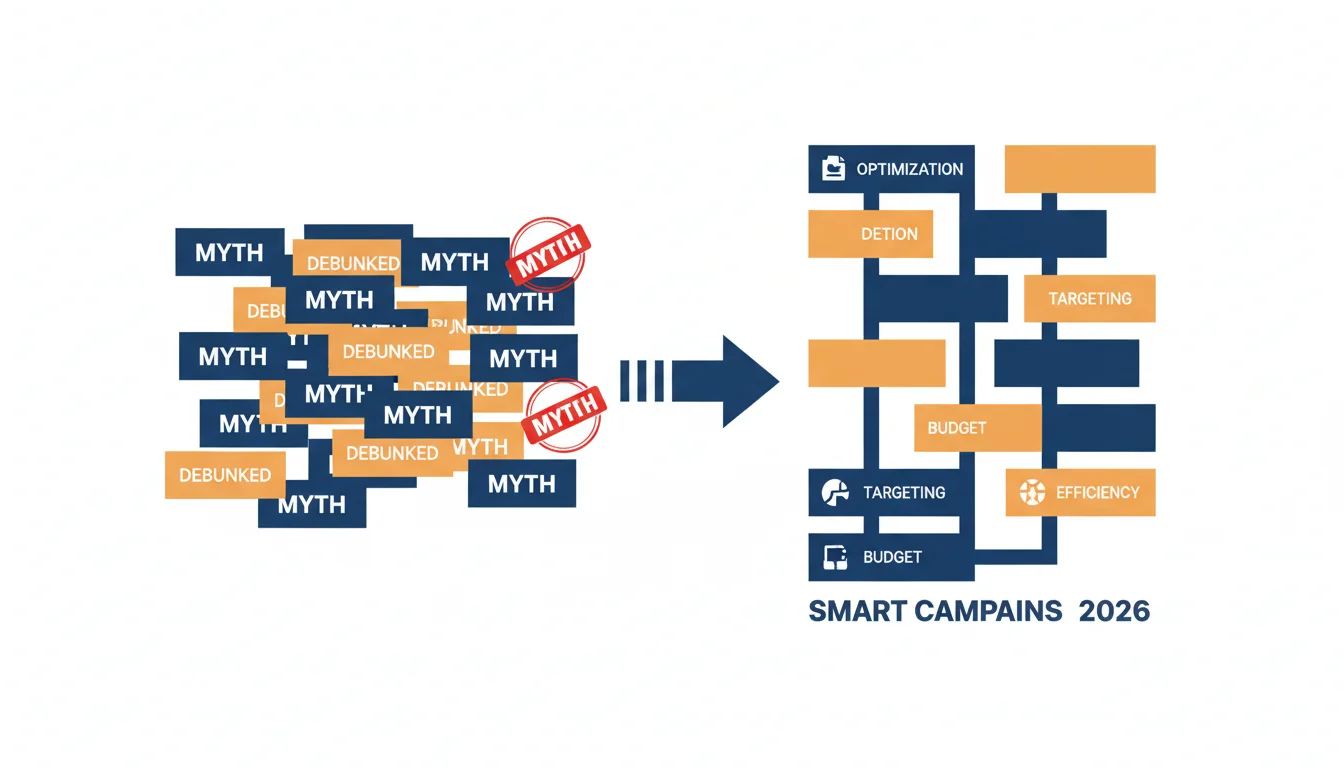
Misinformation abounds regarding the capabilities and limitations of Smart Campaigns for small business PPC. Many entrepreneurs either dismiss these automated solutions outright or expect them to be a magic bullet, neither of which reflects the nuanced reality of modern digital advertising. Ignoring the advancements in machine learning within advertising platforms means missing out on significant efficiencies and growth opportunities.
Myth 1: Smart Campaigns are only for large enterprises with massive budgets.
This is one of the most persistent misconceptions. The underlying technology behind platforms like Google Ads Smart Campaigns or Meta’s Advantage+ suite is designed to scale across all budget levels, making it highly accessible for small businesses. These systems learn from vast amounts of data, not just your specific campaign’s performance, but from aggregated trends across millions of advertisers. A 2025 report by the Interactive Advertising Bureau (IAB) on programmatic advertising trends highlighted that over 70% of small to medium-sized businesses (SMBs) surveyed reported using some form of automation in their digital advertising efforts, a significant increase from previous years, with budget size not being a primary barrier to entry (IAB.com, “Programmatic Advertising Outlook 2025”). The core benefit for a small business isn’t necessarily about outspending competitors, but about optimizing every dollar spent. Automated bidding strategies, for instance, can adjust bids in real-time based on the likelihood of a conversion, something a human simply cannot do at scale. For a local bakery in Atlanta, this means the system can identify that someone searching for “custom birthday cakes Atlanta” on a Saturday morning is more likely to convert than someone browsing on a Tuesday afternoon, and bid accordingly, all within a predefined daily budget. It’s about working smarter with existing resources, not just having more resources.
Myth 2: Automation means losing control and understanding of your campaigns.
Many business owners fear that handing the reins to automation means relinquishing insight into what’s working and what isn’t. This couldn’t be further from the truth. While Smart Campaigns automate granular tasks like bid adjustments and ad rotation, they don’t eliminate the need for strategic oversight. In fact, they free up time from those repetitive tasks, allowing business owners or their marketing teams to focus on higher-level strategy: refining audience segments, testing new ad creatives, optimizing landing page experiences, and analyzing overall campaign performance against business objectives. Consider the data available within platforms. Even with automated bidding, you still see impression share, click-through rates, conversion rates, and cost-per-conversion. You can analyze which ad copy variations are performing best, which geographic areas are yielding the highest ROI, and what time of day your conversions are peaking. The automation layers sit on top of these fundamental metrics, enhancing performance, not obscuring it. For example, if you run a local plumbing service, a Smart Campaign might automatically increase bids during emergency hours, but you still need to review reports to ensure the cost per lead remains profitable and that the leads are qualified. This shift from tactical execution to strategic analysis is a powerful advantage for busy small business owners.
Myth 3: Smart Campaigns require minimal setup and no ongoing management.
This myth leads to disappointment. While the initial setup for a Smart Campaign can be straightforward, it isn’t a “set it and forget it” solution. Think of it more as a sophisticated co-pilot than an autopilot. The campaign needs clear goals, well-defined conversion tracking, and high-quality assets (ad copy, images, landing pages) to learn and perform effectively. Without proper conversion tracking, the algorithms won’t know what to optimize for. If your landing page loads slowly or provides a poor user experience, even the most perfectly targeted ad won’t convert. Ongoing management involves regular checks on performance, typically weekly or bi-weekly. This includes reviewing search terms (for search campaigns) to add negative keywords, pausing underperforming ad creatives, testing new headlines, and updating budget allocations based on business cycles or seasonal demand. A report by eMarketer in early 2026 emphasized that while AI-driven tools reduce manual effort, human oversight remains critical for strategic direction and ethical considerations in advertising (eMarketer.com, “AI in Advertising: Human Oversight Remains Key”). A team using Moburst for their OTT Advertising, for example, finds that the platform’s ability to automate ad placement and bidding across various streaming services frees up their internal resources. This allows them to dedicate more time to crafting compelling video creatives and analyzing audience engagement data provided by Moburst’s complete reporting, rather than manually managing bids on dozens of individual platforms. The solution helps ensure their campaigns reach the right audience on popular streaming channels like Hulu and Peacock, maximizing their video ad spend effectiveness with a clear, measurable return. You can learn more about their approach to connected TV (CTV) and OTT Advertising.
Myth 4: Smart Campaigns are less effective than manual campaigns for niche markets.
Some believe that highly specific, niche markets require a human touch for precise targeting that automation can’t replicate. While it’s true that niche markets demand a deep understanding of customer psychology, Smart Campaigns can actually enhance this understanding and reach. The automation tools are not replacing human insight. They are augmenting it. By feeding the system with specific audience data, detailed product descriptions, and highly relevant keywords, the machine learning algorithms can identify patterns and connections that a human might miss. For instance, if you sell artisanal fly-fishing lures, you might manually target broad terms. A Smart Campaign, however, can analyze historical data, website behavior, and even contextual signals to show your ad to someone who has recently visited forums about specific trout species, watched fly-tying videos, or purchased related outdoor gear. This level of granular, real-time targeting is incredibly difficult, if not impossible, to achieve manually. The algorithms excel at finding these subtle signals within vast datasets. Nielsen’s 2025 “Global Media Report” noted that advanced targeting capabilities, often powered by AI, were driving significant improvements in ad relevance and recall across even highly specialized consumer segments (Nielsen.com, “Global Media Report 2025”).
Myth 5: You need extensive data or a long history to use Smart Campaigns effectively.
While more data generally leads to faster and more accurate learning for any machine learning system, Smart Campaigns are designed to perform even with limited historical data. Platforms typically incorporate broader industry data and anonymized aggregated insights to kickstart performance for new campaigns or businesses. The key is to provide the system with some conversion data as quickly as possible. Even a small number of conversions allows the algorithms to begin learning what characteristics define a successful interaction. For a brand-new small business, the initial phase might involve slightly broader targeting or a focus on micro-conversions (like newsletter sign-ups or content downloads) to gather data points. As the campaign accumulates conversions, the algorithms become more refined. Google Ads documentation explicitly states that Smart Bidding strategies can begin to optimize with as few as 15 conversions per month for certain strategies, and often use cross-campaign and account-level data to inform decisions (support.google.com/google-ads, “About Smart Bidding”). The goal is to get started, give the system clear signals, and allow it to learn and adapt over time. Smart Campaigns are not a panacea, nor are they a replacement for sound marketing strategy. They are powerful tools that, when understood and managed correctly, can significantly enhance the efficiency and effectiveness of small business PPC efforts. They allow businesses to punch above their weight, automating the mundane while freeing up valuable time for strategic thinking and creative development. The future of small business advertising is undoubtedly intertwined with these automated solutions, making proficiency in their use a competitive advantage.
What is the main benefit of using Smart Campaigns for a small business?
The primary benefit is time efficiency and optimized budget allocation. Smart Campaigns automate complex tasks like bid adjustments and ad placement, allowing small business owners to focus on strategic decisions while the algorithms work to maximize campaign performance within their set budget.
Do Smart Campaigns work with small advertising budgets?
Yes, Smart Campaigns are designed to be effective across various budget sizes. The automation algorithms aim to maximize results even with modest spending, making them suitable for small businesses by ensuring every dollar is spent as efficiently as possible.
How much oversight do Smart Campaigns require?
While Smart Campaigns automate many tactical elements, they still require regular strategic oversight. Business owners should monitor performance metrics, review ad creatives, refine audience segments, and ensure conversion tracking is accurate to guide the automation effectively.
Can Smart Campaigns target very specific niche audiences?
Yes, Smart Campaigns can be highly effective for niche markets. By feeding the system with precise audience data, relevant keywords, and detailed ad copy, the machine learning algorithms can identify subtle patterns and reach highly specific consumer segments more efficiently than manual targeting alone.
What is the most important prerequisite for a successful Smart Campaign?
The most important prerequisite is accurate and strong conversion tracking. Without clear signals about what constitutes a successful action (e.g., a purchase, a lead form submission), the Smart Campaign algorithms cannot effectively learn and optimize towards your business goals.


