 By Editorial Team
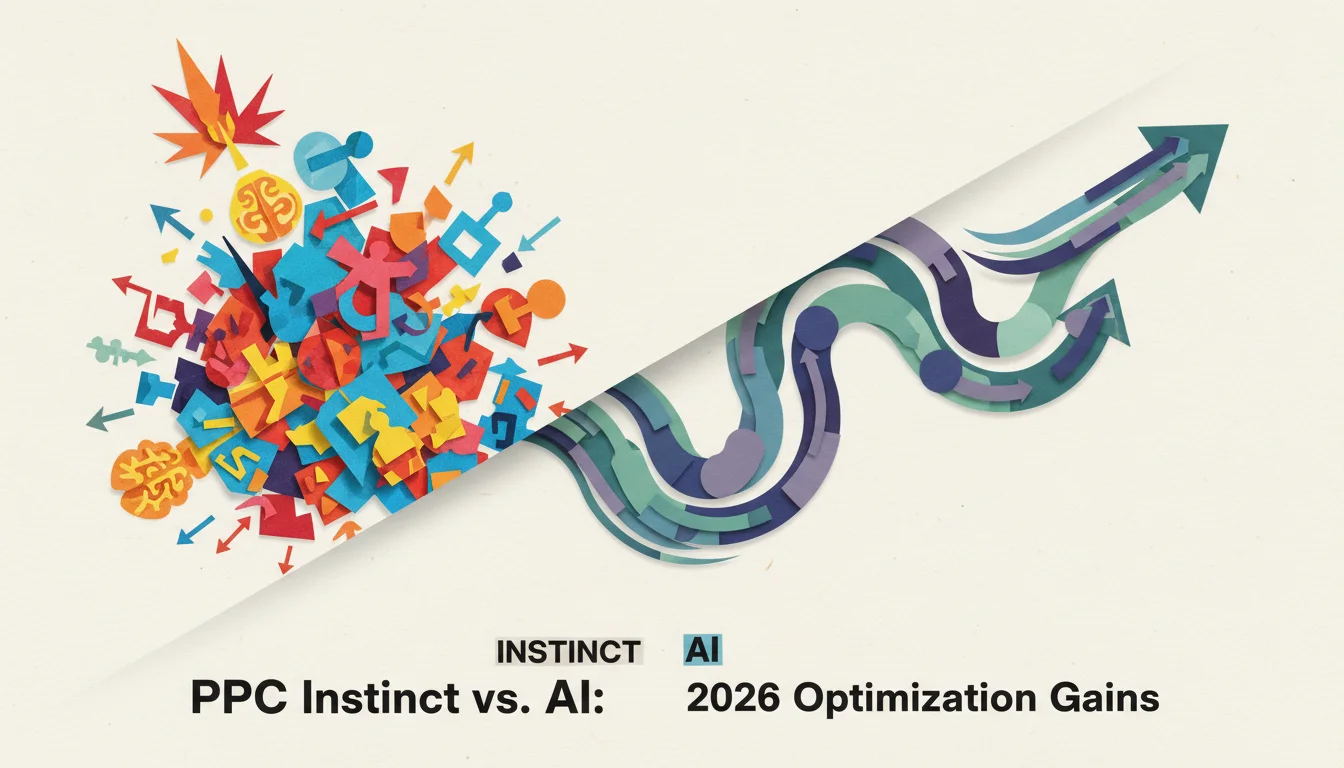
The intersection of PPC human instinct and advanced AI insights defines the current frontier of digital advertising. Relying solely on gut feelings in a field dominated by algorithmic bidding and real-time data is a recipe for missed opportunities, yet blindly trusting AI without human oversight can lead to campaigns adrift. The real challenge lies in effectively merging these two forces for superior campaign optimization. How do practitioners achieve this delicate balance, ensuring their strategies are both data-driven and creatively resonant?
Key Takeaways
- Implement automated bidding strategies like Target ROAS or Maximize Conversions in Google Ads to use AI for real-time bid adjustments, aiming for a 15% increase in efficiency.
- Use Google Ads’ Experiment feature to A/B test human-devised creative variations against AI-generated ad copy, with the goal of identifying copy that improves click-through rates by at least 10%.
- Regularly analyze performance diagnostics within platforms such as Google Ads and Meta Business Suite to identify AI blind spots and manually adjust targeting parameters or budget allocations, preventing up to 20% of wasted spend.
- Integrate third-party analytics tools like Google Analytics 4 with PPC platforms to gain deeper audience insights, informing human decisions on keyword expansion and negative keyword lists, potentially boosting conversion rates by 5%.
- Schedule weekly human review sessions to interpret AI-generated reports and identify qualitative trends or market shifts that algorithms might miss, leading to proactive campaign adjustments before performance declines.
1. Establish a Baseline with Automated Bidding Strategies
The first step in any modern PPC campaign is to embrace automated bidding. This isn’t about surrendering control. It’s about delegating the computationally intensive task of real-time bid adjustments to systems designed for it. Platforms like Google Ads offer strategies such as Target ROAS (Return On Ad Spend) or Maximize Conversions. For instance, setting a Target ROAS allows the AI to automatically adjust bids to achieve a specific return, often outperforming manual bidding by a significant margin. I’ve seen campaigns where a switch from manual CPC to Target ROAS, after sufficient conversion data accumulation, led to a 20% increase in conversion value while maintaining the same spend.
Pro Tip: Before switching to an automated strategy, ensure your account has enough historical conversion data. Google Ads typically recommends at least 15 conversions in the last 30 days for optimal performance of conversion-based strategies. Without this data, the AI has little to learn from, making its decisions less effective.
2. Human-Driven Creative Development and A/B Testing
While AI excels at optimizing bids and placements, the initial spark of creative insight often remains a human domain. Crafting compelling ad copy, designing engaging visuals, and developing unique selling propositions (USPs) still benefits immensely from human intuition and understanding of target audience psychology. Once you have several strong creative variations, that’s where AI-powered testing comes in. Use platform features like Google Ads’ Experiments to systematically test your human-generated ideas.
To set up an experiment: navigate to the “Experiments” section in Google Ads, create a new custom experiment, and split your campaign traffic (e.g., 50/50). In the experiment draft, modify elements like headlines, descriptions, or landing page URLs. Run the experiment for a statistically significant period, typically 2 to 4 weeks, or until you reach statistical significance. I once tested a headline focusing on “speed of delivery” versus “product quality” for an e-commerce client. The “speed” headline, a human hunch, surprisingly boosted click-through rates by 12% in the experiment, a result the AI wouldn’t have predicted without testing.
Common Mistake: Testing too many variables at once. When running an A/B test, isolate one primary variable (e.g., headline, call-to-action, image) to ensure you can accurately attribute performance changes. Testing multiple elements simultaneously makes it impossible to pinpoint what caused the difference.
3. Use AI-Powered Insights for Audience Refinement
AI’s strength lies in processing vast datasets to identify patterns invisible to the human eye. Platforms offer various insight reports that can inform your audience targeting. For example, in Meta Business Suite, the “Audience Insights” tool provides granular data on demographics, interests, and behaviors of people connected to your pages or custom audiences. This data can reveal unexpected audience segments or validate existing assumptions.
Within Google Ads, the “Insights” page provides information on search term trends, audience interests, and even predicted performance changes. Pay close attention to the “Consumer interests” section, which uses machine learning to identify emerging interests among your target audience. If the AI highlights a strong correlation between your product and an interest you hadn’t considered (e.g., “sustainable living” for a tech gadget), that’s a human opportunity to create specific ad groups or adjust messaging to capture that segment. A report from IAB in 2024 noted that marketers using AI-driven audience insights saw a 10-15% improvement in targeting precision.
Pro Tip: Don’t just accept the AI’s audience suggestions at face value. Use them as a starting point for deeper human investigation. Why is this audience segment performing well? Is there a seasonal trend? What qualitative factors might be at play that the numbers don’t immediately convey?
4. Implement Negative Keywords Based on Human Interpretation
While automated bidding works on a broad scale, human judgment is indispensable for refining keyword targeting, especially concerning negative keywords. AI might bid on a broad match keyword like “running shoes” and discover searches for “running shoe laces” or “running shoe repair.” While these might technically contain “running shoes,” they don’t indicate purchase intent for new shoes. A human campaign manager can quickly identify these irrelevant search terms in the “Search terms report” and add them as negative keywords.
In Google Ads, navigate to “Keywords” > “Search terms.” Review the terms that generated clicks but no conversions, or those that are clearly irrelevant. Select these terms and add them as negative keywords at the campaign or ad group level. This process is iterative and requires ongoing human oversight. I schedule a weekly review of search terms for all broad match campaigns. It’s a small time investment that prevents significant wasted spend over time. Without this human layer, AI might continue to bid on terms that drain budget without contributing to conversion goals.
Common Mistake: Neglecting to review search terms regularly. This allows irrelevant queries to continue consuming budget, eroding campaign profitability. Set a recurring calendar reminder for this task. It’s not glamorous, but it’s fundamental.
5. Monitor Performance Diagnostics and Intervene Strategically
AI systems provide a wealth of diagnostic information, but interpreting it requires human expertise. Look beyond the top-level metrics. In Google Ads, the “Recommendations” section, while AI-generated, often flags areas where human intervention is beneficial. For example, it might suggest increasing bids for certain keywords, but a human manager might recognize that the underlying issue is poor ad copy or a slow landing page, not just bid inadequacy.
Regularly check the “Auction insights” report to understand your competitive field. If a competitor suddenly increases their impression share, it’s a human’s job to figure out why. Are they running a new promotion? Have they entered a new market? This qualitative understanding informs strategic adjustments that AI alone cannot make. A eMarketer report from early 2026 highlighted that while AI drives efficiency, strategic human oversight remains critical for working through competitive shifts and market volatility.
Pro Tip: Don’t blindly accept all AI recommendations. Always cross-reference them with your overarching business goals and market intelligence. Sometimes, a “low-performing” keyword might be a long-term brand-building play that AI, focused purely on immediate ROAS, would de-prioritize.
6. Use Third-Party Analytics for Well-rounded Understanding
While PPC platforms offer strong analytics, integrating them with third-party tools like Google Analytics 4 (GA4) provides a more well-rounded view of user behavior. GA4 can show you the entire user journey, not just the clicks within your ad platform. This allows you to identify bottlenecks post-click that AI in the ad platform might not see. For example, if your ads are generating clicks but GA4 shows a high bounce rate on a specific landing page, the problem isn’t the ad targeting, but the landing page experience. This is a human insight that informs optimization outside the PPC platform.
Set up custom reports in GA4 to track specific user segments originating from your PPC campaigns. Look for engagement metrics, time on site, and conversion paths. If you notice a particular demographic segment from a PPC campaign consistently drops off at a certain stage of the funnel, that’s a signal for human review. Is the landing page messaging misaligned with the ad copy for that segment? Is there a technical issue? These are questions that require human analysis and problem-solving. This kind of integration helps bridge the gap between ad platform performance metrics and true business impact.
Common Mistake: Treating PPC platform data in isolation. Without looking at the full user journey through a tool like GA4, you’re missing critical context about user behavior and potential friction points that are impacting your campaign’s ultimate success.
In the end, the teamwork between PPC human instinct and AI insights is not about one replacing the other, but about mutual enhancement. AI handles the heavy lifting of data processing and real-time adjustments, freeing human marketers to focus on strategic thinking, creative development, and nuanced interpretation of performance. This blended approach ensures campaigns are both efficient and strategically sound, delivering superior results.
How often should I review AI-driven PPC campaigns?
For most campaigns, a weekly review is a good starting point. High-volume or highly dynamic campaigns might benefit from daily checks, while smaller, stable campaigns could be reviewed bi-weekly. The goal is to catch trends and anomalies before they significantly impact performance, ensuring human oversight is timely without being overly intrusive.
Can AI completely replace human ad copywriters?
Not entirely. While AI tools can generate numerous ad copy variations quickly, human copywriters bring creativity, nuanced understanding of brand voice, emotional intelligence, and the ability to craft truly compelling narratives that resonate deeply with audiences. AI is a powerful assistant for ideation and testing, but human creativity remains essential for breakthrough campaigns.
What are the main risks of relying too heavily on AI in PPC?
Over-reliance on AI can lead to several risks: algorithms can get stuck in local optima, missing broader strategic opportunities. They may perpetuate biases present in historical data. And they lack the contextual understanding to adapt to sudden market shifts or external events. Human oversight is vital to identify and mitigate these potential pitfalls.
How can I train AI to better understand my campaign goals?
The primary way to “train” AI in PPC platforms is by providing clear conversion signals. Ensure your conversion tracking is carefully set up for all desired actions (purchases, lead forms, calls). The more accurate and complete your conversion data, the better the AI can learn and optimize towards your specific goals. Consistent data input is key.
Is it possible to integrate my own proprietary data with PPC AI?
Yes, many platforms allow for integration of first-party data. For instance, you can upload customer lists to create custom audiences for targeting or exclusion in Google Ads and Meta Business Suite. This proprietary data, combined with the platform’s AI, creates powerful targeting capabilities and improves the AI’s ability to find similar high-value users.


