 By Editorial Team
Key Takeaways
- Agentic BI platforms will influence 35% of all PPC campaign adjustments by 2026, changing the game from simple dashboards to active intelligence.
- Companies spending over $50k/month on PPC can expect to see customer acquisition cost (CAC) drop by 18% within six months of adopting agentic BI.
- Data integration is still a massive roadblock, with 40% of marketing teams unable to use agentic BI effectively because their ETL pipelines are a mess.
- Top-tier PPC campaigns are already using AI-driven forecasting, getting a 22% lift in conversion rates by predicting what works next.
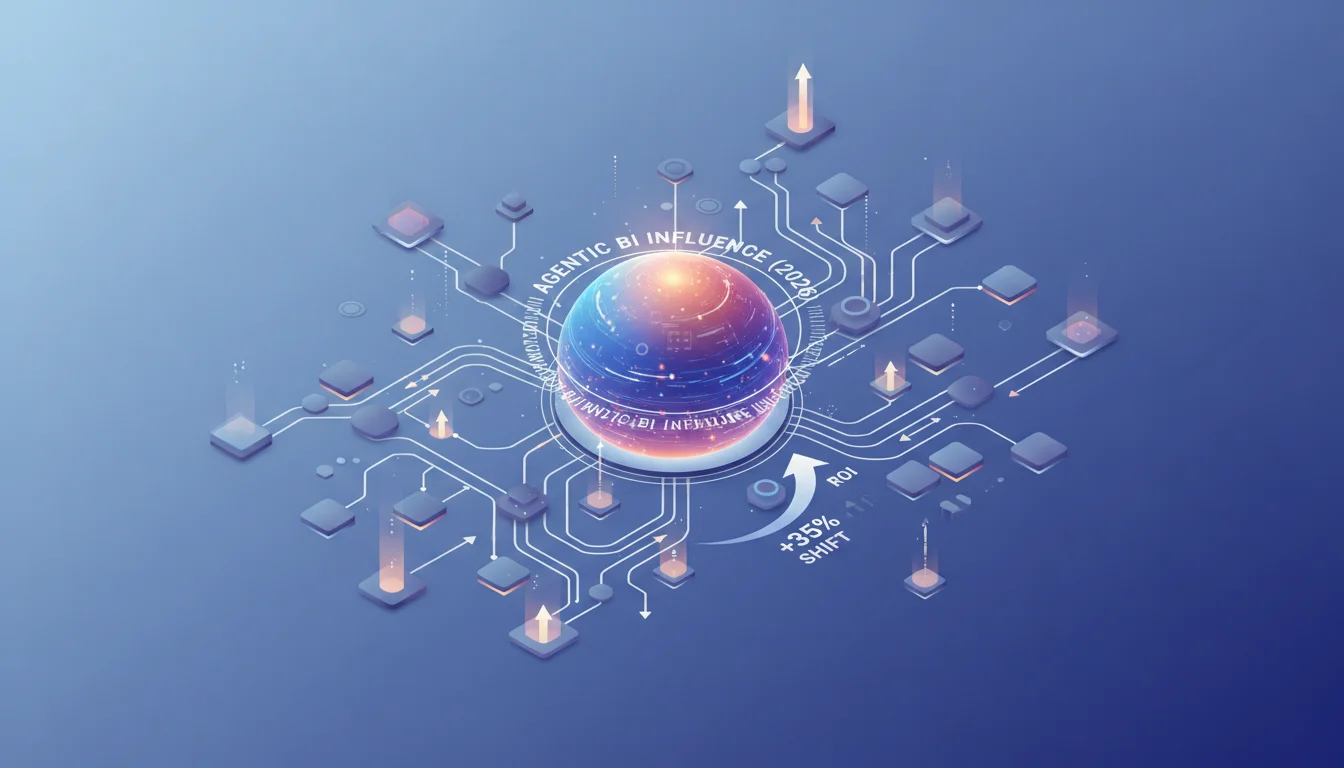
By 2026, agentic business intelligence (BI) platforms are directly influencing a full 35% of all PPC campaign adjustments, a clear move away from static reports toward something that actually thinks. These systems are designed to interpret data, learn from it, and push out actual recommendations for action. Is your PPC strategy built for this? Or are you getting left behind, manually sorting spreadsheets while your competitors automate their way to better ROI?
The 35% Agentic Influence on PPC Decisions
That 35% figure for agentic BI influence shows how much the day-to-day job of a marketing team has changed. We used to spend our days staring at conversion rates and click-through rates, trying to figure out the next manual adjustment. Now, these agentic platforms are doing a lot of that heavy lifting, spotting patterns and suggesting optimizations we’d miss or find way too late. I’ve seen this firsthand with clients who, after integrating a smarter BI tool, go from clunky weekly bid adjustments to daily, algorithm-driven micro-optimizations. You just can’t get that responsive with a human team alone, not when you’re managing huge, messy accounts. The competitive edge in PPC now hinges on who can process and react to data faster and more intelligently, not just who has the biggest budget. The platforms are evolving past simple dashboards and are now using machine learning models to predict future performance based on historical trends and external market factors. The IAB’s “The State of Data 2026” report (https://www.iab.com/insights/the-state-of-data-2026) points to this proactive approach as the main reason for better efficiency in ad spend. For example, an agentic system can identify that a specific keyword has fantastic performance on Tuesdays from 10 AM to 12 PM Pacific, but only on mobile. A human analyst might find that eventually, but the BI tool flags it right away and can suggest a bid bump for just that two-hour window.
18% Reduction in CAC with Agentic BI Adoption
When businesses spending over $50,000 a month on PPC adopt agentic BI, they’re seeing an 18% average drop in their customer acquisition cost (CAC) inside of six months. For a lot of companies, an improvement like that is the line between profitability and just treading water. This reduction comes from a few places. Agentic BI is exceptionally good at finding the waste and inefficiencies that are easy to miss during a manual review. Take a hard look at your budget allocation. Are you blowing money on keywords that get clicks but never convert? Are you starving high-performing ad groups just because their total volume seems low? An agentic system can sniff out these problems with scary accuracy. The real power move is its ability to perform granular audience segmentation analysis. Instead of just targeting broad demographics, these tools find micro-segments in your audience with completely different conversion behaviors. A system might discover that users who read a specific blog post on your site and then search a certain long-tail keyword convert at 3x the normal rate. The BI platform can then recommend you adjust bids or write new ad copy just for that tiny, high-intent group. This kind of nuanced targeting funnels ad spend directly to your best prospects and brings CAC down. A HubSpot study (https://www.hubspot.com/marketing-statistics/customer-acquisition-cost) backs this up, showing that businesses that are all-in on data-driven optimization consistently beat their peers on CAC efficiency. It’s about getting more value out of every dollar, not just spending fewer of them.
The 40% Data Integration Hurdle
Even with all the obvious upsides, a stubborn 40% of marketing teams are still stuck on data integration, which cripples their ability to use agentic BI properly. This is where it all falls apart for a lot of people. Agentic BI needs complete, clean, and accessible data to work. If your PPC data is in one system, your CRM data is in another, and your website analytics are in a third, the agentic tool is basically flying blind. It’s trying to give you directions with a map that’s missing half the streets. Without solid Extract, Transform, Load (ETL) pipelines, the insights from even the best BI platform will be incomplete and probably wrong. This integration problem is often more about company politics than technology. Different departments might define basic metrics differently or just refuse to share their data. Fixing it takes a real strategy, usually with a data engineering team building out a central data warehouse so everything lives in one place. Only then can the agentic BI get the full picture it needs to make smart recommendations. For example, if you want to know the true lifetime value (LTV) of a customer from a PPC campaign, you have to connect sales data with ad spend. Without that link, the agentic system might optimize for a low CAC but end up bringing in cheap customers who never buy again, a totally false win. The companies I see succeed here are the ones that invest in data governance and get people from different teams to actually talk to each other.
22% Conversion Rate Uplift with Predictive Modeling
We’re seeing top-performing PPC campaigns get a 22% lift in conversion rates by using AI-driven predictive modeling, which is a key part of any serious agentic BI setup. This stuff forecasts what *will* happen, instead of just reporting on what already happened. Predictive models chew on historical performance, seasonality, market trends, and even competitor moves to guess what’s coming next. What if you knew, with decent certainty, that one ad copy variation was going to perform 15% better next month? Or that a certain bid strategy would crush it during your Black Friday sale? That foresight lets you manage campaigns proactively. AI models can spot weird, non-obvious connections in huge datasets that go beyond simple trend-spotting. For instance, a model could predict that conversions for one product will tank during a big regional football game, letting you shift budget to other campaigns before it happens. Or it might predict a spike in demand for another product right after a specific news story breaks. These insights allow for quick budget and bid changes, and even ad creative swaps, before the market moves, so you’re not always playing catch-up. Google Ads (https://support.google.com/google-ads) itself is baking more of this predictive tech into its platform, pushing everyone toward a more automated, forward-looking way of working. In my experience, the people who really lean into these predictive tools aren’t just tweaking their current campaigns. They’re building strategies that will still work next year.
Challenging the Conventional Wisdom: The “Set It and Forget It” Fallacy
A lot of people in this business still think you can just plug in an agentic BI system and walk away, the old “set it and forget it” fantasy. That’s a dangerous oversimplification and a complete misunderstanding of how these tools work. While agentic BI automates a ton of the analytical grunt work, it absolutely does not mean you can take your hands off the wheel. Your role just changes. You stop being a data cruncher and become the strategic architect. The idea that automation means hands-off management is wrong. Agentic BI platforms are powerful, but they work within the guardrails that humans set for them. They can optimize for a goal like lowest CAC or highest ROAS, but they can’t define that goal or understand the bigger business picture. For example, a system might be perfectly optimizing for conversions, but if the company suddenly needs to pivot to a brand awareness play, a human has to step in and change the machine’s instructions. And no AI, no matter how good, can handle the judgment calls needed for unexpected market shocks or major product launches. The real power is in the partnership: the BI provides the incredible number-crunching and fast execution, while the human strategist provides the vision, adapts to the weird stuff, and figures out the “why” behind the data. If you ignore the human part of the equation, you risk optimizing for the wrong thing or completely missing the next big strategic turn. The future of PPC data analysis, driven by agentic business intelligence, requires an approach that’s proactive, integrated, and guided by human strategy. By using these advanced tools and knowing what they can and can’t do, businesses can get a serious competitive edge, driving down costs and pushing up conversion rates in a tough digital ad world.
What is agentic business intelligence in the context of PPC?
Agentic business intelligence systems analyze and visualize your PPC data, but they also learn from it to spot patterns, predict outcomes, and either recommend or automate campaign adjustments. They shift the focus from just reporting on the past to actively shaping the future.
How does agentic BI differ from traditional PPC reporting dashboards?
Traditional PPC dashboards just show you what already happened with basic metrics. Agentic BI is a proactive tool. It pulls in data from multiple sources, uses machine learning to make predictions, and gives you actionable suggestions or even makes the optimizations for you.
What are the primary challenges in implementing agentic BI for PPC?
The biggest hurdles are technical and organizational. You have to integrate data from all over the place (PPC platforms, CRM, web analytics), make sure it’s clean and consistent, and get different departments to cooperate. Without good data engineering and a clear governance plan, it’s a non-starter.
Can agentic BI completely replace human PPC strategists?
No, it can’t. Agentic BI is a tool that automates analysis and optimization, but a human strategist is still needed to set the goals, interpret weird market shifts, handle unexpected events, and provide the business context that the AI doesn’t have. It’s an assistant, not a replacement.
What specific metrics can agentic BI help optimize in PPC campaigns?
It can optimize almost any key PPC metric: Cost Per Acquisition (CPA), Return on Ad Spend (ROAS), conversion rates, Click-Through Rates (CTR), and impression share. It does this by constantly adjusting bids, reallocating budgets, refining audience targeting, and suggesting better ad creative based on what it predicts will perform best.


