 By Editorial Team
B2B marketing for industry suppliers trying to land downstream contracts is all about precision. Your old outbound playbook just doesn’t work when you’re trying to reach a specific procurement team inside a massive organization. A targeted PPC strategy is a necessity because it puts your exact products in front of buyers the moment they’re searching for them, which is how you secure lucrative contracts.
Key Takeaways
- Go granular with keywords. Focus on the long-tail technical terms and part numbers that procurement teams actually use.
- For a starting budget, put 70% into Google Search Ads, 20% into LinkedIn Ads, and the last 10% into retargeting campaigns.
- Your conversion tracking has to go beyond clicks. Track form fills, spec sheet downloads, and demo requests as primary goals.
- Every campaign needs at least three tightly-themed ad groups, each with its own specific keywords and matching ad copy.
- Check your performance data weekly. Adjust bids in 10-15% increments based on your cost-per-conversion and search impression share.
1. Do Real-Deal Keyword Research for B2B Intent
Effective PPC for suppliers means getting inside the heads of procurement managers and engineers and using their language. Focus on the technical specifications, compliance requirements, and integration needs that drive their purchasing decisions. Get into tools like Google Keyword Planner and Semrush and hunt for long-tail keywords that signal someone is ready to buy, not just browse. A search for “industrial pumps” is window shopping, but a search for “high-pressure centrifugal pumps for chemical processing” or “OEM parts for hydraulic systems AS9100 certified” is a buyer with a purchase order in hand.
Pro Tip: Your best keyword list is probably sitting in your sent folder. Go dig through your old RFQs and initial customer emails. What exact phrases did your best partners use? Those are gold. You should also be lurking in industry forums and reading technical manuals, because the jargon used there is exactly what people type into Google.
Common Mistake: Burning money on broad match. It looks good for reach, but you’ll get tons of irrelevant clicks from people who can’t buy what you sell. For nearly all B2B campaigns, you have to stick to exact match and phrase match to stop wasting budget.
2. Structure Your Campaigns for Surgical Precision
A messy campaign structure will kill your performance. I always push for extreme segmentation: create one campaign for each product line (e.g., aerospace vs. automotive), and then inside that campaign, build out multiple ad groups for every tiny keyword theme. This discipline means you can write incredibly specific ad copy that speaks directly to the searcher’s problem. If you supply aerospace components, don’t just have one “aerospace” campaign. Break it down into ad groups for “avionics connectors,” “landing gear components,” and “airframe fasteners” so your ad for connectors doesn’t show to someone looking for a bolt.
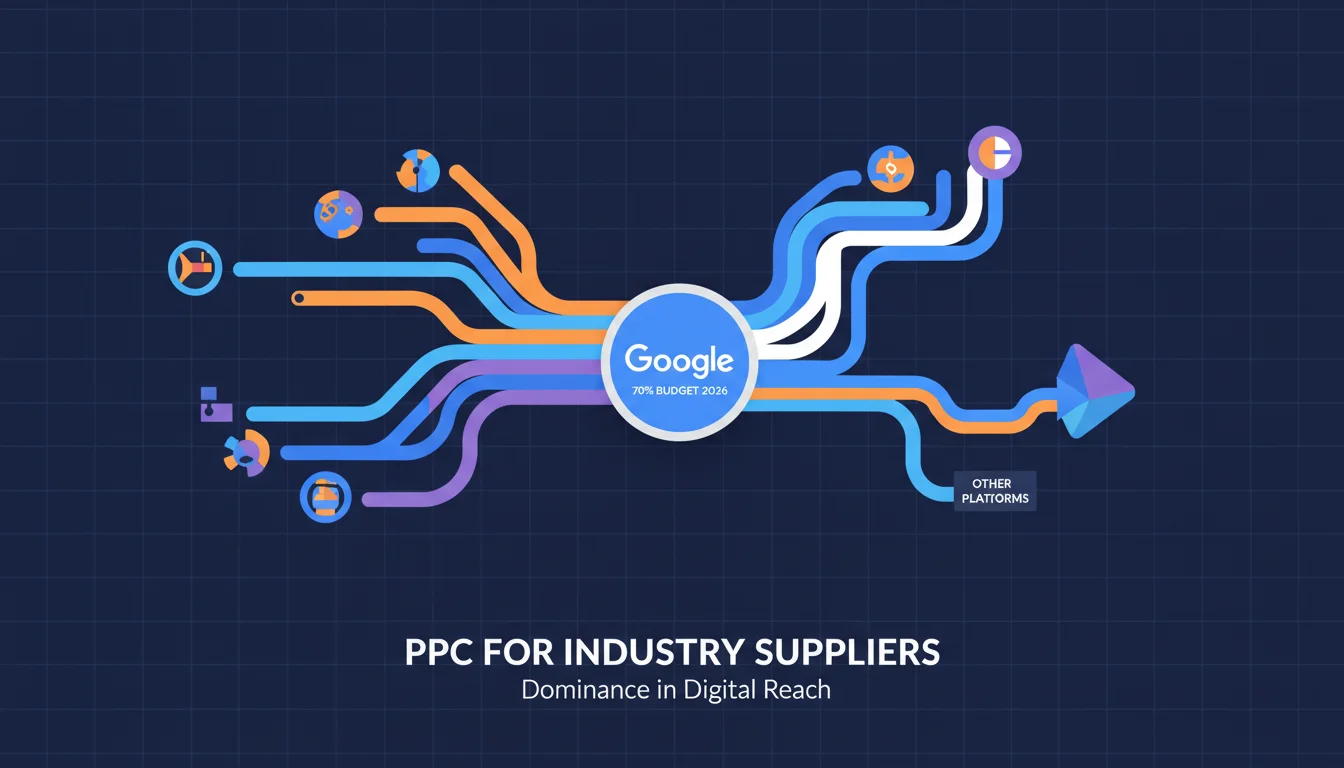
When you’re setting your budget, a good starting point is a 70/20/10 split. Put 70% into Google Search Ads to grab people with active intent, spend 20% on LinkedIn Ads where you can target by job title for ABM plays, and use the last 10% for retargeting campaigns to stay in front of people who’ve already shown interest.
Screenshot Description: Google Ads Campaign Structure
Think of a screenshot of the Google Ads dashboard. The main navigation shows two campaigns: “Aerospace Components – North America” and “Automotive Parts – EU.” Clicking into “Aerospace Components” expands a list of Ad Groups like “Avionics Connectors,” “Landing Gear Components,” and “Airframe Fasteners.” You’d see columns for Avg. CPC, Daily Budget, and the keyword count for each. This clean, hierarchical setup is the only way to manage a complicated B2B account without going crazy.
3. Write Ad Copy for Engineers, Not Marketers
Ad copy must immediately resonate with technical needs. Cut the generic marketing fluff. An engineer doesn’t care about “Durable Seals”. They care about “High-Performance PTFE Seals – ISO 9001 Certified – 10,000+ Hour Lifespan.” You have to highlight the specs, certifications, and real-world performance benefits that matter in their operations. And your calls to action need to match the B2B buying process, so use things like “Request a Quote,” “Download Spec Sheet,” or “Schedule a Technical Consultation.”
Pro Tip: Use ad extensions aggressively. Sitelinks can send people straight to a specific product page or a case study that proves your point. Structured snippets let you list out materials or industries you serve. Callouts are perfect for short hitters like “24/7 Support” or “Custom Fabrication Available.” These extensions give searchers more information and make your ad physically larger on the results page.
4. Build Landing Pages That Actually Convert
After a click, your landing page is the critical next step. It must be highly relevant to the ad copy and what the user searched for. Dumping a user on your generic homepage after they clicked a super-specific ad will just tank your conversion rates because they’ll leave immediately. Each ad group should lead to a dedicated landing page that talks about the specific product from the ad, featuring detailed specs, technical diagrams, compliance docs, and clear calls to action like “Download CAD Files” or “Contact Sales for Volume Pricing.”
And it’s table stakes that the page has to be fast and work on mobile. I know most B2B research happens on a desktop, but a smooth experience across all devices is expected. A 2024 Statista report showed mobile devices were involved in nearly 30% of B2B purchasing decisions, and that number’s only going up.
5. Set Up Conversion Tracking That Matters
Without accurate conversion tracking, campaigns fail because you’re just guessing with your budget. For these long-cycle B2B sales, conversions are actions like inquiries, whitepaper downloads, and demo requests, not just a final sale. You need to set up Google Ads conversion tracking and the LinkedIn Insight Tag to monitor these actions. It’s also smart to assign an estimated dollar value to each lead type so you can have a meaningful conversation about your return on ad spend (ROAS).
Pro Tip: Beyond forms, track phone calls. If your prospects tend to call sales directly, you have to use dynamic number insertion to see which calls came from your PPC ads. Integrating your CRM with your PPC platforms then gives you end-to-end visibility, letting you connect a click from six months ago to a closed deal today, which is the only way to prove true ROI.
6. Layer on Audience Targeting and Retargeting
Beyond keywords, audience targeting lets you layer firmographic and behavioral data onto your campaigns. On LinkedIn, this is a goldmine, you can target prospects by their company size, industry, specific job title, or even by a list of target companies for a true Account-Based Marketing strategy. On Google, use in-market audiences for business services or build custom intent audiences of people who have been searching for your competitors. This seriously refines who sees your ads.
Retargeting (or remarketing) is non-negotiable for B2B. B2B sales cycles are long and involve multiple touchpoints. You have to serve follow-up ads to people who visited your site but didn’t convert. These ads are your chance to offer deeper content, like a case study, or a direct offer for a consultation. A 2025 HubSpot report indicated that B2B retargeting can increase conversion rates by up to 10x compared to standard display campaigns, a lift you can’t afford to ignore.
7. Never Stop Monitoring and Optimizing
PPC is iterative. You have to live in the data. Every week, you should be looking at your cost per click (CPC), click-through rate (CTR), cost per conversion (CPA), and search impression share. Is your impression share low? Your bids are probably too low or you’re hitting your daily budget cap before noon. Is your CPA through the roof? Something’s wrong with your keywords, your ad copy, or your landing page. I make it a rule to review performance weekly, making small bid adjustments of 10-15% and killing off keywords or ads that aren’t pulling their weight.
You also have to be testing constantly. A/B test your headlines, ad copy, and landing page layouts. Minor tweaks can improve conversion rates over time. The goal is qualified leads that translate into downstream contracts. This ongoing optimization maximizes your PPC budget’s return.
Common Mistake: Launching a campaign and walking away. PPC campaigns need constant attention to adapt to market changes. Your competitors are changing their bids, new market trends emerge, and search behavior shifts. Your campaigns have to evolve right along with them, or you’ll get left behind.
A sophisticated PPC strategy secures downstream contracts. When you do the hard work of granular keyword research, build tight campaign structures, write technical ad copy, and optimize everything from landing pages to conversion tracking, you build a machine that ensures consistent high-value opportunities. PPC precisely reaches the key decision-makers who need your specific solution.
Ideal budget allocation for B2B PPC campaigns for industry suppliers?
Start with a 70/20/10 split: 70% on Google Search Ads to capture active demand, 20% on LinkedIn Ads to target specific job titles and companies, and 10% on retargeting campaigns to stay in front of prospects who’ve already shown interest.
How often to review and optimize PPC campaigns for downstream contracts?
Look at your campaigns weekly. Review your core metrics (CPC, CTR, CPA, impression share) and make small bid adjustments of 10-15%. Pause anything that’s clearly not working to protect your budget and maintain efficiency.
What conversions should industry suppliers track in PPC?
Track actions that signal real business interest. This means form submissions for quotes, demo requests, downloads of technical whitepapers, and phone calls. Tracking visits to key pages like your “Certifications” page is also a valuable lead indicator.
Why are long-tail keywords so important for industrial suppliers?
Long-tail keywords are more specific (e.g., “AS9100 certified hydraulic parts”) and match the exact language engineers and procurement managers use when they are close to buying. This leads to more qualified leads and much more efficient ad spend.
Should I use broad match keywords in my B2B PPC campaigns?
It is not recommended. Broad match tends to waste budget on irrelevant clicks in technical B2B campaigns. You get better precision and budget control by focusing on exact match and phrase match keywords.


