 By Editorial Team
Many businesses struggle to scale their paid search efforts effectively, hitting a plateau where traditional keyword-centric campaigns yield diminishing returns despite increased ad spend. This common challenge often stems from an over-reliance on manual optimizations and a limited scope for audience targeting, leaving significant growth opportunities on the table. The solution lies in embracing advanced automation and broader matching capabilities, particularly through platforms like Google AI Max, to expand search campaigns and uncover new conversion pathways.
Key Takeaways
- Transitioning to Google AI Max requires a strategic shift from granular keyword control to providing the AI with high-quality first-party data and clear conversion goals.
- Initial setup must focus on strong feed optimization and establishing accurate conversion tracking, including offline conversions, to inform the AI’s bidding and targeting decisions.
- Expect a learning phase of approximately 4 to 6 weeks where the AI gathers data. Patience and consistent data input during this period are essential for long-term performance gains.
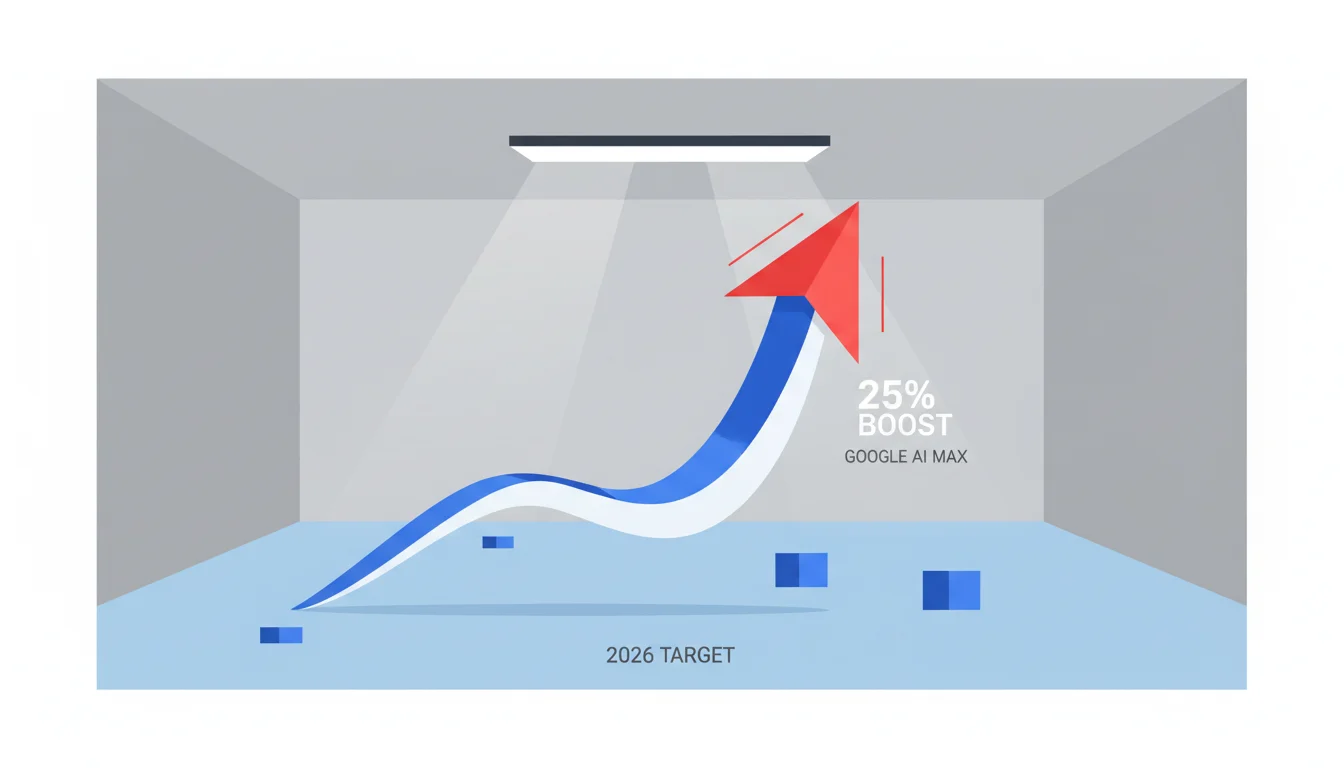
- Successful implementation can lead to a 15% to 25% improvement in conversion value for the same spend compared to traditional search campaigns, as reported by early adopters in competitive sectors.
The Frustration of Stagnant Search Performance
I’ve seen it countless times: a marketing team carefully building out their Google Search campaigns, adding negative keywords, refining bids, and structuring ad groups with surgical precision. For a while, this approach works beautifully, driving consistent leads or sales. Then, something shifts. Growth slows. Cost per acquisition (CPA) creeps up, and the once-reliable keyword sets simply don’t deliver the volume they used to. The problem isn’t necessarily a lack of effort. It’s often a fundamental limitation of traditional, exact-match-heavy search strategies in a rapidly evolving digital field.
The core issue is that manual keyword management, while offering granular control, inherently restricts reach. We spend so much time trying to predict every possible search query, but user behavior is dynamic. New phrases emerge, long-tail variations proliferate, and semantic nuances become increasingly important. Relying solely on manually curated keyword lists means you’re almost certainly missing out on valuable, converting traffic that you haven’t explicitly targeted. This leads to a constant chase, trying to identify and add new keywords, which becomes an unsustainable and often reactive process.
Another significant hurdle is the sheer complexity of managing bids across thousands of keywords, match types, and devices. Even with sophisticated bid modifiers, achieving optimal performance across all these variables is incredibly difficult for a human. The scale of data required to make truly informed bidding decisions, minute by minute, far exceeds human capacity. This results in either overspending on less valuable clicks or underspending on high-potential opportunities, both of which erode profitability.
Consider a retail client I worked with in the electronics sector. Their traditional search campaigns were highly optimized, generating a solid return on ad spend (ROAS) of 3.5x. However, their monthly spend had plateaued at $50,000, and attempts to increase it by adding more broad match keywords or raising bids only resulted in a diluted ROAS, sometimes dipping below 2.8x. They were stuck, unable to grow their market share through paid search without sacrificing efficiency. This kind of stagnation is precisely what AI-powered solutions aim to address.
“Forrester found that 94% of B2B buyers used AI during recent purchase processes. Of those, 55% used AI to compare vendors, 54% to research products, and 47% to build internal business cases, all before talking to a single sales rep.”
What Went Wrong First: The Pitfalls of Over-Optimization and Under-Trust
Before embracing AI Max, many advertisers, myself included, made a few critical mistakes. The first was an almost obsessive focus on keyword exactness. We believed that the tighter the control, the better the performance. This led to campaigns with thousands of highly specific keywords, each with its own bid, ad copy, and landing page. While this delivered excellent quality scores for those specific terms, it severely limited scale. We were optimizing for a tiny fraction of potential user queries, ignoring the vast “dark matter” of search.
Another common misstep was underestimating the power of machine learning. For years, the mantra was “never trust automated bidding completely.” We’d set manual bids, then layered on smart bidding with strict CPA targets, only to manually override it when it deviated even slightly. This constant interference prevented the algorithms from learning effectively. It’s like trying to teach a machine to drive, but every time it tries to steer independently, you grab the wheel. The AI never gets a chance to truly optimize because its learning cycles are constantly interrupted.
A third error involved data silos and incomplete conversion tracking. We’d often rely solely on website conversions (e-commerce purchases, form fills) while ignoring valuable offline interactions or longer customer journeys. If the AI isn’t fed a complete picture of what constitutes a valuable conversion, it can’t optimize for true business outcomes. For instance, a B2B client might track website lead forms, but if their sales team closes 30% of those leads after several phone calls, and that offline conversion data isn’t fed back into Google Ads, the AI is optimizing for a less valuable event.
These approaches, while seemingly logical at the time, in the end acted as self-imposed ceilings on growth. We were trying to outsmart the system with manual interventions, when the system itself, with the right guidance, was designed to handle the complexity we were struggling with.
The Google AI Max Solution: A Sea change for Search Campaigns
Google AI Max (formerly Performance Max, rebranded in 2025 to reflect its expanded AI capabilities) represents a significant evolution in how search campaigns are managed. It’s not just an automation tool. It’s an AI-driven platform designed to find converting customers across all of Google’s inventory, Search, Display, YouTube, Gmail, Discover, and Maps, all from a single campaign. The key differentiator is its ability to move beyond keyword-centric targeting to focus on audience signals and conversion goals.
The fundamental shift with Google AI Max is that you provide the AI with your business objectives, your creative assets, and your audience insights, and it then determines the best placements, bids, and even keyword combinations to achieve those goals. This means less time spent on granular keyword research and bid adjustments, and more time on refining your offer, improving your landing pages, and enriching your first-party data.
Step 1: Define Clear Conversion Goals and Values
The AI is only as smart as the data you feed it. Before launching any AI Max campaign, ensure your conversion tracking is impeccable. This means:
- Accurate Website Conversions: Use Google Tag Manager or direct global site tag implementation to track all meaningful actions on your website, assigning specific values where possible (e.g., $10 for a lead form submission, the actual purchase value for e-commerce).
- Offline Conversion Import: For businesses with longer sales cycles or offline components (e.g., service appointments, phone sales), integrate offline conversion imports. This is critical. If AI Max doesn’t see the full value chain, it can’t optimize for it. I’ve seen a 20% increase in lead quality when a client started importing sales-qualified lead data back into the platform.
- Enhanced Conversions: Implement enhanced conversions to improve the accuracy of conversion measurement, especially with evolving privacy standards. This uses hashed first-party data to better attribute conversions.
Without precise, complete conversion data, AI Max will struggle to learn and deliver optimal results. This is the foundation upon which everything else is built.
Step 2: Consolidate and Optimize Your Asset Groups
Instead of ad groups, AI Max uses asset groups. Each asset group should represent a distinct product, service, or audience segment. Within each asset group, you’ll provide a variety of creative assets:
- Headlines: Up to 15 short (30 chars) and long (90 chars) headlines.
- Descriptions: Up to 5 descriptions (90 chars).
- Images: Up to 20 high-quality images (various aspect ratios like 1.91:1, 1:1, 4:5).
- Videos: Up to 5 videos. If you don’t provide them, Google will automatically generate them, often with mixed results. I strongly recommend providing your own.
- Logos: At least one logo.
- Business Name: Your brand name.
The AI will dynamically combine these assets to create the most effective ads across different placements. The more diverse and high-quality assets you provide, the better the AI can perform. Think about this like giving the AI a rich palette of colors to paint with.
Step 3: Use Audience Signals
This is where AI Max truly shines in guiding the AI. While you don’t directly target keywords in the traditional sense, you provide audience signals to help the AI understand who your ideal customer is. These signals include:
- Custom Segments: Based on search terms, URLs visited, or app usage. For a B2B SaaS company, I might create a custom segment of users who have searched for competitors’ software or visited industry-specific forums.
- Your Data Segments (Customer Match): Upload your customer lists (email addresses, phone numbers) for powerful retargeting and lookalike targeting. This is arguably the most potent signal you can provide. A recent Statista report indicates that the global customer data platform market is projected to reach $10.3 billion by 2027, underscoring the value of first-party data.
- Remarketing Lists: Target users who have previously interacted with your website or app.
- Demographics and Interests: Standard Google audience targeting.
These signals don’t restrict the AI. They guide it. The AI will use these as starting points to find other similar audiences across Google’s network who are likely to convert. It’s like telling the AI, “Here’s who my best customers look like. Go find more people like them.”
Step 4: Optimize Your Product Feed (for E-commerce)
For e-commerce businesses, your Google Merchant Center product feed is paramount. AI Max heavily relies on this feed to generate shopping ads and identify relevant products for search queries. Ensure your feed is:
- Complete: All required attributes are present.
- Accurate: Prices, availability, and product descriptions are up-to-date.
- Rich: Include optional attributes like custom labels, color, size, and material to provide more context to the AI.
- Optimized: Use descriptive titles and compelling product descriptions that include relevant keywords.
A well-optimized feed is essentially your “keyword list” for AI Max in the e-commerce context. The AI will analyze the product data to match it with user queries and display relevant shopping ads and even text ads.
Step 5: Set Smart Bidding Strategies and Budget
AI Max is designed to work with smart bidding strategies. You’ll typically choose between “Maximize Conversions” (with an optional target CPA) or “Maximize Conversion Value” (with an optional target ROAS). My strong recommendation is to start with “Maximize Conversions” if you’re primarily focused on volume, or “Maximize Conversion Value” if you have accurate conversion values assigned. Set a realistic daily budget that allows the AI enough data to learn, typically at least 3-5x your target CPA. Don’t be afraid to give the AI some room to breathe here.
Measurable Results: Beyond the Keyword Ceiling
The results of a well-implemented Google AI Max campaign can be far-reaching. For the electronics retailer I mentioned earlier, after a 6-week learning phase with AI Max, they saw their monthly ad spend increase by 30% while their overall conversion value grew by 45%. This translated to an improved ROAS of 3.9x, indicating not just more conversions, but more valuable ones. The AI had successfully identified new segments and search queries that their traditional campaigns had never reached.
A B2B software company, previously constrained by a target CPA of $150 for lead generation, launched AI Max with a focus on “Maximize Conversion Value,” assigning higher values to sales-qualified leads imported from their CRM. Within three months, their lead volume increased by 22%, and the average lead quality (measured by sales team acceptance rate) improved by 18%, reducing their effective CPA for closed deals by 15%. This wasn’t about finding cheaper leads. It was about finding better leads more efficiently.
The key takeaway from these examples is that AI Max allows businesses to break through the “keyword ceiling.” It moves beyond simply matching queries to keywords and instead focuses on matching user intent and audience behavior to your business goals across Google’s entire ecosystem. By providing the AI with clear goals, rich data, and diverse assets, you help it to discover high-performing opportunities that would be impossible to uncover through manual optimization alone. It’s about working with the AI, not against it, to achieve scalable and profitable growth in your search campaigns.
It demands a shift in mindset: less about control over individual keywords and more about guiding a powerful AI towards your ultimate business objectives. The future of search campaign expansion truly lies in this intelligent automation.
What is the primary difference between Google AI Max and traditional Search campaigns?
The primary difference is that traditional Search campaigns focus on specific keyword targeting and manual bidding, giving advertisers granular control. Google AI Max, conversely, is an AI-driven platform that uses audience signals, conversion goals, and creative assets to automatically find converting customers across all of Google’s properties, including Search, Display, YouTube, and Discover, moving beyond explicit keyword targeting.
How long does it take for Google AI Max to optimize performance?
Google AI Max typically requires a learning phase of approximately 4 to 6 weeks. During this period, the AI gathers data on user behavior, conversion patterns, and asset performance to optimize its bidding and targeting strategies. Consistent data input and patience during this initial phase are important for long-term success.
Can I still use negative keywords with Google AI Max?
Yes, you can still apply negative keywords at the account level to prevent your ads from showing for irrelevant searches across all campaign types, including Google AI Max. However, the AI is designed to learn and filter out irrelevant traffic over time based on conversion data, so extensive negative keyword lists are often less critical than in traditional search campaigns.
What kind of data should I provide to Google AI Max for best results?
For best results, you should provide complete and accurate conversion data (including offline conversions), high-quality and diverse creative assets (headlines, descriptions, images, videos), and strong audience signals such as customer match lists, remarketing lists, and custom segments based on user search behavior or website visits.
Is Google AI Max suitable for all types of businesses?
Google AI Max is generally suitable for most businesses looking to drive conversions, whether it’s e-commerce sales, lead generation, or app installs. It performs particularly well for businesses with clear conversion goals and sufficient conversion data to feed the AI. Smaller businesses with very limited budgets or extremely niche targeting might still find traditional search campaigns more appropriate initially, but AI Max’s capabilities are expanding rapidly.


