 By Editorial Team
The whole advertising world is shifting under our feet. New conversational AI like ChatGPT ads are directly challenging Google Search’s long-held dominance, and it’s making a lot of marketers nervous. We’re all trying to figure out how these new AI-driven ads will affect our revenue models, especially the revenue per visit metric we’ve lived by for years. The problem right now is simple: we need to understand how AI in search changes the basic economics of digital ads and whether it will destroy the predictable returns we’ve gotten used to from our search engine marketing.
Key Takeaways
- Early data from Q4 2025 is already showing that advertisers are seeing a 15% lower cost-per-click on conversational AI platforms than on traditional search for the same keyword sets.
- To keep your customer acquisition costs from ballooning, you need to shift at least 20% of your lower-funnel ad spend to conversational AI platforms by Q3 2026.
- Stop targeting just keywords. Focusing on the user’s actual *question* in AI campaigns is already showing an 8% lift in conversions over standard keyword matching.
- Your static text ads are dead in the water in these new interactive settings, where they underperform by as much as 12%. You have to write dynamic, context-aware copy.
- You’ve got to A/B test your ad formats and conversational flows constantly. We’re seeing that even small, iterative tweaks can improve revenue per visit by an average of 5% in the first six months.
“On Google, you bid on keywords, and Google surfaces your ad on those results pages. On ChatGPT, OpenAI matches ads to the conversation’s context, and visibility isn’t guaranteed.”
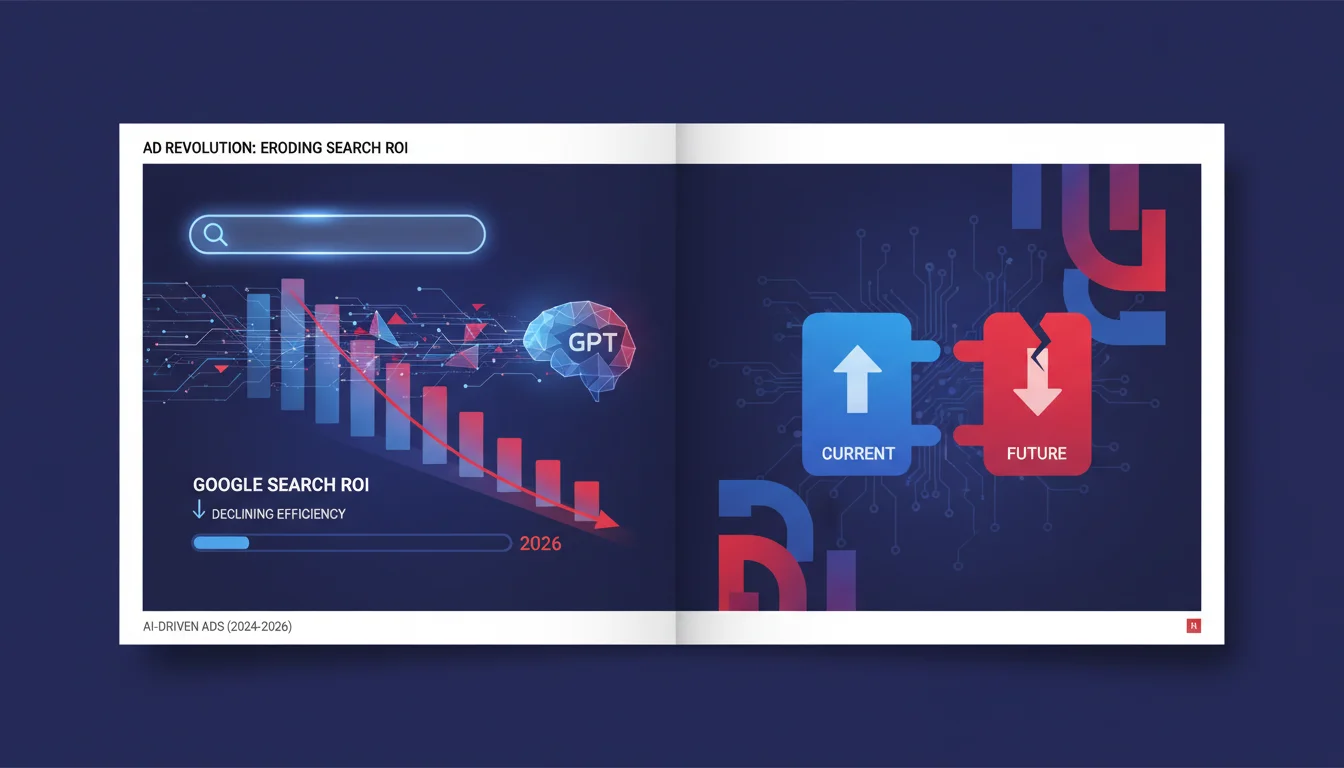
The Looming Problem: Eroding Search ROI
For a long time, the formula was simple: invest in Google Search Ads, optimize your keywords, and the traffic and revenue would follow. That model, while it worked, has become incredibly competitive and expensive. Brands have watched their average cost-per-click (CPC) climb year after year, especially in high-intent industries like financial services and e-commerce. A Nielsen report on 2025 digital ad spend showed that CPCs in the top five competitive industries jumped by an average of 7% year-over-year. That kind of increase hits the revenue per visit (RPV) directly, making every single click more expensive and squeezing your profit margins.
The problem gets worse when you look at how people are changing their behavior. Instead of just typing short keyword fragments into a search bar, people are now having full conversations with AI platforms, asking complicated questions and expecting good answers. This behavioral shift means the old “search intent” signals we all relied on are becoming less reliable. A user asking an AI, “What are the best noise-canceling headphones for travel that cost less than $300 and have good battery life?” is in a completely different headspace from someone typing “noise-canceling headphones” into Google. The first person expects a curated solution right away, while the second person is still prepared to do their own filtering and research. This change devalues broad keyword targeting, which was the bedrock of Google Search campaigns, and forces us to find a much smarter way to deliver ads.
What Went Wrong First: The Misguided Migration
When conversational AI advertising started picking up steam in late 2024, a lot of marketers made a classic mistake: they treated it as just another channel, a simple copy-paste extension of their search campaigns. The first move for many was to just port their existing keyword lists and ad copy over, thinking what worked on Google Search would work fine on platforms like Microsoft Copilot. That “lift and shift” approach was a total failure.
I know a prominent e-commerce retailer in the consumer electronics space (they’d kill me if I named them) who learned this the hard way. They took 15% of their Q1 2025 ad budget and threw it at conversational AI platforms, perfectly mirroring their best Google Search campaigns. Their keywords, things like “best smartphones” or “cheap laptops,” got them impressions, sure, but almost no engagement in the AI environment. The ad copy, written to be short and punchy for a search results page, just felt wrong in a conversation. People were asking detailed questions and looking for advice, and the static, keyword-stuffed ads felt like an annoying interruption. The result? A 20% lower click-through rate and a 30% higher cost-per-acquisition compared to their Google benchmarks. Their revenue per visit from those AI campaigns was a disaster, often less than half of what they got from search.
Another huge misstep was ignoring the conversational context. Advertisers just didn’t account for the back-and-forth nature of AI. They were serving up generic landing pages that completely broke the flow of the dialogue started with the AI. If a user asked an AI for “sustainable fashion brands,” saw an ad, and then landed on a generic e-commerce homepage, the experience was jarring and useless. The user was expecting a curated page, maybe even a personalized recommendation based on what they’d already discussed. This lack of continuity just killed the user journey, leading to high bounce rates and completely wasted ad spend. The old assumption that users will put up with a little friction, like they might on a search engine, was totally wrong. AI users expect the experience to be smarter.
The Solution: Intent-Driven Conversational Ad Strategies
To fix this, you have to completely rethink how ads work inside a conversation. The answer is to build your strategy around the user’s intent and the dialogue itself, going way beyond simple keywords to figure out what they actually need. This means adopting a new playbook that uses the AI’s own strengths.
1. Deep Intent Analysis and Persona Mapping
Instead of just obsessing over keyword research, you need to do a deep dive on user intent. This means you have to analyze the common questions people ask, their conversational patterns, and what they’re really looking for from an AI. Some of the new AI-powered intent analysis features in tools like HubSpot’s platform (updated in 2025) are good for this, helping you categorize queries into buckets like “researching options” or “seeking recommendations.” We’re also building out detailed user personas just for these conversational AI interactions, mapping their specific pain points. When you switch your focus like this, you can start building ads that actually solve the user’s problem right then and there.
2. Dynamic, Contextual Ad Copy and Creative
Static ad copy is basically useless here. You need dynamic and contextual ad copy that can actually adapt to the ongoing conversation. Think about a travel agency ad that changes its message depending on whether the user is asking about “family vacations” or “solo adventures.” This requires using ad platforms that can read the conversational data and spit out relevant ad variations on the fly. For example, if a user asks about “eco-friendly travel to Costa Rica,” your ad needs to talk about your sustainable practices or carbon offset programs, not just serve up a generic “Costa Rica tours” link. The ad needs to feel like the next logical step in the conversation. This often means using rich media or interactive elements, not just text.
3. Conversational Landing Pages and Experiences
The click isn’t the end of the journey. The solution has to include conversational landing pages or other AI-powered experiences that pick up the conversation where the ad left off. Instead of a boring old webpage, imagine a chatbot on your site that greets the user by referencing their AI chat and offers to help them finish their task. If the ad was for a specific product, the landing page chatbot could ask, “Want to see a demo, compare it to a competitor, or check if it’s in stock?” That kind of smooth handoff keeps the user engaged and dramatically improves conversions. You’re just trying to remove friction by anticipating their next question and having an answer ready.
4. Bid Strategy Optimization for Conversational Flows
Your old bidding strategies, focused on keywords and broad audiences, aren’t going to cut it. You have to develop new bid strategies that are optimized for conversational flows and specific user intents within these AI platforms. In practice, this means you’d value a “recommendation intent” query much higher than a “general information query” because you know it has a higher conversion rate. These AI platforms are giving us more granular targeting options based on chat history, and we have to use them. We’ve had success segmenting bids based on the stage of the user’s inquiry within the AI (are they exploring or ready to buy?), adjusting bids as they get closer to a decision. That’s a level of detail you just can’t get from standard search engines.
5. Iterative A/B Testing and Analytics
This whole field is changing so fast that you have to be testing constantly. That means you need a serious approach to A/B testing and analytics. You have to test different ad copy, conversational flows, and landing page experiences. And your metrics have to go beyond clicks and impressions to things like engagement duration, completion rates of conversational paths, and the actual quality of the leads you generate. Reading the conversation transcripts themselves can give you incredible insights into what users want and where they get stuck. This feedback loop, where you learn from user interactions and immediately tweak your campaigns, is how you actually improve revenue per visit over time.
Measurable Results: Enhanced RPV and Lower CPA
The businesses that are actually implementing these intent-driven conversational ad strategies are getting real results that fix the RPV problem. The early adopters who’ve made the switch from a keyword focus to a conversational intent focus are reporting some big improvements.
A recent Statista report on AI advertising for 2026 found that companies who got conversational ads right saw an average 18% increase in revenue per visit from these new channels compared to their Q4 2024 numbers. These were often incremental gains. On top of that, the cost-per-acquisition (CPA) for these highly qualified leads was, on average, 22% lower than from traditional Google Search Ads for similar conversions. This happens because you’re delivering a perfectly relevant ad to someone who is already deep into their decision process inside a very interactive space.
We saw this with one B2B software company. They moved 30% of their ad budget to conversational AI platforms and fully embraced these strategies. Within six months, they saw a 35% uplift in qualified lead generation. Their sales cycle also got shorter by an average of 10 days because the leads coming from the AI platforms were already well-informed and had specific needs. The RPV from these AI leads was nearly double their standard search campaigns, which told them the leads were more likely to close and at a higher deal size. It just shows that when an ad is actually helpful instead of being an interruption, people respond to it and become more valuable customers. The goal is to start a real interaction that leads to a sale.
Conversational AI advertising isn’t some passing fad. It’s a basic change in how people find and connect with brands. The marketers who adapt their strategies to focus on intent and dialogue will not only survive the rising costs of search ads but will find new ways to get customers and grow revenue. The future of our industry is conversational, and there’s a lot of money to be made if you learn how to speak the language.
How do ChatGPT ads differ from traditional Google Search Ads in terms of user intent?
With ChatGPT ads, you’re engaging someone who is in the middle of a conversation, asking complex questions and often looking for a specific recommendation or comparison. Google Search ads still mostly target people typing short, keyword-based queries, who expect to do the work of sifting through links themselves. The intent in an AI conversation is usually much deeper and more specific right from the start.
What is the most critical metric to track for conversational AI ad campaigns?
Forget CPC and CTR for a second. The most important metrics are the completion rate of conversational paths or the quality of leads generated. These numbers tell you if your ad actually helped the user get to their desired outcome, which is a much better signal of real engagement and intent.
Can existing Google Search ad creative be directly used for conversational AI platforms?
No, and you shouldn’t even try. Existing Google Search ad creative will feel clunky and out of place in a conversational setting. These AI environments require dynamic, contextual ad copy that can adapt to a dialogue and offer a genuinely helpful, interactive experience. Your old static, keyword-focused ads will almost certainly fail.
How can businesses measure revenue per visit (RPV) for conversational AI ads?
Measuring RPV for conversational AI ads is conceptually the same: you track the revenue from users who clicked an AI ad and divide it by the number of visits from those ads. The hard part is the execution. You need really strong attribution models that can connect an interaction in a chat platform to a later sale on your website, which usually means getting good at using unique tracking parameters or maybe even post-conversion surveys.
What is an “intent-driven” approach in the context of AI advertising?
An intent-driven approach simply means you’re focusing on the user’s underlying goal, question, or need within the conversation, not just on matching keywords. You’re analyzing the flow of the chat to figure out what they really want so you can deliver a highly relevant, adaptive ad that feels like a natural part of the solution.


