 By Editorial Team
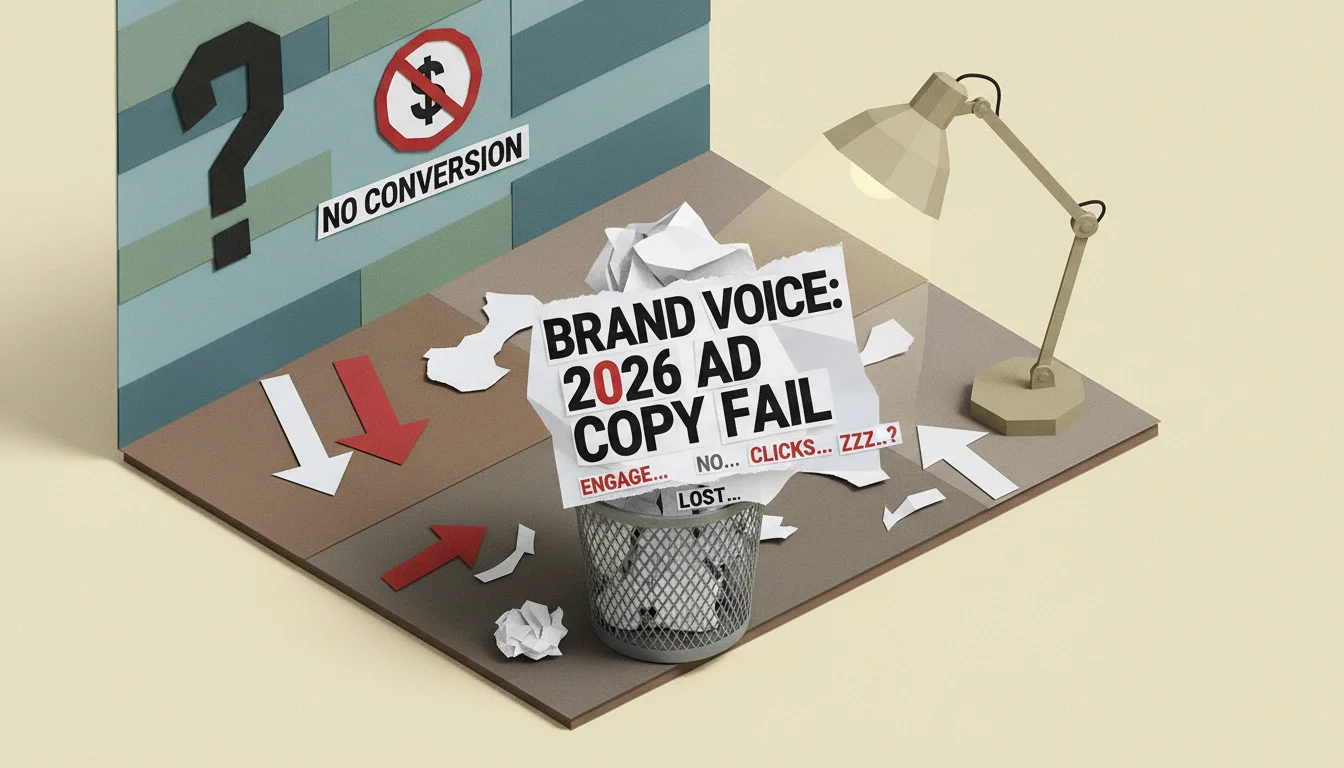
So many businesses throw huge budgets at paid ads and get nothing back but silence as their message dissolves into the digital background. The issue isn’t always the ad platform or the targeting settings. More often than not, it’s the complete absence of a distinct brand voice. Their copy sounds exactly like their competitors’, so potential customers just keep scrolling, leaving conversion rates to flatline. How do you actually get someone’s attention and make a real connection?
Key Takeaways
- Before writing any ad copy, define your core brand identity by digging into your company’s values, your audience’s real-world needs, and what your competitors are saying.
- Create a specific linguistic style guide, detailing everything from preferred words to sentence rhythm, to keep your voice consistent across every single paid campaign.
- Run A/B tests on your ad creatives by systematically changing brand voice elements, like a headline’s tone or the phrasing of a call-to-action, so you can measure what actually works.
- Make sure every content creator and ad manager is trained on your brand voice guidelines, because coherence and authenticity are built on everyone being on the same page.
- Continuously review performance data and watch for market shifts, then use that information to tweak and refine your brand voice so it stays sharp and effective.
I’ve watched companies wrestle with this problem for years. They’d launch campaigns using the most generic headlines and calls to action imaginable, then sit there wondering why their click-through rates (CTRs) were stuck at the industry average or, even worse, sinking below it. The ads were technically fine, but they had zero personality. Because they weren’t speaking to anyone in particular, they weren’t really speaking to anyone at all. One of the most common blunders I saw was people just grabbing copy from their website and cramming it into an ad, assuming that what works on a landing page will somehow translate to a 30-character headline. It almost never works. The tight space and split-second attention span of paid ads require a much more deliberate and refined voice.
The Cost of Indistinguishable Ads
Think about the default approach for a company selling project management software. Their ad copy probably says something like, “Boost Productivity with Our Project Management Tool.” It’s a true statement, but it’s also identical to what dozens of competitors are saying. There’s no emotional hook, no unique angle communicated through the language, and no reason for a user to stop scrolling. This failure to stand out just inflates cost-per-click (CPC) as everyone bids on the same generic keywords without ever capturing real interest. A 2025 eMarketer report projects global digital ad spending will top $700 billion, yet a huge chunk of that investment will be wasted on creative that just doesn’t connect, often because the brand voice is weak or nonexistent. Getting your voice right means your ad spend is actively building brand recognition and loyalty from that very first impression.
Another failure I’ve seen over and over is a company trying to copy a competitor that seems successful. If a rival brand has a funny, informal tone, they’ll try to bolt it onto their own marketing, even when it completely clashes with their company’s actual values or what their audience expects. This inauthentic approach almost always backfires because it creates a jarring brand experience that just confuses people. Your audience knows when a message feels phony, like someone reading awkwardly from a script. It kills trust and makes your brand instantly forgettable. The objective should always be to communicate with clarity and distinction.
Crafting a Resonant Brand Voice: A Step-by-Step Solution
Building a strong brand voice for your paid ads is a methodical process, not something you figure out on a creative whim. It starts way before you write a single headline.
Step 1: Define Your Core Identity and Audience
You have to know who you are before you can decide how to talk. Start by documenting your brand’s mission, its core values, and its personality. Are you innovative and bold? Compassionate and supportive? Authoritative and reliable? These adjectives are the foundation of your voice. For example, a fintech startup trying to upend traditional banking might choose a voice that’s confident, accessible, and a little rebellious, which guides their word choice. A luxury brand, on the other hand, would probably use a tone that’s sophisticated and aspirational. These decisions are concrete and directly influence your vocabulary and sentence structure. At the same time, you need to do a deep dive on your target audience, not just their demographics, but their psychographics. What are their real pain points, what do they aspire to, and how do they like to communicate? Are you talking to technical experts who want precise language or to busy parents who need empathetic and straightforward solutions?
Step 2: Establish Linguistic Guidelines
With your identity and audience defined, it’s time to translate those ideas into a set of practical, linguistic rules. This means you need a style guide built specifically for ad copy. It should spell out:
- Vocabulary: What specific words or phrases feel like your brand? What words will you ban (like corporate jargon or cringey slang)? A cybersecurity company might lean on words like “fortify,” “secure,” and “resilience,” whereas a sustainable fashion brand would favor “ethical,” “conscious,” and “craft.”
- Tone: This is the emotion behind your words. Are you serious, funny, inspiring, urgent, or reassuring? You should define when to use each. For instance, an ad about customer support should sound reassuring, while a flash sale ad needs to feel urgent. The tone has to match the ad’s goal and where the customer is in their journey.
- Sentence Structure: Do you want short, punchy sentences that hit hard, or are you a brand that uses longer, more descriptive phrasing to add a sense of depth? For most paid ads, being concise is key, but even short copy has a rhythm. Some brands do well with direct, declarative statements. Others might use questions to pull the reader in.
- Punctuation and Capitalization: It might seem small, but how you consistently use exclamation points, question marks, and even capitalization (like title case vs. sentence case in headlines) absolutely shapes the brand’s feel. A playful brand can get away with more emojis and exclamation points, while a B2B professional service should probably steer clear of them.
This document is what keeps everyone on the same page. I’ve found that without these explicit guidelines, ad copy quickly becomes a mess of different writers’ personal styles, creating total inconsistency across campaigns.
Step 3: Implement Voice in Ad Copy and Creatives
Now you take your guidelines and apply them to every part of your ad, the headlines, descriptions, and calls-to-action (CTAs). This is the practical application. Instead of “Boost Productivity,” a brand with a “supportive, helping” voice might write, “Give Your Team the Focus They Deserve.” A “bold, innovative” brand could go with, “This Is How Work Gets Done Now.” That small change in phrasing makes a huge difference in who you attract. Make sure the brand voice also informs your visuals. Do your images match the tone? Do the colors and fonts reinforce the personality you’re projecting? A fun, playful brand shouldn’t be using stark corporate stock photos, and a serious financial firm shouldn’t be using whimsical illustrations. When every element is consistent, the message hits much harder.
Step 4: Test, Analyze, and Iterate
Digital advertising lets you test everything, so you should. Set up A/B tests that isolate specific elements of your brand voice. For instance, you could run two ads that are identical except for the headline, one formal, one informal. Or you could test two CTAs, like “Learn More” versus “See How It Works.” Tools like Google Ads and Meta Business Suite have built-in A/B testing functions that make this easy. When you analyze the results, look beyond just clicks and pay close attention to conversion rates, how long people stay on the landing page, and what they do after they click. A distinct ad might have a slightly higher cost-per-click but lead to much better conversion quality, which is a huge win. The performance data gives you hard evidence about which parts of your voice connect with your audience. The market shifts constantly, so your voice needs to adapt with it, without losing its core identity.
Measurable Results of a Strong Brand Voice
A well-defined brand voice has a direct and measurable effect on paid ad performance. I’ve personally seen clients turn their underperforming campaigns into their best customer acquisition channels. One e-commerce client selling niche skincare products was using generic, feature-based headlines. They switched to a “friendly expert” voice, and their ad headlines changed from “Anti-Aging Cream” to “Revitalize Your Skin with Our Expert-Formulated Solution.” Within just three months, their ad CTR went up by 18%, and their conversion rate from an ad click to a sale jumped by 12%. Nothing about the product or the price changed. It was all about how they communicated their value.
In another case, a B2B SaaS company was failing to get qualified leads from their LinkedIn Ads because their copy was overly technical and fixated on features. After we developed a “problem-solver, empathetic” voice, their ads started speaking to specific industry pain points in a much more human way. An ad that once read “Advanced Analytics Platform” became “Struggling with Data Overload? We Help You See Clearly.” That strategic shift led to a 25% drop in their cost-per-lead (CPL) and a 30% improvement in lead quality, according to feedback from their sales team. The new leads weren’t just more plentiful. They were better informed and more open to the solution because they understood the brand’s value before the first sales call even happened.
These aren’t flukes. A consistent and authentic brand voice builds trust and familiarity, even in the few seconds a user sees your ad. It helps pre-qualify your audience, attracting people who connect with your brand’s ethos while filtering out those who don’t, which makes your ad spend far more efficient. It also strengthens brand recall, making your ads and your brand more memorable across the web. The result is a more effective marketing funnel built on stronger customer relationships which in the end leads to a healthier bottom line. Investing the time to define and execute a distinct brand voice for paid ads is a foundational part of succeeding in a competitive digital field.
When you develop a distinct brand voice for your paid ads, your marketing becomes a genuine connection with your audience instead of just a one-way broadcast. This strategy makes every ad impression build recognition and encourage people to engage, which directly translates into better campaign performance and stronger customer relationships.
What is the primary benefit of a distinct brand voice in paid ads?
It’s all about differentiation. A distinct voice makes your ads stand out from a sea of competitors, grab your audience’s attention, and build instant recognition and trust. This directly leads to higher engagement and better conversion rates.
How does brand voice affect ad performance metrics?
A strong voice can seriously improve your key metrics. We’re talking higher click-through rates (CTR), better conversion rates, and higher quality leads. By attracting more relevant and engaged users, it also tends to lower your cost-per-click (CPC) and cost-per-lead (CPL).
Can a brand voice be too niche for broad ad campaigns?
Your voice needs to be distinct, but it also has to be flexible enough to work for your target audience across different ad placements. The goal is to be specific, not exclusive. You want a voice that resonates deeply with your ideal customer without completely alienating others who could still be a good fit.
Should brand voice be consistent across all marketing channels?
Yes, absolutely. Keeping your brand voice consistent across paid ads, organic social, email, and your website creates a cohesive and trustworthy experience for customers at every single touchpoint.
What specific elements should be included in a brand voice style guide for ads?
A solid style guide for ads needs to detail your preferred vocabulary, the overall tone (e.g., formal, witty, empathetic), rules for sentence structure and length, how to use punctuation, and any brand-specific terms you want to use or avoid.


