 By Editorial Team
A 37% higher return on ad spend for campaigns using AI-enhanced audience modeling in 2025 is a number that should make any PPC pro stop and think. That’s the performance lift compared to traditional segmentation, and it’s forcing a complete re-evaluation of our lookalike strategies. The goal is no longer just finding more people, it’s about finding the right people with a precision we haven’t had before.
Key Takeaways
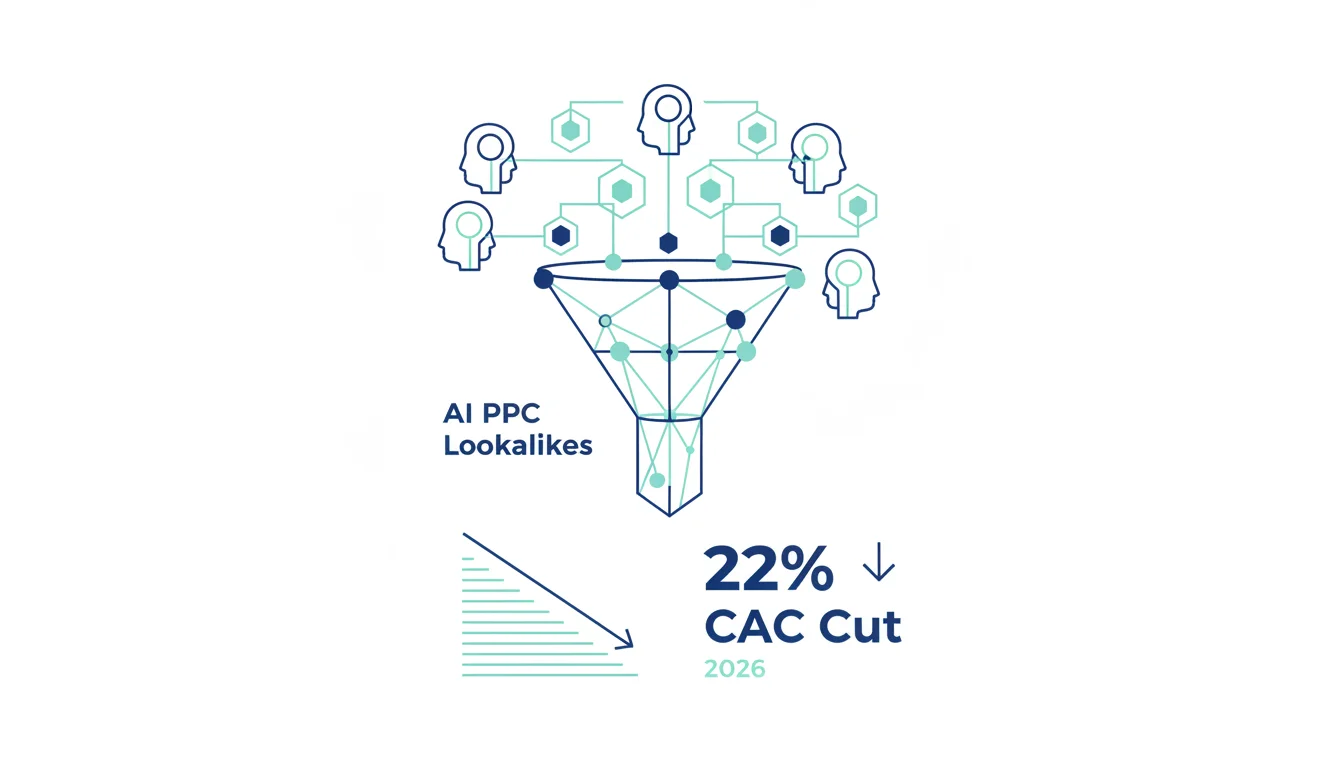
- AI lookalikes are cutting customer acquisition cost by an average of 22% by finding better prospects, faster.
- Feed your first-party data into AI models and you can see audience match rates jump by up to 15% over just using platform data.
- Top performers are putting at least 40% of their PPC budget into AI-enhanced lookalike campaigns to capitalize on this accuracy.
- You have to feed performance data back into the AI. Each time you do, audience quality improves by 5-7%.
Data Point 1: AI-Driven Lookalike Audiences Reduce Customer Acquisition Cost by an Average of 22%
We all used to think that broader lookalike audiences just meant diluted efficiency. A Q4 2025 IAB report blows that up, showing that campaigns using AI to refine their lookalike segments are cutting customer acquisition cost (CAC) by an average of 22%. This is a substantial gain in profitability for advertisers.
So how does this work? The AI is simply finding subtle patterns in your customer data that we can’t see. Your old-school lookalike might match on a few basic demographics. The AI, on the other hand, can process thousands of signals at once, identifying complex correlations a human or a simple algorithm would never catch. I’ve seen it connect dots that seem totally unrelated, like buyers of a specific high-end product also being into sustainable living content and following a specific group of micro-influencers. These aren’t things you’d ever think to put in your initial segmentation, but the AI finds that correlation, building a much sharper, more predictive audience so your ad spend hits people who are actually likely to buy.
If you’re still building lookalikes with manual rules, you’re just leaving money on the table. The AI’s precision cuts down on wasted impressions and clicks, which is how you get that lower cost per acquisition. It’s about casting a much, much smarter net.
Data Point 2: Integrating First-Party Data with AI Models Increases Audience Match Rates by Up to 15%
When you feed your own first-party data, your CRM lists, website behavior, purchase history, into an AI lookalike engine, you can boost your audience match rate by up to 15%, according to a recent eMarketer analysis. Higher match rates mean more of your ideal customers are actually reached. The standard method of just uploading a customer list to a platform like Google Ads or Meta Business Suite and hoping for the best is too limited. You’re stuck with their generalist models and whatever data they have.
I see this in my own work all the time. A big part of my consulting is just getting clients to clean up and structure their first-party data. It’s not glamorous, but that rich data is gold when you feed it to a custom AI model. The AI then takes your unique customer DNA and finds matches in the wild who share those same deep behavioral and psychographic traits, not just surface-level similarities. We had a luxury car client, for example, whose AI found that its best customers were all attending the same regional arts festivals and reading certain niche financial magazines. You’d never find that manually, and it completely changes the quality of the audience you build.
The mistake a lot of marketers make is thinking their first-party data is just for retargeting. It’s your single best asset for prospecting when you pair it with AI. That data is the unique blueprint of your ideal customer, and the AI’s job is to go find clones. Without that rich, proprietary input, your AI lookalike modeling is a lot less precise and a lot more expensive.
Data Point 3: Marketers Should Allocate at least 40% of PPC Budget to AI-Enhanced Lookalike Campaigns
Top-performing brands are now putting around 40% of their total PPC budget into AI-enhanced lookalike campaigns, according to a recent Nielsen report. This isn’t a test budget anymore. It’s a core strategic investment. It’s a huge change from the old days where lookalikes got maybe 10-20% of the spend after we’d saturated our core interest and demo targets.
This budget allocation shows a real confidence in AI’s predictive power. It’s a strategic pivot from guessing who might be interested to using data to tell us who *will* be interested. This is about responding to tangible performance improvements. When I see clients hesitant to shift budget, I just point to the consistent data. Superior CAC reduction and higher match rates are becoming the norm for those who embrace these technologies. Frankly, at this point, not allocating a significant budget to these advanced methods is a bigger risk than doing so.
I get that people hesitate because they don’t fully understand how the AI models work, or they’re just comfortable with old targeting methods that feel more transparent. But the “black box” nature of these AI models is what gives them their power. They find patterns that defy simple human logic. My advice is to start with a substantial test budget (say, 25-30%) and then scale up aggressively as performance metrics validate the investment. If you wait for ‘perfect understanding,’ you’re just letting your competitors get an insurmountable lead.
Data Point 4: Continuous Feedback Loops Improve Audience Refinement by 5-7% with Each Iteration
A lot of people miss this, but you have to create a continuous feedback loop. HubSpot’s latest marketing statistics show that campaigns feeding performance data back into their AI models see an average audience quality improvement of 5-7% with each iteration. The AI learns and adapts over time, making future lookalikes more precise. Too many marketers treat audience generation as a one-off task, creating a lookalike and then running it into the ground, which is a huge mistake.
This iterative process is the whole point of using AI. The model generates an initial lookalike, then watches what happens, it’s tracking CTRs, conversion rates, time on site, and even post-conversion behavior. That data gets fed back in, and the model learns to discard less effective segments and double down on those that perform exceptionally well. It’s a self-optimizing system. For instance, a retail client selling athletic wear started by targeting lookalikes of past fitness gear buyers, but the feedback loop showed the AI that the *best* converters also consumed a ton of outdoor adventure travel content, a connection we hadn’t made. This insight then refines the next audience segment and improves targeting.
Manual lookalikes just don’t have this dynamic adaptability. A manually created lookalike remains static until a marketer intervenes, and this reactive approach is just inefficient compared to a proactive, AI-driven learning system. I hear people say, “once you’ve found a ‘good’ lookalike, you stick with it,” and I strongly disagree. The market, consumer tastes, and your own products are always evolving. Your audiences must evolve too, and AI provides the mechanism for that continuous adaptation. Set up your campaigns with clear tracking and configure your AI platforms to ingest and act on this performance data. It’s fundamental to sustained success.
PPC for AI audience modeling is creating a fundamental shift in how we identify and engage potential customers. The data shows AI is an essential tool for superior targeting, lower acquisition costs, and continuous campaign improvement. Ignoring these advancements creates a strategic disadvantage in an increasingly competitive market. For more on this, see how AI keyword tools reshape PPC budgets, and dig into how AI reshapes 2026 skill demands for marketing teams.
What is PPC lookalike modeling with AI?
It’s using AI algorithms to analyze your best customers and then find new people out in the world who act and think just like them, making them prime targets for your ads. Machine learning finds patterns that go way beyond traditional segmentation.
How does AI improve traditional lookalike audiences?
AI improves lookalikes by processing a much larger volume of data points, including behavioral signals and psychographics, to find more nuanced and predictive patterns. This produces a higher-quality audience segment which leads to better campaign performance.
What kind of data is essential for effective AI-enhanced lookalike modeling?
You need both first-party and third-party data. Your first-party data (CRM records, website analytics, purchase history) is the gold standard. Third-party data from the advertising platforms then helps the AI find matches across a much wider population.
Can small businesses benefit from AI-powered PPC lookalikes?
Yes, absolutely. Many advertising platforms now offer integrated AI tools that make the process simple. Even with smaller data sets, AI can find valuable patterns, helping small businesses target high-potential customers more effectively without needing huge budgets.
What are the common pitfalls to avoid when implementing AI lookalike strategies?
The biggest pitfalls are using low-quality seed data, failing to feed performance data back into the AI model for refinement, and not testing different lookalike percentages or source audiences. Over-reliance on a single data source or neglecting to monitor campaign performance closely will also hinder success.


