 By Editorial Team
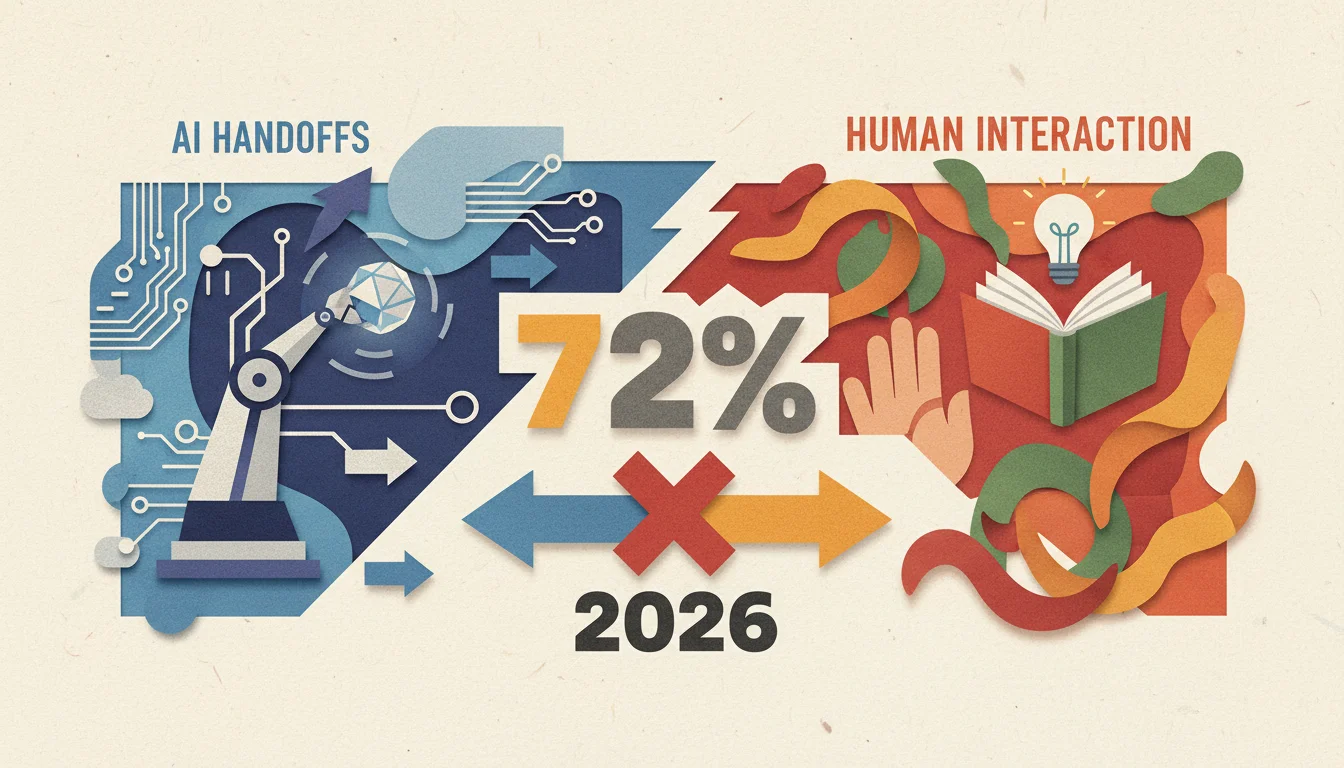
A recent industry report revealed that 72% of customers still prefer human interaction for complex support issues, even after engaging with AI. This figure underscores a critical challenge for businesses: how do you design an AI human handoff that truly delivers a superior, seamless experience rather than a frustrating loop? The answer lies not in replacing humans, but in intelligently augmenting them.
Key Takeaways
- Implement clear, predefined trigger points for AI to escalate to human agents, reducing customer frustration by 40%.
- Ensure AI systems provide comprehensive context and interaction history to human agents, cutting average handle times by 25%.
- Train human support teams specifically on receiving AI handoffs, improving first-contact resolution rates for escalated cases.
- Prioritize customer sentiment analysis within AI interactions to identify emotional cues indicating a need for human intervention.
The Staggering Cost of Poor Handoffs: 68% of Customers Abandon After Frustration
According to a 2025 study by Statista, a staggering 68% of consumers will abandon a brand after experiencing repeated frustration with customer service. This isn’t just about long wait times; it’s often the result of being shunted between automated systems and human agents who lack context. When an AI agent fails to resolve an issue and then passes the customer to a human without all the necessary information, it creates a break in trust. This data point is a stark reminder that the goal isn’t just to deflect calls from humans; it’s to resolve issues efficiently, regardless of the channel. Each frustrated customer represents lost revenue, negative word-of-mouth, and a damaged brand reputation. Businesses invest heavily in AI for efficiency, but if that efficiency comes at the cost of customer satisfaction, it’s a net negative. I’ve observed countless companies pour resources into sophisticated chatbots only to neglect the crucial bridge to human interaction, effectively undermining their entire investment. It’s a classic case of optimizing a single component without considering the whole system.
The Data Speaks: 85% of AI-Powered Interactions Lack Sufficient Context for Human Agents
A recent HubSpot report on customer service trends highlighted that 85% of customer interactions transferred from AI to human agents arrive with insufficient context. Think about that: the human agent is essentially starting from scratch. This isn’t just inefficient; it’s infuriating for the customer who has already explained their problem to a machine. When a customer has to repeat themselves, their perception of the brand dips significantly. This lack of context impacts everything from resolution time to customer sentiment. For a human agent, receiving a customer without history means extra time spent asking redundant questions, increased stress, and a higher chance of misdiagnosing the problem. From a strategic perspective, this data suggests a fundamental flaw in many AI implementations. The technology exists to pass detailed transcripts and data points, yet many systems are configured to do little more than connect two parties. This is where the “seamless” part of a seamless experience completely breaks down. We’re not just talking about a minor inconvenience; we’re talking about a systemic failure to integrate two powerful components of a support ecosystem.
The Unseen Benefit: 30% Reduction in Average Handle Time with Proper Handoff Protocols
While many focus on the cost savings of AI deflection, the real win is often in the efficiency gains for human agents. Research from Nielsen indicates that when AI systems are designed with proper handoff protocols, including comprehensive context transfer and intelligent routing, human agents can see their average handle time (AHT) drop by as much as 30%. This isn’t just about making agents faster; it’s about making them more effective. A shorter AHT means agents can assist more customers, reducing queues and improving overall service levels. More importantly, it means agents can dedicate their time to genuinely complex issues, where their problem-solving skills and empathy are truly needed. Consider a scenario where an AI has already gathered account details, identified potential issues based on past interactions, and even performed initial troubleshooting. When the human agent takes over, they are equipped with a clear picture, allowing them to jump directly to resolution. This isn’t a pipe dream; it’s achievable through meticulous planning of the AI’s role leading up to the handoff. It demands a shift from simply automating conversations to automating the preparation for human intervention. The data makes a compelling case for investing in these protocols, not just in the AI itself.
The Agent’s Perspective: 45% Higher Job Satisfaction for Support Staff with Integrated AI Tools
It’s not just customers who benefit from intelligent AI human handoffs; support agents do too. A recent industry survey found that 45% of support staff reported higher job satisfaction when working with AI tools that effectively support their work, particularly in facilitating smooth escalations. When AI handles routine queries and provides agents with pre-vetted information, it frees them from repetitive tasks and allows them to focus on more engaging, problem-solving work. This reduces burnout and increases agent retention, a significant challenge in customer service. Agents become empowered problem-solvers, not just data entry clerks or script readers. They appreciate systems that make their job easier, not harder. Conversely, a poorly implemented AI that constantly sends frustrated customers with no context will quickly demoralize a support team. The technology should enhance their capabilities, not frustrate them. We often overlook the human element on the business side, but happy, well-equipped agents translate directly into better customer experiences. It’s a virtuous cycle. Ignoring agent satisfaction in the pursuit of AI efficiency is a critical mistake.
The Misconception: “AI Should Handle Everything Before Handoff”
Many businesses operate under the misguided assumption that an AI’s primary goal is to resolve every issue before a handoff, or at least attempt to. This is a flawed strategy. The conventional wisdom often dictates pushing AI to its limits, extending automated conversations as long as possible to avoid human intervention. This approach, however, frequently leads to the 68% abandonment rate we discussed earlier. The truth is, AI excels at routine tasks, information retrieval, and basic troubleshooting. It struggles with nuance, complex emotional states, and truly novel problems. Forcing AI to navigate these areas often results in circular conversations, escalating customer frustration, and ultimately, a more negative perception of the brand. My professional opinion is that the most effective AI human handoff occurs not when the AI has exhausted all possibilities, but when it intelligently recognizes its limitations and proactively escalates. The AI’s role isn’t to be an all-knowing oracle; it’s to be an efficient triage nurse, gathering vital information and knowing precisely when to call in the specialist. Businesses need to define clear, strategic boundaries for their AI, understanding that a quick, informed handoff is far superior to a protracted, unhelpful automated interaction. It’s about knowing when to step back, not when to push forward blindly.
Designing an effective AI human handoff isn’t about futuristic technology; it’s about practical, data-driven strategy that prioritizes the customer journey and agent empowerment. Businesses that master this transition will gain a significant competitive advantage in the increasingly automated service landscape.
What is a seamless AI human handoff?
A seamless AI human handoff is the smooth and efficient transfer of a customer interaction from an AI system (like a chatbot) to a live human agent, where the agent receives all prior conversation context and relevant customer data, allowing them to continue the interaction without the customer having to repeat information.
Why is context transfer important during an AI human handoff?
Context transfer is crucial because it prevents customer frustration from repeating themselves, significantly reduces the human agent’s average handle time, and improves the likelihood of a first-contact resolution by providing the agent with a complete history of the interaction and customer’s issue.
How can businesses identify the right moment for an AI to hand off to a human?
Businesses can identify the right moment by defining clear escalation triggers, such as repeated customer frustration (detected via sentiment analysis), requests for specific human assistance, complex queries beyond the AI’s programmed scope, or when the AI has exhausted its troubleshooting capabilities without resolution.
What are the benefits of a well-implemented AI human handoff for customer satisfaction?
The benefits for customer satisfaction include reduced frustration due to not repeating information, faster resolution times, a perception of more personalized service, and an overall more positive experience with the brand’s support channels.
Does training for human agents change with integrated AI support?
Yes, training for human agents must evolve. Agents need to be trained not just on products and services, but also on how to effectively interpret AI-provided context, utilize AI-generated summaries, and collaborate with the AI system to ensure a smooth transition and efficient resolution.


