 By Editorial Team
Key Takeaways
- Find out where your competitors are spending by identifying their main ad platforms, like Google Ads or Meta Ads Manager.
- Use tools like Semrush or SpyFu to pull the actual ad creatives and landing page URLs your competitors are using.
- Break down competitor ad copy by offer, emotional hook, and CTA to spot the market segments they’re ignoring.
- Analyze the keywords in their ads to find high-value terms they aren’t bidding on or are underbidding.
- Run A/B tests that target the content gaps you found, hitting on pain points and value props your rivals miss.
In 2026, you can’t just throw money at ad platforms and expect results. You need precision, especially when rivals are spending heavily. So many businesses I see are burning cash because they can’t figure out where their competitors are actually winning, and they miss huge opportunities. The problem gets bad when you’re trying to figure out what your competitors are saying that you aren’t, or what they’re failing to say that your audience desperately needs to hear. How do you find these critical ad copy gaps and make them work for you?
The Cost of Blindly Following
For years, I’ve watched companies waste budgets on ad campaigns that are just faint echoes of their competitors. They see a rival’s campaign do well and immediately launch a knockoff. This “me too” approach is a recipe for getting into bidding wars over saturated keywords and watching your returns shrink. One of my clients, a B2B SaaS company, was spending almost $50,000 a month on Google Search Ads for six months straight, mostly on keywords their top three competitors already owned. Their click-through rates (CTRs) were stuck around 1.5%, and their cost per conversion was nearly 40% higher than the B2B software industry average reported by the IAB back in 2025. They were just padding Google’s pockets without creating their own space. This was a failure of insight, a complete lack of deep competitor content understanding. They thought matching the top dogs was the right move, but it just created an expensive stalemate. Another pitfall is getting obsessed with keyword gaps while ignoring the actual message. You might find a keyword your competitors aren’t bidding on, but if your ad copy doesn’t connect with the searcher’s intent for that term, you’ve wasted your time. I remember a DTC brand that found a cluster of long-tail keywords around “sustainable pet supplies” their rivals had missed. But their first ads were totally generic, talking about product features instead of the environmental angle that people searching those terms obviously cared about. They got clicks, sure, but their conversion rates were terrible, sitting below 0.5%. The gap was in the narrative and the unique selling proposition their ad copy analysis should have found.
A Systematic Approach to Unearthing Ad Copy Gaps
Finding real ad copy gaps means you have to dig deeper than just a quick glance at competitor ads. You have to break down their strategies, figure out their audience, and spot the needs they aren’t meeting.
Step 1: Identify Key Competitors and Ad Platforms
First, list your direct competitors, the companies fighting for the same customers you are. And look beyond the big, obvious names. Consider the new players or the specialists who own a niche you want to get into. Then, figure out where they’re running paid ads. The big ones are still Google Ads for search and display and Meta Ads Manager for Facebook and Instagram. But don’t forget LinkedIn Ads for B2B, TikTok Ads for reaching younger crowds, and Amazon Ads if you’re in e-commerce. You can run a quick check with a tool like Semrush or SpyFu to see their main platforms and get an idea of their spend. For example, if a competitor is all over the top search results for high-intent commercial keywords, you know they’re dumping money into Google Search Ads. If their social feeds are full of sponsored posts, Meta is their playground.
Step 2: Extract Competitor Ad Creatives and Landing Pages
Once you know their platforms, you need to collect their ads and see where the traffic goes. Tools like Semrush’s Advertising Research or SpyFu’s Kombat feature are great for this because they let you see the exact headlines, descriptions, and even the images or videos your competitors are running. For social, the Meta Ad Library is a free and essential resource. You can search for any brand and see all their active ads on Facebook and Instagram. You need a good sample size. I tell my clients to collect at least 50 to 100 ad variations from each major competitor from the last 90 days to see real patterns. And don’t forget to grab the landing page URLs for those ads. The ad copy is half the story. The landing page shows you the actual offer and the full sales pitch. I dump all this into a spreadsheet, noting the platform, ad copy (headline, description, CTA), creative, and the landing page URL.
Step 3: Categorize and Analyze Ad Copy Themes
With all that data in a spreadsheet, you can start the real analysis. Go through each ad and tag it with a core message. I use these categories:
- Offer Type: Is it a discount (“20% off”), a free trial, a demo, a free resource (like a whitepaper), or a limited-time deal?
- Emotional Appeal: Are they using FOMO, aspiration, a problem/solution frame, security, or convenience?
- Unique Selling Proposition (USP): Are they pushing speed, quality, price, a specific feature, or customer service?
- Call to Action (CTA): What are they asking people to do? “Shop Now,” “Learn More,” “Get a Quote,” “Sign Up,” “Book a Consultation.”
As you do this, look at the specific language they use, the pain points they mention, and the benefits they push. Do competitors focus on price or premium features? Do they use urgency or long-term value? This breakdown reveals their strategic messaging.
Step 4: Identify Keyword and Audience Alignment
While you’re analyzing the ad copy, you need to cross-reference it with the keywords they’re targeting in their search ads. Semrush can show you exactly which keywords trigger which ads. This step is so important for understanding their message, their audience, and their timing. For instance, if a competitor always runs ads about “fast delivery” for keywords like “last-minute gift ideas,” you know they’ve connected urgency to that specific search intent. Look for the patterns. Are they using generic ads for broad keywords or getting super specific with long-tail phrases? Are they using dynamic keyword insertion? This detail shows their precision.
Step 5: Pinpoint Content Gaps
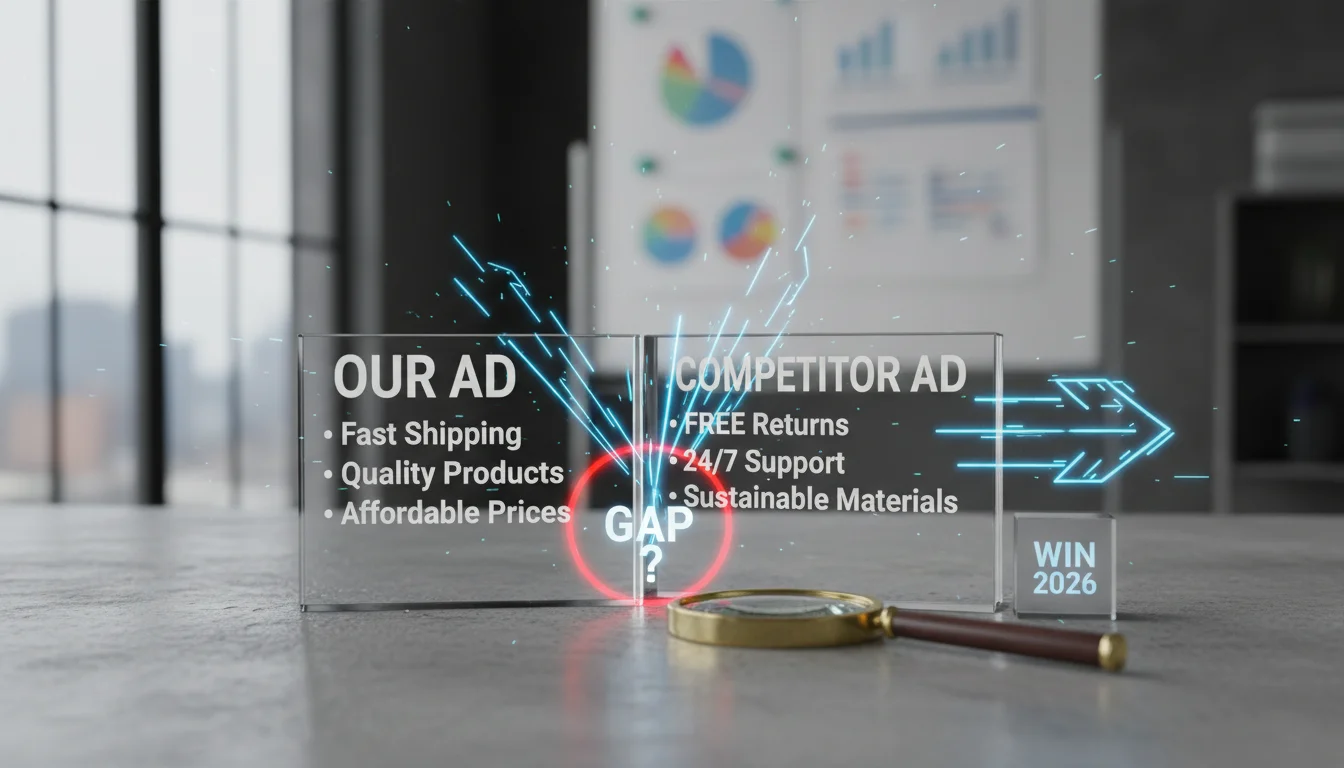
Now, identify the actual gaps. You’re going to compare your categorized list of competitor themes against what makes your own product special and what your audience isn’t getting.
- Unserved Pain Points: What problems does your product solve that competitors ignore or only touch on in their ads? Maybe your software has a killer integration suite but their ads never talk about how painful integrations can be. That’s a gap.
- Undervalued Features/Benefits: What do you offer that they can’t? If you have 24/7 live chat support while they’re stuck on email, but none of their ads talk about great customer service, you have a clear opening.
- Neglected Audience Segments: Are all your competitors chasing enterprise clients in their ads, leaving small businesses out in the cold? Your product might be a perfect fit for a segment they completely ignore.
- Differentiation in Tone/Voice: If every competitor sounds like a stiff corporation, you have an opportunity to stand out with a more approachable or direct brand voice.
- Missing Offers/CTAs: Are competitors just pushing free trials? Maybe a part of your audience would prefer a free consultation or a detailed case study.
I once worked with an e-learning platform where we found that all the competitors were just shouting about “certification courses.” Our platform had great community features and mentorship, but none of the rival ads mentioned the loneliness many online students feel. So we made that our gap. We ran ads focused on “learn with a supportive community” and “personalized mentorship,” and the message hit home, boosting lead quality by 35%.
Implementing and Testing Your Findings
Finding the gaps is just the start. The real work is writing new ad copy and testing it. Create new ad variations that hit the gaps you found head-on. If competitors ignore a pain point like “slow onboarding process,” write headlines like “Tired of Complex Onboarding? Get Started in Minutes.” Then, run A/B tests. On Google Ads, set up an experiment to split traffic between your current best ads and the new gap-focused ads. On Meta, use the built-in A/B test feature to compare creatives and copy. Keep an eye on these metrics:
- Click-Through Rate (CTR): A higher CTR means your new copy is more compelling.
- Conversion Rate: This is what really matters. Are the clicks actually turning into leads or sales?
- Cost Per Click (CPC) and Cost Per Acquisition (CPA): Sometimes targeting an underserved niche pays off with lower CPCs and CPAs because there’s less competition.
Iterate. Your first shot at filling a gap might not be perfect. The test data will show you where to make changes. Maybe a different phrase connects better, or a certain image makes the message pop.
The Measurable Impact of Strategic Ad Copy Analysis
A proper ad copy analysis delivers real results. I had a client with a B2C subscription box service whose growth had flatlined for a year. Our analysis showed that every competitor was focused on the “surprise and delight” angle. What they all missed was the growing number of consumers who wanted personalized, ethically sourced goods. Our client offered both. We built new ad copy around phrases like “curated, sustainable products tailored to your preferences” and “support ethical artisans,” and tapped right into that underserved market. Within three months, their Google Ads CTR on those new campaigns shot up by 4.2 percentage points. Their conversion rate from click to subscriber jumped from 1.8% to 3.1%. Their CPA dropped by 22%, which gave them the confidence to scale their ad spend. It was about outsmarting the competition by understanding what the audience actually wanted to hear. By focusing on these gaps, they differentiated themselves, pulled in a more engaged audience, and built a competitive advantage that just throwing more money at ads never could have achieved.
Conclusion
Identifying and acting on competitor ad copy gaps is a necessity for efficient digital advertising in 2026. When you systematically break down what your competitors are saying, you find what the audience isn’t hearing and can create much more powerful ads that lead to better campaign performance. Start by categorizing competitor ad themes to find where their messaging is weak.
What are the best tools for spying on competitor ads?
For search and display, I always recommend Semrush and SpyFu to see competitor ad copy, keywords, and landing pages. For social ads, the Meta Ad Library is free and absolutely essential for seeing active ads on Facebook and Instagram.
How often should I be doing this analysis?
I’d do a full, deep-dive analysis every quarter. The ad world moves fast. But you should also do lighter monthly check-ins to catch any big changes in competitor messaging or new campaigns they launch.
What metrics should I watch when testing new ad copy?
Look at your Click-Through Rate (CTR) to see if the ad is grabbing attention, your Conversion Rate to see if it’s driving action, and your Cost Per Acquisition (CPA) to judge efficiency. A lower CPA is a great sign your messaging and targeting are on point.
Is it enough to just find what competitors *aren’t* saying?
No. Finding the omission is step one. You have to make sure the thing they aren’t saying is something your target audience actually cares about, and it has to be a promise your product can genuinely deliver on. The gap has to be both relevant and something you can own.
Can I use AI to help with this?
AI tools are great for the grunt work, like categorizing a huge pile of ad copy and spotting basic themes. But human insight is still needed for the most important part: interpreting those findings and identifying the strategic gaps that really matter, especially when it comes to market nuance.


