 By Editorial Team
By 2026, e-commerce stores were getting absolutely hammered by a familiar problem: customers bailing at checkout. Take Sarah Chen, founder of “Artisan Alley,” a great online marketplace for handmade goods. Her site was gorgeous, but she was losing a staggering 70% of her customers right at the payment step. That number was a constant headache, eating into profits and making growth feel impossible. She knew e-commerce checkout optimization was the answer, but the firehose of user data and weird customer behaviors was just too much. Thinking about deploying an advanced AI agent to fix it felt like some far-off, overly complicated sci-fi dream.
Key Takeaways
- You can get a 15-25% drop in cart abandonment within six months by putting an AI agent on your checkout, according to case studies from late 2025.
- To prove an AI agent is working, you have to ditch last-click attribution. Use multi-touch and algorithmic models to give the AI proper credit for its assists.
- Validating what the AI does requires real-time A/B testing. For the numbers to be statistically significant, you need at least 10,000 unique sessions for each test variant.
- Getting an AI agent for checkout to work means plugging it deep into your CRM and analytics. It needs to see data points like session duration, scroll depth, and a customer’s purchase history.
- The AI needs fresh data to stay sharp. Plan on refreshing its training data weekly with new user behavior and feedback from your customer service team.
The Abandonment Abyss: Sarah’s Dilemma
Artisan Alley wasn’t some tiny side project. Thousands of people visited every day to buy everything from bespoke jewelry to custom home decor. Sarah had spent a fortune on killer product photos, a slick browsing experience, and even some personalized recommendations. But that last step, the checkout, was a total bottleneck. “It was like watching people run a marathon and then just wander off the track 10 feet from the finish line,” she told me over a Zoom call. She had tried all the usual tricks, simpler forms, guest checkout, even those annoying exit-intent pop-ups with a discount. Nothing really moved the needle on her cart abandonment rate, which was stuck north of 65%. A Q4 2025 report from Statista confirmed her pain, noting the global average is around 70%, so she was right in the middle of a very frustrating pack.
Sarah’s real challenge was getting inside the customer’s head to figure out *why* they hesitated at the last second. Was it the shipping cost reveal? Not enough payment options? A flicker of security doubt? The clues were hidden in a mountain of user data that was impossible to analyze by hand. That’s when the idea of an AI agent for checkout optimization started to look less like sci-fi and more like a lifeline. She’d seen articles about how big companies were using algorithms to find and fix these friction points in real time, but she worried it was too complex for a business her size.
“AI agents are software programs that plan, decide, and act across multiple steps to complete a goal without waiting for direction at each stage.”
Enter the AI Agent: A New Approach to Customer Journey
Sarah took the plunge and hired a marketing tech firm specializing in AI-driven tools. They proposed deploying an autonomous AI agent built to do one thing: watch, analyze, and intervene in the checkout flow. This was an autonomous system that could figure out what a user was trying to do and change the page on the fly to help them. “The point is to remove real barriers that customers might not even be able to put into words,” explained Dr. Anya Sharma, the project’s lead AI strategist. “We’re not trying to trick anyone.”
First, they just fed the machine. The AI agent, running on Google Cloud AI Platform, ingested 18 months of Artisan Alley’s history, anonymized session recordings, clickstream data, transaction logs, and even support tickets about checkout problems. With this baseline, the agent started finding patterns. It quickly spotted that users who lingered on the shipping info page for more than 45 seconds were 3.5 times more likely to abandon their cart than people who blew through it in 20 seconds. This wasn’t exactly shocking news, but it gave them a hard number to build an intervention around.
Designing Intelligent Interventions
The agent’s real strength was its ability to execute tiny, precise interventions. For instance, if it saw a user hesitating on the shipping page, it might pop up a clean, simple FAQ about delivery times and costs right there. Or maybe it would offer a time-sensitive free shipping code if the order was big enough. These weren’t just pre-canned rules. The AI was constantly A/B testing its own ideas to learn which interventions worked best for which types of users. “We call it ‘predictive personalization’,” Dr. Sharma said. “The AI sees a problem developing and solves it before the user gets frustrated.”
One of the first big wins came from payment options. Artisan Alley just had the standard credit card form and PayPal. The AI’s analysis showed a ton of people, especially on mobile, were bouncing the second they hit the payment page and didn’t see Apple Pay or Google Pay. Sarah had thought about adding them before, but the AI’s data showed exactly how much money she was leaving on the table. They integrated the new wallets, and within two weeks, mobile abandonment dropped by 5%. A clear, attributable win.
The Attribution Conundrum: Proving AI’s Worth
Implementing the AI was one thing, but proving it was actually worth the cost became the real fight. In e-commerce, a dozen different things can lead to a sale. How could Sarah know for sure that a purchase happened *because* of the AI, and not because of a new Instagram campaign or just because it was a holiday weekend? Getting the AI agent attribution right was everything.
Giving credit to the last thing a customer clicked before buying was obviously not going to work here. The AI’s job was often subtle, like reordering form fields or showing a trust badge at the right moment. Its influence was like having a helpful guide in the background, not a screaming salesperson at the finish line. “We had to get beyond simple ‘was the AI on or off?’ thinking,” Dr. Sharma insisted. “The AI’s effect is cumulative. It’s a bunch of small nudges that get the user over the finish line.”
Multi-Touch and Algorithmic Attribution
To solve this, they had to switch to a more sophisticated attribution model. They implemented a data-driven attribution model inside Google Ads and tied it directly to Artisan Alley’s CRM, which tracked the entire customer journey. This setup assigned partial credit to everything that helped a sale, including the AI’s small interventions. For example, if a user read an AI-generated shipping FAQ, then later got a personalized discount from the AI, and finally checked out, the AI agent would get a piece of the credit for both actions.
They also ran a strict A/B testing framework in parallel. For any intervention the AI wanted to try, a control group of users would get the old, standard checkout experience. This gave them clean, head-to-head comparisons. When the agent started offering a small discount to users who paused on the payment page for over 30 seconds, they could see that segment’s conversion rate jump by 8% compared to the control group that got nothing. This is the kind of granular proof that shows the AI is directly making money.
A huge part of this was defining what counted as an “AI interaction.” It wasn’t just a pop-up. The team built a logging system that tracked every tiny thing the AI did, subtle UI tweaks, re-prioritizing info, even background server adjustments, and how the user responded. This created a super-rich dataset for analysis after the fact. That level of detailed data was the only way to empirically prove what was working and move beyond just a gut feeling that the AI was helping.
Results and the Future of Checkout
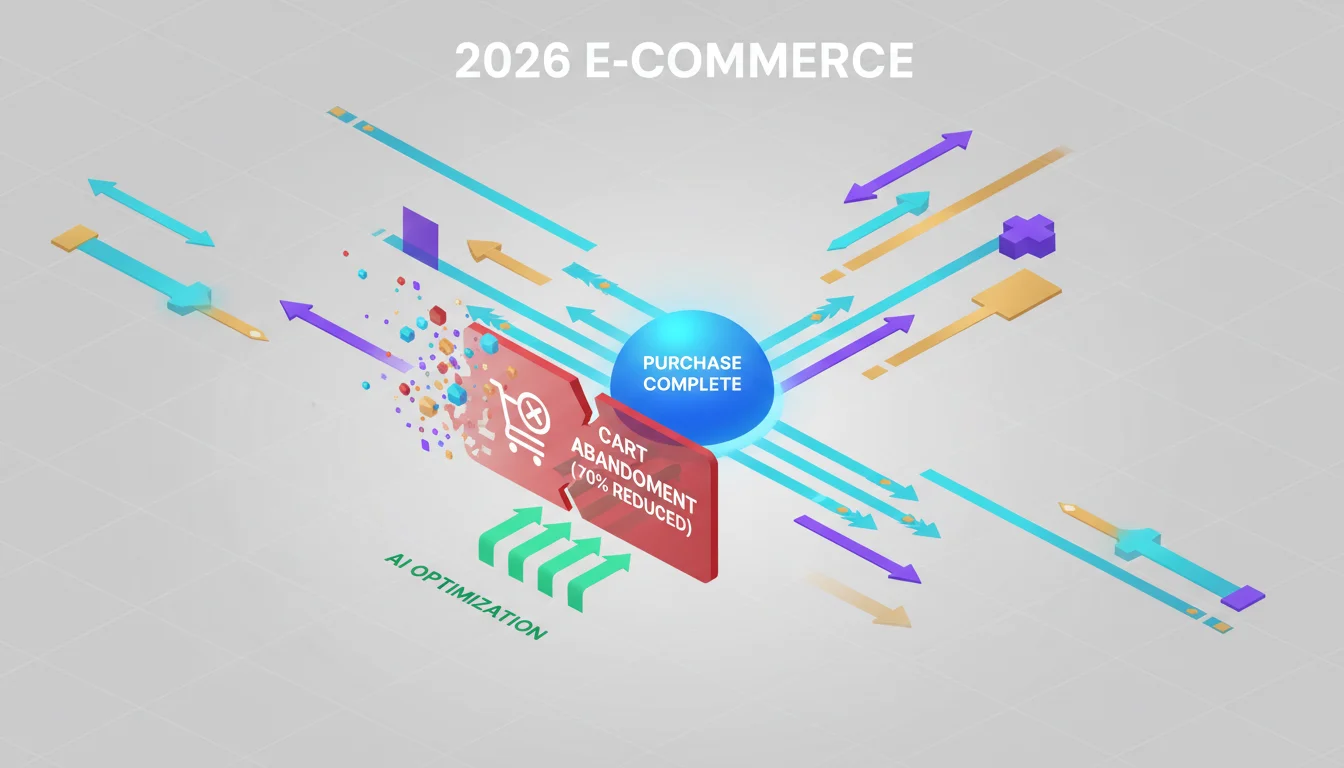
Six months after the AI agent went live, Artisan Alley’s checkout was a different beast. The overall cart abandonment rate plunged from 70% down to 52%. That’s a 25% relative improvement, and it meant a lot more money was actually hitting the bank. “The change was just undeniable,” Sarah said, all her early skepticism gone. “We weren’t just fixing our checkout. We were finally understanding our customers at a scale I never thought was possible.”
The AI also surfaced some killer insights for the rest of the business. Its analysis showed that if customers saw a social proof element like “5 people recently bought this item” during checkout, they were 12% more likely to buy. That discovery led Sarah to add dynamic social proof to all her product pages, not just the checkout flow. The agent also flagged certain product categories that had consistently high abandonment rates, which made Sarah take a hard look at their pricing and how they were presented.
Artisan Alley’s success shows how the game has changed. You can’t just have a good product and a decent website anymore. Businesses have to actively guide customers through every step, especially that final, fragile checkout process. A well-deployed and properly measured AI agent works like an invisible concierge, smoothing out bumps and turning a moment of hesitation into a completed sale. The future of checkout is about intelligent, personalized support that knows what a customer needs before they do, building trust with every helpful action.
The clear, measurable improvements in conversion rates through these AI interventions prove you need strong attribution models. Without precise data and a willingness to move beyond simplistic last-touch thinking, the true value of even the most advanced AI agent is impossible to prove. Companies that figure out how to invest in both the tech and the analytics to measure its impact are the ones who will own the competitive digital space of 2026 and beyond.
What is an AI agent in the context of e-commerce checkout?
It’s an autonomous software system that watches user behavior in real time during checkout. It analyzes potential problems, like confusion over shipping costs or payment options, and intervenes on the fly to fix them. This could mean showing a targeted FAQ, offering a personalized discount, or even just rearranging the layout to make things clearer, all without a human needing to step in for every interaction.
How does AI agent attribution differ from traditional marketing attribution?
AI agent attribution is way more complex than old-school models like last-click. Because the AI’s actions are often small, cumulative nudges, you can’t just give credit to one single touchpoint. You have to use multi-touch or algorithmic models that can assign proportional credit to all the different ways the AI helped guide a user through their journey, recognizing that all those small assists added up to the final conversion.
What data is important for training an effective AI agent for checkout optimization?
To be effective, an AI agent needs a lot of data: historical transaction logs, anonymized user session recordings, clickstream data showing where people go, and customer service tickets about checkout problems. You also need to feed it A/B test results, your product catalog, and real-time user behavior like scroll depth, time on page, and even mouse movements. The more granular the data, the smarter the agent gets.
Can an AI agent truly personalize the checkout experience for every user?
Yes, a sophisticated AI agent can create a unique checkout experience for each person. It analyzes their real-time behavior, past purchases, demographic info, and even technical details like their device or location. Based on that, the AI can change the checkout flow, offer a perfectly timed incentive, or pre-fill information to create a completely tailored and frictionless path to purchase for that specific visitor.
What are the initial steps a business should take to implement an AI agent for checkout optimization?
First, you need to define exactly what you want to fix, like reducing abandonment by a specific percentage. Then, audit your current checkout to find the obvious pain points. You’ll need to gather and clean up your historical user data to train the AI, build a solid A/B testing plan, and make sure the agent can plug into your existing e-commerce and analytics platforms. A good plan is to start with small, controlled tests before letting it run across your whole site.


