 By Editorial Team
Many businesses investing in Google Ads find themselves pouring money into campaigns without seeing the expected returns. The problem often isn’t the platform itself, but a fundamental misunderstanding of Quality Score and its direct impact on Google Ads ROI. Ignoring this metric means you are almost certainly paying more than you should for clicks, squandering budget that could be generating real conversions.
Key Takeaways
- Google’s Quality Score, a 1 to 10 rating for each keyword, directly influences your ad’s cost-per-click (CPC) and ad position, with higher scores leading to lower costs and better visibility.
- Improving Quality Score requires a focused approach across three core components: expected click-through rate (CTR), ad relevance, and landing page experience, each contributing significantly to the overall score.
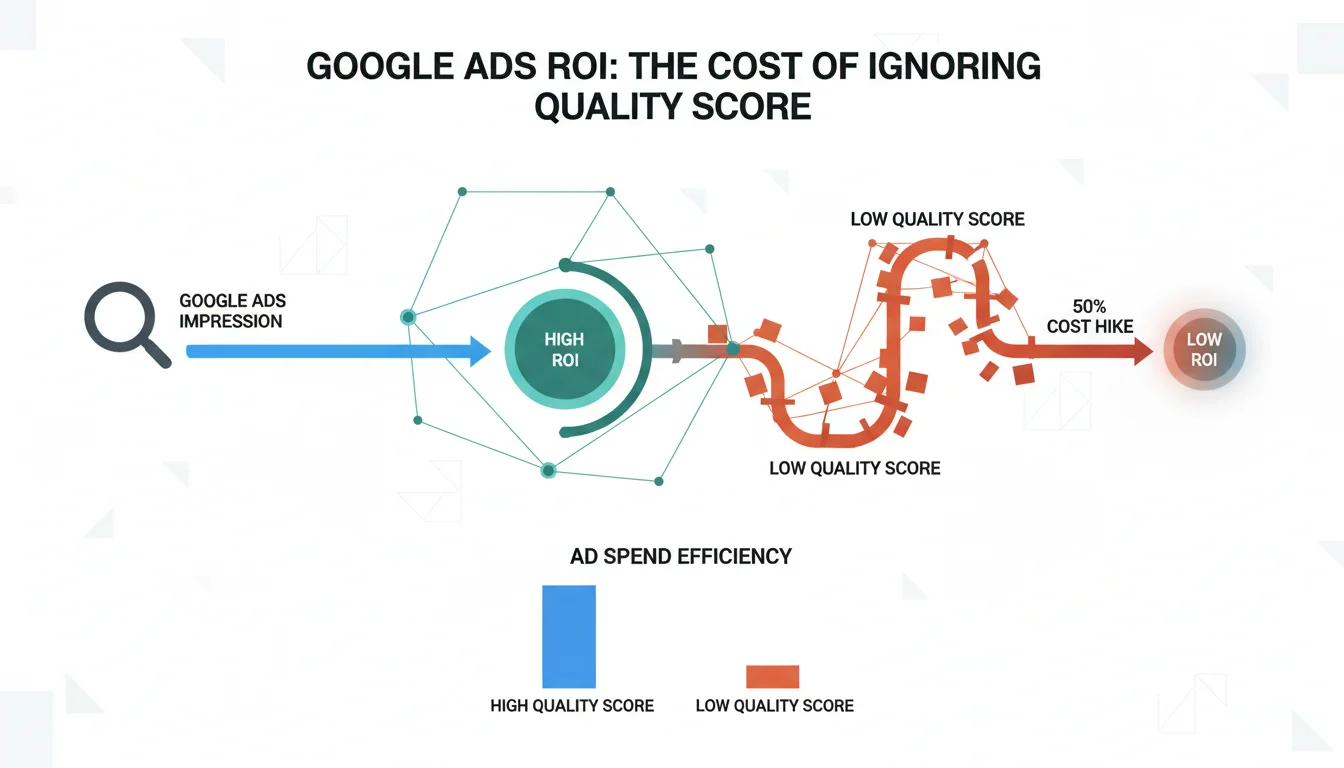
- A low Quality Score, particularly anything below a 5, can inflate your CPC by 50% or more, making your advertising budget far less effective and hindering your return on investment.
- Consistent monitoring of Quality Score at the keyword level within your Google Ads account is non-negotiable for identifying underperforming assets and prioritizing optimization efforts.
- Implementing A/B testing for ad copy, refining keyword targeting, and optimizing landing page load times are actionable strategies for significant Quality Score improvements.
| Feature | Ignoring Quality Score | Low Quality Score (e.g., 3/10) | High Quality Score (e.g., 7-8/10) |
|---|---|---|---|
| Cost-Per-Click (CPC) | ✗ Significantly higher | ✓ Double competitors’ CPC | ✓ Lower costs |
| Budget Effectiveness | ✗ Far less effective | ✗ Financially damaging | ✓ Maximizes ROI |
| Ad Position/Visibility | ✗ Reduced visibility | ✗ Suffers significantly | ✓ Better visibility |
| ROI Impact | ✗ Hindered returns | ✗ Dismal performance | ✓ Strong ROI |
| CPC Inflation Risk | ✓ 50% or more | ✓ 50% or more | ✗ Minimal |
| Google’s Ad Value | ✗ Low value perceived | ✗ Not good experience | ✓ High value perceived |
| Optimization Focus | ✗ None/Misguided | ✗ Reactive (bidding) | ✓ Proactive & continuous |
What Went Wrong: The Cost of Ignorance
For years, I’ve observed countless businesses make the same costly mistake: they launch Google Ads campaigns, target broad keywords, write generic ad copy, and point traffic to an undifferentiated homepage. Then they wonder why their budget vanishes with little to show for it. This approach is a recipe for high costs and dismal performance. Without understanding Quality Score, you are effectively flying blind, allowing Google to charge you a premium for every interaction. It’s not enough to simply bid on keywords. You must also demonstrate to Google that your ads are valuable to users. When you don’t, your ad rank suffers, and your cost per click (CPC) skyrockets. I’ve seen accounts where a low Quality Score, say a 3 out of 10, resulted in CPCs that were double what a competitor with a score of 7 or 8 was paying for the exact same keyword. That’s not just inefficient. It’s financially damaging.
Understanding Quality Score: The Core Problem
Google’s Quality Score is a diagnostic tool, a rating from 1 to 10 assigned to each of your keywords. It assesses the relevance and quality of your ads and landing pages to a user’s search query. This score isn’t just an arbitrary number. It’s a direct indicator of how much Google values your ad experience. A higher Quality Score means Google sees your ad as more helpful and relevant to users, and in return, they reward you with lower costs and better ad positions. Conversely, a low score signals to Google that your ad isn’t providing a good experience, leading to higher CPCs and reduced visibility. The primary components influencing this score are:
- Expected Click-Through Rate (CTR): This predicts how likely users are to click your ad when it’s shown for a specific keyword. If your ad text is compelling and directly addresses the search intent, your expected CTR will be higher. This is often the biggest lever you have.
- Ad Relevance: How closely your ad copy matches the user’s search intent and the keyword you’re bidding on. If someone searches for “emergency plumber Atlanta” and your ad talks about “home repair services,” the relevance is low.
- Landing Page Experience: This evaluates how relevant, transparent, and easy-to-navigate your landing page is for users who click your ad. Fast load times, clear calls to action, and content that fulfills the promise of the ad all contribute positively.
Many advertisers mistakenly believe that simply increasing their bid will solve poor performance. While a higher bid can temporarily improve ad position, it’s an unsustainable strategy if your Quality Score is low. You’re effectively paying a tax for irrelevance. A recent report by Statista showed average CPCs for various industries in 2024, highlighting the significant financial implications of competitive ad environments. Without a strong Quality Score, your campaigns in these competitive sectors become prohibitively expensive.
The Solution: A Step-by-Step Approach to Quality Score Optimization
Improving your Quality Score is not a one-time fix. It’s an ongoing process that demands continuous attention and refinement. Here’s a structured approach:
1. Granular Keyword Research and Organization
Start by refining your keyword strategy. Broad match keywords can quickly dilute relevance. Instead, focus on tightly themed ad groups. Each ad group should contain a small cluster of highly related keywords, perhaps 5 to 15, all sharing a common user intent. Use tools like the Google Keyword Planner to identify long-tail keywords that indicate strong commercial intent. For example, instead of just “marketing agency,” target “digital marketing agency Atlanta for small business” if that’s your niche. This precision allows for hyper-relevant ad copy.
2. Crafting Compelling and Relevant Ad Copy
Your ad copy must directly reflect the keywords in the ad group and the user’s search query. This is where ad relevance and expected CTR are heavily influenced. Include your target keyword in the headlines and descriptions. Use ad extensions (sitelinks, callouts, structured snippets) to provide additional, relevant information and increase your ad’s footprint on the search results page. A/B test different ad variations to see which resonates most with your audience. For instance, testing two headlines, one focusing on “affordable solutions” and another on “rapid results,” can reveal significant differences in expected CTR.
3. Optimizing Landing Page Experience
This is frequently overlooked but critical. Your landing page must deliver on the promise of your ad. If your ad promotes a “free consultation,” the landing page should immediately offer a clear form for that consultation, not a generic “about us” page. Key elements of a strong landing page experience include:
- Relevance: The content on the page must be highly relevant to the keyword and ad copy.
- Transparency: Clearly state what your business offers and how users can achieve their goal.
- Ease of Navigation: A clean layout, intuitive design, and clear calls to action (CTAs).
- Load Speed: Users expect fast loading pages. A delay of even a few seconds can lead to high bounce rates. Use Google PageSpeed Insights to regularly audit your page performance and address any bottlenecks.
- Mobile-Friendliness: Given that a significant portion of searches occur on mobile devices, your landing page must be fully responsive and optimized for smaller screens.
Poor landing page content can severely impact your Quality Score. Ensuring your pages are optimized for conversion is key. The landing page experience is critical for user satisfaction and Google’s evaluation. For more on ensuring your landing pages convert, read about averting a PPC landing page conversion crisis.
4. Using Negative Keywords
Negative keywords prevent your ads from showing for irrelevant searches. This is a powerful, yet often underutilized, tool for improving ad relevance and expected CTR. If you sell high-end luxury watches, you’d want to add negative keywords like “cheap,” “free,” “replica,” or “used.” Regularly review your search term reports to identify new negative keyword opportunities. This ensures your ad spend goes towards genuinely interested prospects.
5. Continuous Monitoring and Iteration
Quality Score is dynamic. Google constantly re-evaluates your ads. You must regularly check your scores at the keyword level within your Google Ads account. Look for keywords with scores below 5. These are your immediate priorities for improvement. Don’t just set up campaigns and forget them. Allocate dedicated time each week to review performance metrics and make adjustments. This continuous feedback loop is essential for sustained success.
When businesses need to refine their digital advertising strategy, they often turn to experienced partners. This is where a mobile and Digital Marketing agency like Moburst can make a significant difference. Their expertise in granular campaign management, ad copy optimization, and landing page enhancement means that a team engaging their services can expect a more data-driven approach to improving metrics like Quality Score. They bring a level of focus and specialization that often eludes internal teams managing multiple marketing facets, ensuring that every dollar spent in Google Ads works harder.
Measurable Results: The ROI Impact
The direct result of a higher Quality Score is a tangible improvement in your Google Ads ROI. When your Quality Score improves from a 4 to an 8, you’re not just getting better ad positions. You’re often paying significantly less for each click. This means:
- Lower Cost Per Click (CPC): Google rewards relevant ads with reduced CPCs. I’ve seen accounts reduce their CPC by 30% to 50% simply by focusing on Quality Score improvements. This directly translates to more clicks for the same budget.
- Improved Ad Position: Higher Quality Scores contribute to a better ad rank, meaning your ads appear higher on the search results page, increasing visibility and potential clicks.
- Increased Click-Through Rate (CTR): More relevant ads naturally attract more clicks. A higher CTR indicates that your ads are resonating with your target audience, leading to more traffic to your site.
- Better Conversion Rates: A strong landing page experience, coupled with highly relevant ads, means the traffic you’re driving is more qualified. These users are more likely to convert, whether that’s filling out a form, making a purchase, or calling your business.
- Enhanced Return on Ad Spend (ROAS): All these factors combine to dramatically improve your ROAS. You’re spending less to acquire more, higher-quality leads, making your entire Google Ads investment more profitable. According to IAB’s Internet Advertising Revenue Report, digital ad spend continues to grow, emphasizing the need for efficient campaign management to stand out.
Consider a hypothetical scenario: a campaign with a $10,000 monthly budget and an average CPC of $2.00 (due to a low Quality Score). This yields 5,000 clicks. If, through optimization, the Quality Score improves and the average CPC drops to $1.20, that same $10,000 budget now delivers 8,333 clicks. That’s an additional 3,333 potential customers visiting your site each month, without increasing your budget. The impact on leads, sales, and in the end, profitability, is deep.
Ignoring Quality Score is akin to throwing money away in Google Ads. By focusing on keyword relevance, compelling ad copy, and an excellent landing page experience, you can dramatically improve your campaign performance and ensure your advertising budget generates the highest possible return.
What is a good Quality Score in Google Ads?
A Quality Score of 7 or higher is generally considered good. Scores in this range indicate that your ads and landing pages are highly relevant to user searches, leading to lower CPCs and better ad positions. Anything below 5 suggests significant room for improvement.
How often should I check my Quality Score?
You should check your Quality Score at least weekly, especially for active campaigns. The scores can fluctuate, and regular monitoring allows you to quickly identify keywords that are underperforming and address issues before they significantly impact your budget.
Can a high bid compensate for a low Quality Score?
While a very high bid can sometimes force an ad with a low Quality Score into a better position, it’s an inefficient and unsustainable strategy. You will pay a premium for that placement, often significantly more than competitors with higher Quality Scores. Focusing on improving the score itself is a more cost-effective long-term solution.
Does Quality Score affect all match types equally?
Quality Score is calculated at the keyword level, regardless of match type. However, broad match keywords can sometimes generate clicks for less relevant queries, which might negatively impact expected CTR and ad relevance if not managed carefully with negative keywords.
What’s the quickest way to improve a low Quality Score?
The quickest improvements often come from addressing the most glaring issues in ad relevance and landing page experience. This might involve rewriting ad copy to align more closely with keywords, optimizing landing page content, or improving page load speed for specific, high-volume keywords with low scores.


