 By Editorial Team
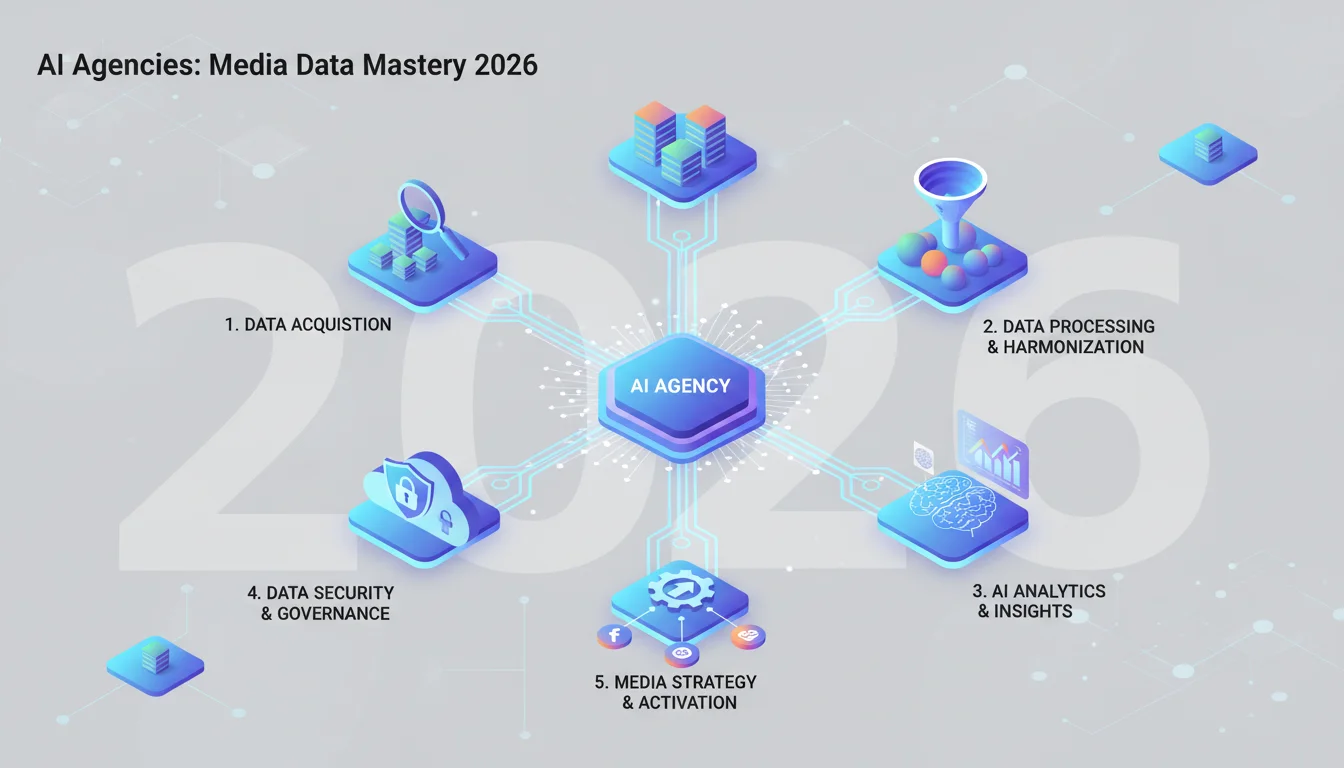
Using AI in marketing is completely changing how agencies wrestle with huge amounts of media data. This whole AI shift is more than just an efficiency play, it’s shaking up strategic planning and how we run campaigns. Agencies have to get their media data open and ready for intelligent agents if they want to see superior performance.
Key Takeaways
- Build a unified data lake to centralize your media data, giving AI agents a single point of access for analysis.
- Prioritize data cleansing and standardization. AI model performance tanks with messy data, and your insights can be off by as much as 30%.
- Use API integrations to hook AI platforms directly into Google Ads and Meta Ads Manager, which automates data ingestion and actions.
- Set up clear data governance policies, access controls, privacy rules, before you let any AI agent touch your data to prevent compliance problems.
- Train AI models on your historical campaign and audience data to generate accurate predictions for future media buys.
1. Centralize Media Data into a Unified Data Lake
First, you have to consolidate all your scattered media data sources. Agencies are notorious for data silos, performance metrics are in one place, audience data is in another, and creative assets are somewhere else entirely. An AI agent can’t give you the full picture if it’s trying to glue together data from a dozen disconnected systems. You need a unified data lake architecture. It’s a scalable repository for all your raw, unstructured, and structured data, ready for AI.
Start by inventorying every single source of media data you have. This means platforms like Google Ads, Meta Ads Manager, your programmatic DSPs, social analytics tools, CRMs, and even offline sales data. For instance, if you have a retail client, you absolutely need their in-store foot traffic data connected to their digital ad spend. Pick a solid cloud solution like AWS Lake Formation or Google Cloud Dataproc to build your data lake. These platforms offer the scalable storage and computation you’ll need for the mountains of media data you’re about to pour in.
Pro Tip: Schema-on-Read for Flexibility
Traditional data warehouses make you define a rigid schema before you load any data (schema-on-write). Data lakes are different, often using a schema-on-read approach. You can just dump raw data in and define its structure when you query it. This flexibility is a lifesaver for media data, which often changes format or adds new metrics without warning. It reduces your initial setup time and lets you ingest new data types without a massive re-engineering project.
Common Mistake: Ignoring Data Governance from the Start
Too many agencies get excited and rush to build a data lake without thinking about governance. This leads to a data swamp, where data quality is poor and compliance becomes a nightmare. You have to establish clear rules for data ownership, access controls, and privacy protocols (think GDPR and CCPA) before you start filling your lake. A fragmented approach here completely undermines the point of centralizing in the first place.
2. Implement Strong Data Cleansing and Standardization Processes
Once your data is in one place, its value to an AI agent depends completely on its quality. AI models, especially for things like predictive analytics, are extremely sensitive to “dirty” data. Inconsistent naming, missing values, duplicates, or wrong data types will spit out flawed insights and bad recommendations. In fact, Nielsen found that poor data quality can degrade marketing campaign effectiveness by up to 30%.
You’ll need automated scripts or dedicated tools like Talend Data Quality or Informatica Data Quality to get your data clean. The job involves a few key things:
- Deduplication: Finding and killing redundant records. If you’ve got conversion data from your CRM and your ad platform, you need to make sure you’re only counting it once for your analysis.
- Standardization of Naming Conventions: Your campaigns, ad groups, and creatives need to have the same name everywhere. “Campaign_Q1_2026_BrandX” can’t show up as “Q1-BrandX-Campaign” in another system. It will break everything.
- Handling Missing Values: You need a plan for blank data points. You might fill them in with an average (imputation), delete the record if it’s not critical, or flag it for someone to look at.
- Data Type Validation: Make sure your data types are right, spend should be a number, dates should all be in one format like YYYY-MM-DD.
- Outlier Detection: Find and investigate data points that are way off, as they could signal a tracking bug or a reporting error.
This is an ongoing job. Data quality isn’t a one-time project you check off a list. Regular monitoring and automated checks are absolutely essential to maintain the integrity of your data lake.
3. Establish API Integrations for Real-time Data Flow
For AI agents to be effective, they need current data. Batch processing is useful for historical analysis, but it’s not nearly fast enough for real-time optimization. The solution is strong API integrations. Most major advertising platforms offer complete APIs that give you programmatic access to campaign data, reporting, and even management functions.
Set up direct API connections from your data lake to platforms like the Google Ads API and the Meta Marketing API. This allows for automated, incremental data ingestion every hour or day, keeping your data lake fresh. Better yet, these APIs often allow AI agents to read *and* write data, which facilitates automated campaign adjustments based on their analysis.
Example: Automated Bid Adjustments
An AI agent could analyze real-time conversion data, see how the budget is pacing, and then use the Google Ads API to automatically adjust bids for certain keywords, all without a human lifting a finger. This eliminates manual work and lets you respond to market changes way faster than a human team ever could. The IAB’s Programmatic Advertising Guide 2023 even highlights the growing reliance on this kind of API-driven automation for campaign optimization.
4. Implement Granular Access Controls and Privacy Protocols
Opening up your media data to AI doesn’t mean it’s a free-for-all. Security and privacy are paramount. You’re handling sensitive client data, and a breach would have severe repercussions. Implementing granular access controls ensures that AI agents (and their human handlers) only get the data they absolutely need to do their job. This principle of least privilege reduces your risk profile dramatically.
Inside your data lake, you need to configure role-based access control (RBAC). For example, a predictive bidding AI might need campaign performance metrics and budget info, but it has no business seeing client billing details or personally identifiable information (PII). You should also differentiate access levels for different AI models and human users. Always encrypt sensitive data, both when it’s sitting on a server and when it’s moving. And make a habit of auditing access logs to spot any weird activity.
Pro Tip: Pseudonymization and Anonymization
When you have to deal with PII, your first move should be pseudonymization or anonymization. Pseudonymization swaps out real identifiers for fake ones, while anonymization strips them out completely. For many AI tasks, aggregated or anonymized data is perfectly fine, it gives the model the patterns it needs to learn without creating a huge privacy risk.
5. Train AI Models on Historical Performance and Audience Data
The effectiveness of your AI agents depends entirely on the quality and relevance of their training data. Just feeding them raw, current data is not enough. They need historical context to learn patterns, see trends, and make good predictions. That means you have to dedicate time to curating clean, complete datasets of past campaigns, audiences, and market conditions.
Your training datasets should include:
- Campaign Performance Metrics: A deep history of impressions, clicks, conversions, CPA, and ROAS from your past campaigns.
- Audience Segmentation Data: All the details you have on the demographics, interests, and behaviors of the people who engaged with your ads.
- Creative Asset Performance: Data on which headlines, images, or videos worked best for which audiences and on which platforms.
- External Factors: If you can, pull in external data like seasonal trends, economic shifts, or even competitor activity.
You use this curated history to train your models. For instance, you can train a supervised learning model to predict the conversion probability of a specific ad creative for a certain audience by showing it thousands of historical examples. This iterative training refines the AI’s understanding and improves its predictive power over time.
Common Mistake: Data Bias
You have to be paranoid about data bias. If your historical data is heavily skewed towards certain demographics or campaign types, your AI will inherit and amplify those biases. This can lead to unfair targeting or just plain ineffective campaigns. You need to regularly audit your training data for representativeness and use techniques like re-sampling or re-weighting to correct for any biases you find.
6. Implement Continuous Monitoring and Iteration
Deploying AI agents isn’t a one-and-done job. It requires continuous monitoring, evaluation, and iteration. AI models can drift as market conditions change or new data patterns appear, so you have to keep a close eye on them. Why would you build something so powerful and then not watch it work?
A good monitoring framework should include:
- Performance Dashboards: Build dashboards that track the KPIs your AI is supposed to be improving (ROAS, CPA, etc.). Always compare its performance against a human-managed control group so you know if it’s actually working.
- Anomaly Detection: Set up alerts that flag weird AI behavior or sudden performance drops. This can be the first sign of a problem with the model or its data feed.
- Feedback Loops: Create a process for human experts to give the AI feedback. If a strategist overrides an AI’s recommendation, that action should be fed back into the model’s next training cycle to make it smarter.
- Regular Retraining: You have to periodically retrain your models with fresh data to keep them sharp. A model trained on 2024 holiday data will be out of date by the 2026 holiday season because consumer behavior and platform algorithms will have changed.
This cycle of deploying, monitoring, and refining is what separates the agencies that get real value from AI from those that just have a cool new tech toy. Embracing this continuous improvement mindset is what will put you ahead of the competition.
Agencies that get proactive about opening their media data to AI and follow these steps are doing more than adopting a tool, they’re overhauling their entire operational model. The payoff isn’t just efficiency. It’s deeper strategy, faster response times, and in the end, better results for clients. This isn’t some optional upgrade. For any agency that wants to be a leader in 2026 PPC leadership, this is the new table stakes.
What is a data lake, and why is it better than a data warehouse for AI?
A data lake is a central repository that holds a vast amount of raw data in its native format. It uses a “schema-on-read” approach, so you only define the data’s structure when you need to query it. This is much more flexible and better for AI than a traditional data warehouse, which requires a rigid, pre-defined “schema-on-write.” Media data is messy and changes constantly, and a data lake handles that chaos much better.
How does data quality directly impact AI agent performance?
Garbage in, garbage out. Poor data quality, things like inconsistencies, missing values, or plain old errors, will wreck an AI model’s performance. The models learn from the data you give them, so if the data is dirty, the AI will make bad decisions, leading to flawed insights and inaccurate predictions that can seriously hurt campaign effectiveness.
Can AI agents really make real-time campaign adjustments?
Yes, absolutely. By using strong API connections to platforms like Google Ads and Meta Ads Manager, an AI agent can ingest data in real-time and then execute changes automatically. This means it can adjust bids, reallocate budgets between campaigns, or pause bad ads much faster than any human could, reacting to market changes instantly.
What privacy considerations are critical when giving AI access to media data?
The biggest things are implementing strict access controls (the “least privilege principle”), encrypting sensitive data, and using pseudonymization or anonymization on any personally identifiable information (PII). You have to ensure the AI only sees the data it needs to do its job, which minimizes the risk of data breaches and keeps you from running into compliance issues.
How often should AI models be retrained for media optimization?
There’s no single magic number, but you need to retrain them periodically with fresh data. The right frequency depends on how fast your market moves and your campaign cycles, but a good starting point is quarterly or semi-annually. For very dynamic accounts, you might do it even more often. The key is to keep the models from getting stale so they can adapt to new trends.


