 By Editorial Team
The digital advertising arena is a battleground, and your words are your weapons. That’s why A/B testing ad copy matters more than ever, especially in a marketing ecosystem where every click counts. But are you truly wielding your words with maximum impact, or are you just guessing?
Key Takeaways
- Implement a minimum of two distinct ad copy variations per ad group to capture diverse audience segments and identify top performers.
- Prioritize testing calls-to-action (CTAs) and unique selling propositions (USPs) as these elements directly influence conversion rates, often yielding a 10-20% uplift.
- Utilize built-in platform tools like Google Ads’ Ad Variations or Meta’s A/B Test feature for structured testing, ensuring statistical significance in results.
- Dedicate at least 1-2 weeks for each A/B test to accumulate sufficient data (e.g., 500-1000 impressions per variant) before declaring a winner and iterating.
- Maintain a detailed log of all A/B tests, including hypotheses, changes made, and observed performance metrics, to build a cumulative knowledge base for your marketing efforts.
I remember Sarah, the marketing director for “GreenLeaf Organics,” a burgeoning online retailer specializing in sustainable home goods. She was passionate, driven, but also visibly frustrated. Her Google Ads campaigns were burning through budget faster than a wildfire in August, and the conversion rates? They were flatlining. “We’re spending nearly $15,000 a month on ads, Mark,” she confessed to me over a lukewarm coffee at the Ponce City Market food hall last spring, “and our ROAS is barely breaking even. I just don’t understand it. Our product is fantastic, our website is beautiful, but people aren’t clicking the ads, or if they do, they’re not buying.”
This wasn’t an isolated incident. I’ve seen countless businesses, from local Atlanta boutiques to national e-commerce giants, fall into the same trap. They invest heavily in targeting, keywords, and landing page design, but treat their ad copy as an afterthought. A few lines of text, often written in haste, are expected to perform miracles. And when they don’t, the easy answer is “the market’s too competitive” or “our product is too niche.” That’s rarely the truth.
The Silent Killer: Untested Assumptions in Ad Copy
Sarah’s problem wasn’t unique. Her team had crafted what they thought were compelling ads. They highlighted their eco-friendly mission, their ethically sourced materials, and even offered a 10% first-purchase discount. All good things, right? On paper, yes. In practice, however, they were making a critical error: they were assuming what resonated with their audience instead of proving it. This is where A/B testing ad copy becomes not just a best practice, but an absolute necessity for effective marketing.
Think about it. Every single word in your ad copy serves a purpose. The headline grabs attention. The description piques interest. The call-to-action (CTA) drives the click. If any of these elements are off, even slightly, you’re leaving money on the table. A Statista report projects global digital ad spending to exceed $800 billion by 2026. With that kind of money flowing, you cannot afford to guess. You need data, hard data, to inform your decisions.
My first recommendation to Sarah was simple: “Let’s stop guessing. Let’s start testing. We’re going to dissect every single ad, every headline, every description line, and every CTA.”
The Anatomy of an Effective A/B Test for Ad Copy
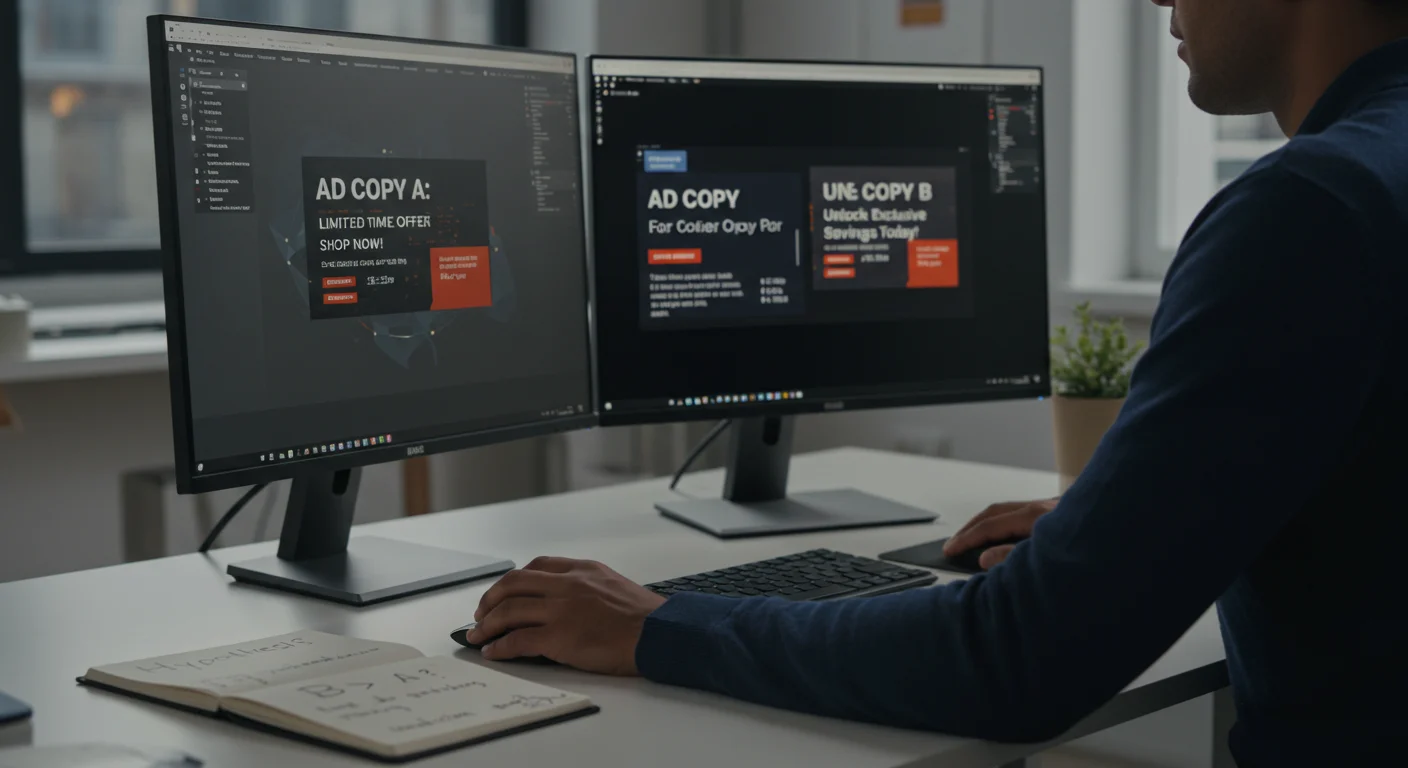
Many marketers hear “A/B testing” and immediately think of complex algorithms and endless spreadsheets. While it can get sophisticated, the core concept is straightforward: you compare two versions of an ad element (A and B) to see which performs better. The key is to test only one variable at a time to isolate its impact.
For GreenLeaf Organics, we started with the headlines. Their original headline was “GreenLeaf Organics: Sustainable Home Goods.” Informative, sure, but did it evoke emotion? Did it create urgency? Probably not. We brainstormed several alternatives, focusing on different angles:
- Version A (Original): “GreenLeaf Organics: Sustainable Home Goods”
- Version B (Benefit-driven): “Transform Your Home with Eco-Friendly Essentials”
- Version C (Problem/Solution): “Tired of Waste? Shop Sustainable Home Decor”
- Version D (Urgency/Offer): “Limited Time: 10% Off All Organic Home Goods”
We launched these variations using Google Ads’ Ad Variations feature. This allowed us to easily create and run multiple versions of the same ad group’s copy, distributing impressions evenly and collecting performance metrics like click-through rate (CTR) and conversion rate. Sarah was initially hesitant to run so many variations concurrently, fearing it would dilute her brand message. I explained that this wasn’t about diluting; it was about discovering which message was her brand message in the eyes of her customers.
Within two weeks, the data started rolling in. Version B, “Transform Your Home with Eco-Friendly Essentials,” had a significantly higher CTR – nearly 35% higher than the original. More importantly, its conversion rate was 18% better. This was a clear win. People weren’t just looking for “sustainable home goods”; they wanted the outcome of sustainability – a transformed, eco-friendly home.
This immediate uplift was a powerful motivator for Sarah. It showed her, in no uncertain terms, that a few changed words could dramatically alter campaign performance. This wasn’t about a gut feeling; it was about irrefutable data. I always tell my clients, if you’re not seeing a 10-20% improvement from a well-executed ad copy test, you’re either not testing the right variables or your audience is just plain weird (which is rarely the case).
Beyond Headlines: The Iterative Process of Ad Copy Optimization
Winning a headline test was just the beginning for GreenLeaf Organics. We then moved on to testing description lines. Their original description was quite factual, listing product categories. We hypothesized that a more emotional appeal, perhaps focusing on the impact of their products, would perform better.
Consider this real-world example from a client I worked with last year, a B2B SaaS company selling project management software. Their original ad copy emphasized “Features A, B, and C.” We tested that against copy that highlighted “Achieve X results faster,” “Reduce Y costs by Z%,” and “Empower your team with seamless collaboration.” The results were stark. The benefit-driven copy, specifically “Achieve X results faster,” saw a 45% increase in qualified leads. Why? Because businesses don’t buy features; they buy solutions to their problems. It’s a fundamental principle of data-driven marketing, yet so often overlooked in ad copy.
For GreenLeaf Organics, we saw similar patterns. A description like “Our bamboo kitchenware is durable and biodegradable” was outperformed by “Feel good about your kitchen: durable, beautiful bamboo that loves the planet.” The latter connected with the customer’s desire for positive emotional impact, not just product attributes.
Next, we tackled the call-to-action (CTA). “Shop Now” is the default for a reason – it’s direct. But is it always the most effective? We tested “Shop Now” against “Discover Eco-Friendly Living,” “Find Your Sustainable Style,” and “Get 10% Off Your First Order.” The last one, “Get 10% Off Your First Order,” consistently generated the highest click-through rate. Why? Because it offered immediate value and created a sense of urgency. Sometimes, the simplest, most direct value proposition wins the day.
The beauty of this iterative process, especially when you’re diligently applying A/B testing ad copy, is that each test builds on the last. You’re not just finding a winner; you’re learning about your audience. You’re understanding their motivations, their pain points, and the language that truly speaks to them. This knowledge then informs not just your ad copy, but your entire marketing strategy – from landing page content to email campaigns.
The Modern Imperative: Why A/B Testing Isn’t Optional Anymore
The digital advertising landscape of 2026 is hyper-competitive. User attention spans are shorter than ever, and ad blockers are increasingly common. Personalization is no longer a luxury; it’s an expectation. In this environment, generic, untested ad copy is a death sentence for your campaigns.
According to a recent HubSpot report on marketing trends, consumers are 71% more likely to make a purchase when ads are personalized. While A/B testing isn’t about individual personalization, it’s about finding the most effective message for a specific segment of your audience, which is a form of aggregate personalization. You’re tailoring your message to what you know works for a group, rather than what you hope works for everyone.
Moreover, the cost of advertising continues to rise. If your ad copy isn’t pulling its weight, you’re essentially throwing money away. Every incremental improvement in CTR or conversion rate from a well-executed A/B test directly translates to a better return on ad spend (ROAS). For GreenLeaf Organics, after three months of consistent A/B testing across their core campaigns, their ROAS had jumped from 0.9x to 2.1x. That’s a massive shift – turning a loss into a healthy profit, all by systematically refining their messaging.
We used tools like Google Ads’ Ad Variations and Meta’s A/B Test feature, which are built right into the platforms. These aren’t obscure third-party tools; they’re readily available and designed to make testing accessible. There’s really no excuse not to be doing it. The data is there, the tools are there, the potential uplift is undeniable.
I get it, sometimes it feels like just another thing to add to an already overflowing marketing to-do list. But I promise you, this isn’t busywork. This is foundational. It’s the difference between blindly spending and strategically investing. It’s the difference between hoping for results and actively engineering them.
The Resolution: GreenLeaf Organics Thrives
By the end of our six-month engagement, GreenLeaf Organics was a different company. Their ad spend had actually increased slightly, but their revenue from those ads had more than quadrupled. Sarah was no longer stressed about ad performance; she was empowered by the data. They had built a repository of winning ad copy elements, understood the nuances of their audience’s language, and had a continuous feedback loop for improvement. They even started applying these learnings to their organic social media posts and email subject lines, seeing improvements across the board.
The shift wasn’t just in numbers; it was in mindset. They moved from a “set it and forget it” approach to a culture of continuous experimentation and learning. This is the true power of A/B testing ad copy. It’s not just about finding a better ad; it’s about building a smarter, more responsive marketing operation. So, if you’re not rigorously testing your ad copy, you’re not just missing out on conversions; you’re missing out on vital intelligence about your own customers. And that, my friends, is an unforgivable sin in today’s data-driven world.
Embrace the test, embrace the data, and watch your marketing efforts blossom. Start small, but start now. Your wallet will thank you.
What specific elements of ad copy should I A/B test first?
Always start with your headlines and calls-to-action (CTAs). These are the most prominent elements and have the biggest impact on attracting clicks and driving conversions. Once you find winning variations for these, move on to description lines and then potentially ad extensions.
How long should I run an A/B test for ad copy?
Aim to run tests for at least 1-2 weeks, or until each ad variant has accumulated enough data to reach statistical significance. This usually means hundreds, if not thousands, of impressions and at least 50-100 conversions per variant, depending on your budget and traffic volume. Don’t pull the plug too early, even if one variant seems to be winning initially.
Can I A/B test ad copy on platforms other than Google Ads and Meta?
Absolutely! Most major advertising platforms, including LinkedIn Ads, Microsoft Advertising, and even Pinterest Ads, offer built-in or workaround solutions for A/B testing ad copy. The principles remain the same: create variations, run them simultaneously, and compare performance metrics.
What metrics should I focus on when evaluating A/B test results for ad copy?
While Click-Through Rate (CTR) is a good initial indicator of ad relevance, your ultimate focus should be on conversion rate and Cost Per Acquisition (CPA). An ad might get a lot of clicks, but if those clicks don’t convert into leads or sales, it’s not truly effective. Always tie your ad copy tests back to your ultimate business goals.
Is it possible to A/B test too many things at once in ad copy?
Yes, it is! Testing too many variables simultaneously makes it impossible to determine which specific change led to the performance difference. Stick to testing one core element at a time (e.g., just the headline, or just the CTA) to get clear, actionable insights. Once you identify a winner for that element, incorporate it and move on to testing the next.


