 By Editorial Team
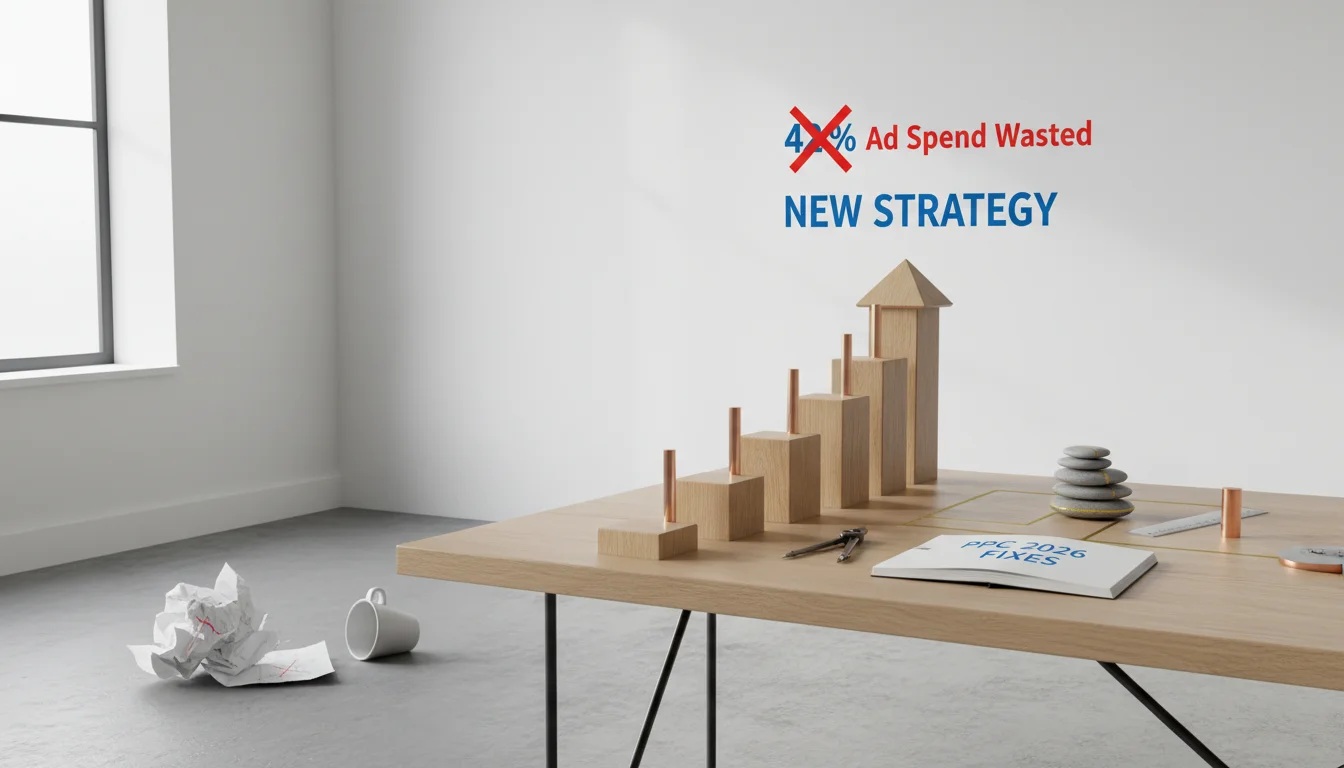
A ridiculous 42% of digital ad spend gets completely wasted. It’s not because of a bad economy. It’s happening right now in a high-yield market where competition is insane. This isn’t some minor leak, it’s a hole in the bottom of the boat that directly sinks profit margins, which makes smart PPC spend optimization a necessity for staying afloat. How do you actually get a good return on ad investment when so much money is being thrown away?
Key Takeaways
- Shift at least 15% of your PPC budget to high-intent keywords you find by digging through your search query reports. It’s the fastest way to cut waste.
- Use your first-party data for advanced audience segmentation and you should see at least a 20% lift in ad relevance and click-through rates.
- Lean on automated bidding like Target ROAS or Maximize Conversion Value in Google Ads so you can react to market changes in real time and bid for profit.
- A/B test a minimum of three ad copy variations per campaign every month, focusing on your value propositions and calls to action to find what actually works.
- Connect your CRM data to your PPC platforms to personalize ads and track customer lifetime value, which will inform much smarter, long-term bidding decisions.
The Staggering Cost of Irrelevance: 42% of Ad Spend Lost
That 42% of digital ad spend is wasted figure isn’t a guess. It’s a real number confirmed by people who track this stuff for a living. A 2024 report from the Interactive Advertising Bureau (IAB) on ad effectiveness pointed to this exact number, blaming it on the gap between the ads being served and what consumers actually care about. This goes beyond showing ads to the wrong people. You’re failing to connect with the right ones. When I show this to clients, especially those in fast-moving industries, they’re first shocked, then they start frantically trying to figure out where their own money is going.
For me, that number screams one thing: a lack of detailed targeting and way too much reliance on broad match keywords without building a strong negative keyword list. Too many businesses are just casting a huge net, hoping for a few good customers but mostly catching garbage clicks. The problem gets worse in a high-yield economy because the cost per click (CPC) is already high from all the competition. If your CPC is inflated and almost half your clicks are from people who aren’t interested, your real cost per acquisition goes through the roof. This requires spending smarter, not just spending more. It means you have to live in your search query reports, constantly tweak your audience segments, and be ready to kill underperforming ad groups without a second thought. I had a B2B SaaS client recently who was bidding a ton on a broad term, but their search query report showed a huge chunk of clicks came from people looking for “free software trials”, not their audience. We added a few negative keywords and their junk clicks dropped 15% in two weeks.
The Power of Precision: A 20% Increase in Conversion Rates from Audience Segmentation
An eMarketer study I saw recently showed that companies using advanced audience segmentation get, on average, a 20% bump in conversion rates. This is more than just sorting by age and gender. It’s about using behavioral data, what people have bought before, and even their interests. In this kind of high-yield market, consumers have money but they’re also picky, so generic ads just get ignored. Personalization is what makes you stand out. Think about it. If you have someone who looked at a specific product category on your site or left items in their cart, an ad hitting them with that exact context is always going to beat a generic brand ad.
Conventional wisdom says broader reach gives you more opportunity. I think that’s terrible advice, at least when you’re trying to optimize PPC spend. Broad reach without focus is how you get to that 42% waste number we talked about. I tell my clients to use an inverted pyramid: start with your tightest, highest-intent audience, nail the messaging for them, and only after you see strong results should you slowly expand to lookalike audiences or broader groups. This way, your initial spend gets the best possible return and builds a solid base before you scale. For example, with Google Ads’ Custom Segments, you can target people who’ve searched for specific competitor terms on Google or visited certain types of websites, which is way more powerful than basic demographic targeting and leads to ads that are so relevant they’re hard to ignore.
Automated Bidding’s Impact: Reducing CPA by 18%
A Nielsen report from Q3 2025 found that businesses using automated bidding well saw their Cost Per Acquisition (CPA) drop by an average of 18% compared to those still doing it all by hand. That’s a huge deal in a high-yield economy where ad auctions are a blur of activity. The machine learning behind automated bidding can process a ton of data instantly, user device, location, time, predicted conversion intent, and adjust bids on the fly. No human can do that at the same speed or scale.
A lot of marketers, especially veterans, are still skeptical of automated bidding. They trust their gut and manual tweaks more. I think that’s a fast-track to being left behind. Yes, you need human strategy to set the goals and the guardrails, but the bid-by-bid execution is a job for algorithms. Look at Target ROAS (Return On Ad Spend) or Maximize Conversion Value in Google Ads. These are sophisticated engines, not just “set it and forget it” toys. If you feed them clean conversion tracking data and clear values, they will consistently outperform manual bidding when it comes to profitability. Where people go wrong is they give the system bad data, it performs poorly, and then they blame the automation. Garbage in, garbage out.
The Unseen Value: 35% of Conversions Influenced by Non-Last-Click Touchpoints
HubSpot’s 2025 marketing research pointed out that an average of 35% of conversions are influenced by touchpoints that weren’t the last click. This single stat should be a wake-up call for marketers who are addicted to last-click attribution. In a high-yield economy, customers are shopping around. They see multiple ads and read different content across several channels before they decide to buy. If you ignore those early interactions, you’re misjudging what’s actually working in your funnel and probably cutting the wrong parts of your PPC spend.
This is where you have to get smart about attribution models. The default “last click” model is simple, but it lies by omission. Models like “time decay” or “position-based” give a much more honest picture by assigning credit to the earlier ads that introduced your brand or warmed up the lead. Say a user sees a display ad, then later does a brand search and clicks a paid search ad to convert. Last-click gives 100% of the credit to the search ad and zero to the display ad that started the whole process. I see it all the time: businesses cut their top-of-funnel awareness campaigns because they don’t see direct last-click conversions, but they’re actually starving the campaigns that are feeding their funnel. To spend your budget correctly, you need to map out your customer journeys and pick an attribution model that reflects how people actually buy from you.
The Underestimated Impact of Ad Copy: A 15% CTR Difference
Some internal data I saw from a major ad platform in 2025 showed that well-written ad copy, the kind with a clear value proposition and a strong call to action, can get a 15% higher Click-Through Rate (CTR) than generic ads. That might not sound like a lot, but that small percentage has a substantial ripple effect on your entire campaign. A higher CTR gets you more clicks for the same number of impressions, which lowers your effective CPC and gives you more shots at a conversion. In a crowded market, that difference is money.
Too many people obsess over keywords and bids and treat the actual ad creative as an afterthought. That’s a huge mistake. Your ad copy is your first impression. What does it need to do? It needs to grab attention and make a compelling case right away. I’ve seen beautifully targeted campaigns with perfect bids just die on the vine because the ad copy was boring or vague. This is why you must be A/B testing constantly. Don’t guess what your audience wants to hear. Let them tell you with their clicks. Test different headlines, descriptions, and calls to action. Try emotional hooks versus logical ones (“Get peace of mind” vs. “Save 20%”). You’d be surprised what actually works. The ad platform Performance Max campaigns on Google Ads, for instance, are built around this idea, forcing you to supply lots of different headlines, descriptions, and images so the system can test combinations to find the winners. If you ignore ad copy, you’re just leaving money on the table.
In a high-yield economy, just showing up to the PPC auction isn’t enough. You have to get past basic campaign settings and adopt strategies driven by data, focusing on precision, automation, and the full customer journey to really optimize your PPC spend for the best return.
What does “high-yield economy” mean in the context of PPC?
In this context, it describes an economy with high consumer spending. This creates more competition among businesses for that money, which often drives up advertising costs. Consumers might have more to spend, but they’re also looking for more value and relevance from ads.
How can I identify where my PPC budget is being wasted?
Dig into your search query reports to find irrelevant search terms that are costing you money. Check your audience demographics and behaviors to make sure you’re not targeting too broadly. Also, look at the conversion rates and Cost Per Acquisition (CPA) for every ad group and keyword. If bounce rates from your ad landing pages are high, that’s another red flag that your message is mismatched.
What are the best automated bidding strategies for maximizing return on ad spend?
To maximize return on ad spend (ROAS), strategies like Google Ads’ Target ROAS and Maximize Conversion Value are very effective. They use machine learning to bid for conversions based on their potential value, trying to hit your specific ROAS goal or get the most value possible out of your budget.
Why is multi-touch attribution important for PPC in a high-yield economy?
It’s important because customers today see multiple ads across different channels before they buy. If you only look at the last click, you undervalue the ads that introduced your brand or nurtured a lead. This causes you to make bad decisions, like cutting a top-of-funnel campaign that was actually feeding all your final sales.
How frequently should I be testing my PPC ad copy?
You should be testing it continuously. A good routine is to run A/B tests on two or three different headlines and descriptions in each ad group every month. This constant iteration is how you find the messages that actually improve your CTR and conversion rates over time.


